Last updated 2026-08-21
TL;DR
Slab lift raises a sunken concrete slab by injecting cement grout or expanding polyurethane through drilled holes, then patching. You start by forming an entity, getting a free IRS EIN, confirming contractor licensing with your state board, binding insurance and any required bond, and setting silica and chemical safety rules. Buy a pump after the paper is real. Confirm class names and fees with the board.
What is slab lift?
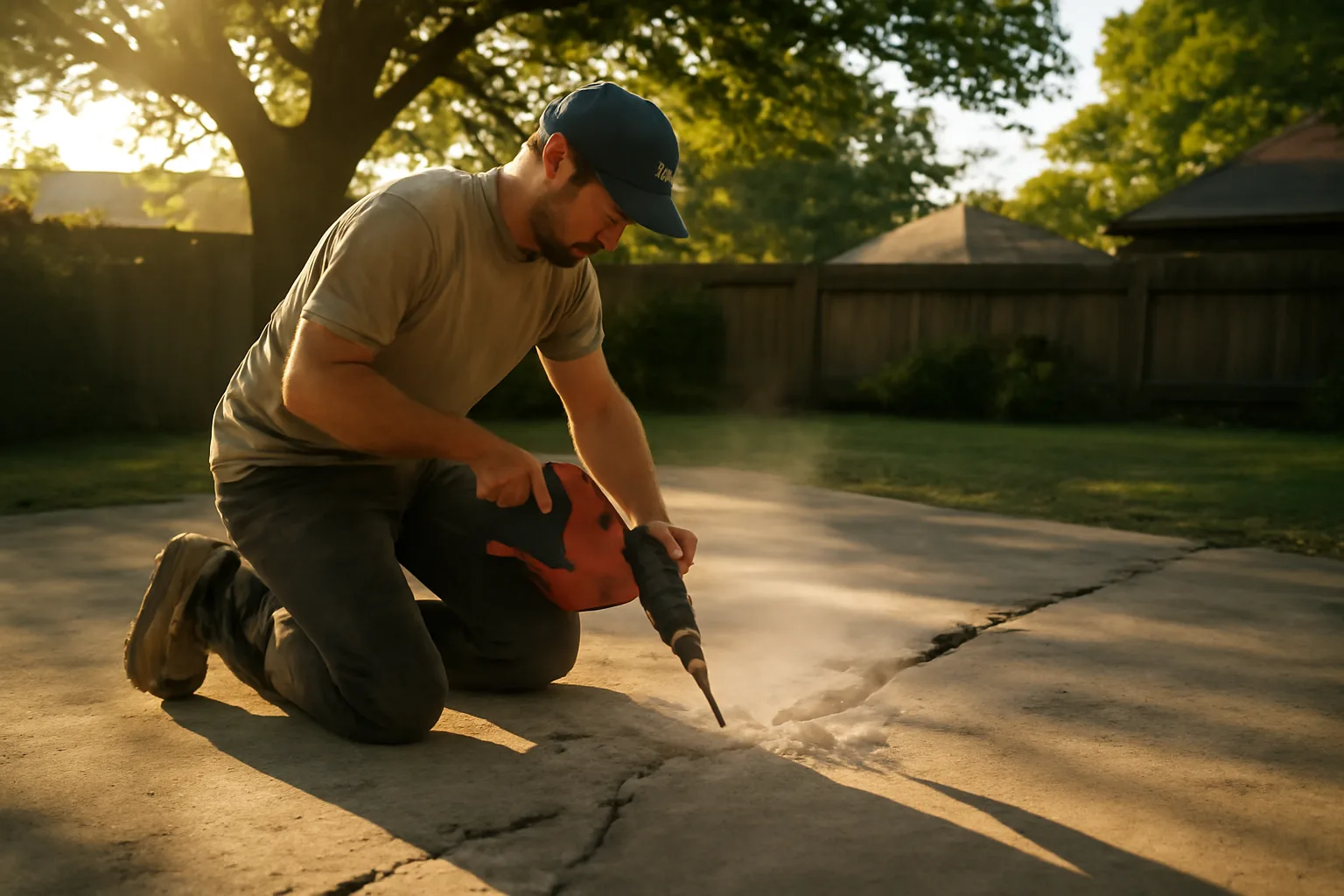
Slab lift is the repair method that raises a sunken concrete slab by injecting grout or expanding foam through drilled holes until the panel moves back toward grade. You patch the holes and check drainage. It is repair, not a new pour.
People also call it mudjacking, slabjacking, or foam lifting. Highway crews have jacked pavement slabs for a long time. Private work is usually driveways, garage floors, sidewalks, pool decks, and warehouse panels. You fill a void and apply pressure. The slab has to be intact enough to move as a piece. A shattered panel will not lift clean.
Two material families do the lifting. Cementitious grout is a slurry pumped under the slab. Polyurethane foam is a two-part chemical that expands and hardens in place. Grout is heavy and can load weak fill. Foam is light and usually costs more to place. Nobody has good national data that proves one always lasts longer on house slabs. Soil, void size, and the person on the gun matter more than the sticker on the trailer.
You are not a foundation company because you own a foam rig. Piers, helicals, and wall anchors are other trades. Mixing them on a card without the right license is how complaint cases start.
If the slab has an active plumbing leak, organic fill, or a tree prying one corner, injection will not fix the cause. I would walk those or price a remove-and-replace. Pride is expensive. For how the work meets year-one paper, see How slab lift works and how operators start year one.
How do you start slab lift?
You start slab lift by treating it as a construction trade. Form an entity, get a free EIN from the IRS, confirm license rules with your state contractor board and your city, bind insurance, and write a hazard communication plan for the chemicals you inject. Practice lift control before you take money.
Marketing comes last. Most new operators buy a rig first. That is backwards.
Some states fold this work into a concrete contractor class. California's C-8 Concrete classification covers forming, pouring, placing, and finishing concrete, including pavement and flatwork.[5] Other states leave repair to a general contractor class or to city permits only. Texas has no statewide general contractor license for typical driveway lifting. Florida defines contractor types in section 489.105.[8] Confirm with the relevant board. Do not trust a forum.
Get the EIN before the business bank account. The IRS does not charge for an EIN when you apply on its site.[9] Keep records from day one. IRS Publication 583 tells you what books and records mean for a new business.[10]
The longer paper list sits in What a slab lift first year really requires on paper. Pair it with A first-year slab lift guide to the real paper path.
What materials actually raise a sunken slab?
Cement grout and polyurethane foam are the two materials that actually raise slabs in the field. Grout fills and lifts with mass. Foam fills and lifts with expansion. Both leave patched holes.
Grout mix designs vary. A common field mix is Portland cement, sand or limestone fines, and water, sometimes with soil. You need a mixer and a pump that can push a thick slurry. Cleanup is messy. The injected mass is heavy. On poorly compacted fill, that extra weight can restart settlement. I still use grout on thick exterior slabs where cost matters and access is easy.
Foam is a two-component polyurethane. Part A is usually an isocyanate (often MDI). Part B is a polyol blend. They mix at the gun and expand under the slab. You need a proportioner, heated hoses if the system calls for them, and the discipline to watch the reaction. EPA has assessed MDI used in polyurethane products under TSCA.[11] Treat the drums like chemicals, not like paint.
I would not start with both systems. Pick one, learn void detection and lift rate, and stay there for a year. Buying two rigs in month one is a waste of money. The slab lift guide for licenses, foam, and first jobs stays on that split if you want more paper around foam work.
Do you need a contractor license for slab lift?
Maybe. License rules sit at the state board, and sometimes at the city. There is no federal slab lift license. Confirm the class name and any dollar threshold with the board that will hear a complaint against you.
In California, a person who undertakes construction for compensation is a contractor under Business and Professions Code section 7026.[14] Concrete work often lands in C-8. The classification page says a concrete contractor "forms, pours, places, finishes and installs specified mass, pavement, flat and other concrete work."[5] Slab lifting is not named in that sentence. Boards still treat structural concrete repair as contractor work when you take payment. If you are not sure, ask the board in writing.
Florida licenses construction contractors under chapter 489. Section 489.105 defines the contractor types.[8] Whether foam injection is specialty structure, general, or something a city handles alone depends on the job and the board's current reading. I would not guess. I would call the Construction Industry Licensing Board and keep the notes.
Some states exempt small jobs under a dollar cap. Caps change. Never invent a current fee, quota, or processing time from memory. Render those as confirm with the relevant board. Exam content also varies. What the slab lift exam actually tests in most states is the honest next read if a written test is on your path.
If you work as a sub to a licensed GC, you can still need your own license, bond, and workers compensation. Sub status is not a cloak.
What insurance and bonds do first-year operators carry?
First-year operators usually carry general liability, commercial auto (or hired and non-owned auto if you only have a personal truck), and workers compensation once they have employees. A surety bond is separate. It is often a license condition, not an insurance product.
California Business and Professions Code section 7071.6 says, "The contractor's bond required by this article shall be in a sum not less than twenty-five thousand dollars ($25,000)."[6] That figure is statute, not a broker flyer. Other states use different amounts or none at the state level. Confirm.
Workers compensation is not optional once you are an employer in California. Labor Code section 3700 says every employer except the state shall secure the payment of compensation in one of the listed ways.[7] Other states have their own statutes. Sole members of an LLC sometimes can waive coverage. That waiver does not cover a helper you pay in cash.
Pollution or contractor's pollution liability comes up with foam because you inject chemicals into soil. Plenty of cheap GL policies exclude pollution. Read the form. If the exclusion is there, buy the endorsement or do not pretend you are covered when a well test goes sideways.
I would not buy a large umbrella in month one unless a GC contract forces it. I would buy honest GL limits, the bond the board names, and workers compensation that actually lists your class code. Fake certificates are how jobs get shut down.
What safety rules apply when you drill and inject?
Drilling concrete makes respirable crystalline silica. Injecting foam can release isocyanates. OSHA already wrote the rules. You follow them.
29 CFR 1926.1153 states, "This section applies to all occupational exposures to respirable crystalline silica in construction work, except where employee exposure will remain below 25 micrograms per cubic meter of air (25 μg/m3) as an 8-hour time-weighted average (TWA) under any foreseeable conditions."[1] The same section sets a PEL of 50 μg/m³. If you rotary-hammer a driveway all day without wet methods or a vac, you are in that standard. Use water or a shrouded vac. Do not treat dust as just concrete.
OSHA Table Z-1 lists a ceiling limit of 0.02 ppm for methylene bisphenyl isocyanate (MDI).[4] That is a ceiling, not an 8-hour average you can bargain with. Foam A-side is an isocyanate family chemical. Read the SDS. Train the helper. 29 CFR 1910.1200 requires hazard classification, labels, and safety data sheets for hazardous chemicals.[3]
PPE is not a vibe. 29 CFR 1926.95 says protective equipment shall be provided, used, and maintained whenever hazards of process or environment are capable of causing injury or impairment.[2] Gloves, eye protection, and the respirator the SDS names are the baseline. 29 CFR 1926.55 also points construction employers at exposure limits for airborne contaminants.[13]
I have a low opinion of operators who inject foam in shorts with no gloves because it only touches the slab. Skin exposure is how people sensitize. Once you are sensitized to MDI, you may be done with this trade.
What paper do you file before the first paid job?
Before the first paid job you should have an entity, an EIN, a local business tax receipt or city license if your city requires one, the contractor license your board requires (or a written note that it does not), insurance certificates, a written HazCom program, and a simple contract. That stack is the job. The pump is equipment.
SBA's guide on choosing a business structure walks through sole proprietorship, partnership, LLC, and corporation in plain language.[12] I prefer an LLC for this work because a driveway claim can exceed what you have in the truck. Talk to a CPA in your state. This site is not your lawyer.
Sales tax is easy to forget. Some states tax repair labor. Some tax materials only. A state comptroller or department of revenue issues the permit. Confirm.
Contracts should say what you will lift, what you will not guarantee (soil, plumbing, future fill settlement), how you measure success (elevation points), and how change orders work. Verbal closeness is how chargebacks start.
If you want a bid worksheet and a mix sheet in one place, SlabLiftPath sells a $149 one-time Mix + Bid-per-Sqft Kit at /start. The licensing steps here stand alone without it.
Slab lift mistakes that cost operators their first year is worth reading before you reuse a friend's contract.
How much startup equipment do you actually need?
Startup equipment for slab lift is a drill, a way to inject, PPE, a vehicle that can carry drums or grout, and measuring tools. Foam proportioning rigs cost more than grout pumps. Used gear is everywhere and some of it is junk.
I will not invent a national price for a new foam rig. Vendors quote what they want, and freight plus training plus drums change the number. Confirm current package pricing with more than one dealer. Grout pumps and mixers are cheaper to buy and heavier to run. That is the trade.
Do not finance a trailer-mounted proportioner before you have a license answer and insurance binders. Interest does not lift slabs.
A rotary hammer, bits, injection ports or simple tubed holes, a laser or zip level, and patches are the small tools. Buy a decent level first. Guessing lift with your eye is a first-year mistake.
Waste of money: custom wraps, drone video, and a third chemical system for commercial work you do not have. Get ten residential slabs done clean. Homeowners will still ask what a lift costs locally. That is a buyer question, not your startup budget. See slab lift cost in California or slab lift cost in Florida if you need a sense of how people talk about price in a specific state.
What does a first job look like on paper?
A first job on paper is a written scope, photos, elevation shots, a signed contract, a change-order blank, and a closeout note with remaining slope. The injection is the short part.
Walk the slab. Mark cracks. Run a hose to see ponding. Ask about downspouts and irrigation. If the cause is still wet, say so in the proposal. Then set points you will measure before and after. Three points on a small patio is thin, but it beats none.
Write the exclusions. Plumbing, soil replacement, and matching old broom finish are the usual fights. Hole patches will show. Say that.
Invoice a deposit only if your state allows deposits in that form. Some contractor boards cap deposits. Confirm with the board. Never invent a current deposit cap.
Bid by area plus void, not by a national square-foot myth. A one-inch void and a six-inch void are not the same job. Probe or you are guessing. Log material use on every job so your next bid is yours, not a vendor chart.
Should you start with mudjacking or foam?
Pick grout if you want lower chemical risk, cheaper pumps, and heavy void fill on thick outdoor slabs. Pick foam if you want less added weight, smaller holes, and a faster set. Pick neither until you have watched both done by someone who will let you hold the gauge.
| Factor | Cement grout (mudjacking) | Polyurethane foam |
|---|---|---|
| Hole size (typical field practice) | Larger, often near 1 to 2 in | Smaller, often near 5/8 in |
| Weight added | High | Low |
| Main chemical hazard | Cement alkali plus silica dust | Isocyanates and amines |
| Set time | Hours | Minutes |
| Pump outlay | Lower | Higher |
| Clean first-year use | Simple exterior pads | Interior slabs and load-sensitive fill |
Hole sizes vary by port and contractor. I will not pretend there is one ASTM hole diameter for residential driveways. Measure what your ports need.
Foam wins indoor jobs because you are not pumping gray slurry next to a fridge. Grout wins when the customer will not pay foam prices and the slab can take the weight. I would learn grout first if cash is tight. I would learn foam first if I already had indoor commercial leads.
What mistakes cost new slab lift operators?
The mistakes that cost new operators are legal and measurement mistakes, not pump mistakes. Unlicensed contracting, no workers compensation, over-lifting a slab until it cracks, and guaranteeing soil you never saw will cost more than a bad bit.
Over-lifting is pride. Foam expands after you stop. You sneak up on grade. Grout can keep moving too. Watch the crack. Stop.
Bidding by the square foot with no void depth is another way to lose money. Vendors will hand you a usage chart. Treat it as marketing until you log your own jobs. Nobody has good public data on average residential foam use per square foot across soils.
Cash helpers with no coverage. Boards and injured-worker lawyers both hate that story.
The longer list is in Slab lift mistakes that cost operators their first year. Read it before you promise a garage floor will stay put for a decade.
Where do you confirm your state's slab lift rules?
You confirm your state's rules on the contractor board site, in the statute that creates that board, and with the city building department for permits. Start with the statute and the classification page, then call and write down the name of the person you spoke with.
California: CSLB classifications plus the Business and Professions Code. Florida: chapter 489 and DBPR. Other states: search the state name with contractor license and concrete, then open the .gov statute, not a blog. Processing times and fees change. Confirm with the relevant board. No article can promise approval.
SlabLiftPath is an independent publisher, not a law firm and not a service company. Use this as a map, then verify. If you want the kit after you have read the board pages, it lives at /start.
Frequently asked questions
What is slab lift?
Slab lift is raising a settled concrete slab by injecting cement grout or expanding polyurethane through drilled holes until the panel moves back toward grade, then patching. It is repair work. It is not a new pour and it is not foundation piercing. The slab has to be intact enough to move as a unit or the job becomes replacement.
How do you start slab lift?
Start on paper. Form an entity, get a free IRS EIN, confirm with your state contractor board and city whether a license applies, bind liability and any required bond, and set silica plus chemical hazard rules. Then buy one injection system and practice lift control. Do not finance a foam rig before the board answers you.
Is mudjacking the same thing as slab lift?
Mudjacking is one kind of slab lift. It uses a cementitious slurry. Foam lifting is the other common kind. Both drill, inject, lift, and patch. The materials, hole sizes, weight added, and chemical hazards differ. People use the names as if they were interchangeable. They are not.
Do I need a license to lift a driveway?
Often yes once you take payment for construction, but the class name is state-specific. California may read this as contractor work under BPC 7026 and the C-8 concrete class. Florida defines contractors in section 489.105. Texas has no statewide general contractor license for typical driveway work. Confirm with the relevant board. Do not invent a dollar exemption.
What OSHA rule covers drilling injection holes in concrete?
29 CFR 1926.1153 covers respirable crystalline silica in construction. It applies unless exposure stays below 25 μg/m³ as an 8-hour TWA under any foreseeable conditions, and it sets a PEL of 50 μg/m³. Wet methods or a shrouded vac are the usual controls. Do not treat driveway dust as harmless.
What is the exposure limit for foam A-side (MDI)?
OSHA Table Z-1 lists a ceiling limit of 0.02 ppm for methylene bisphenyl isocyanate (MDI). A ceiling is not an 8-hour average. Read the SDS for the exact product you pump, run HazCom under 1910.1200, and use the PPE the sheet names. Skin contact is how people get sensitized.
Can I start as a sole proprietor?
Yes, the IRS and SBA both treat sole proprietorship as a real structure. I still prefer an LLC for this work because a cracked garage claim can exceed truck equity. Get an EIN either way if you will hire or open a business account. Talk to a CPA in your state about tax and liability. This is not legal advice.
Does California require a contractor bond for this work?
If you need a CSLB license, California Business and Professions Code section 7071.6 requires a contractor bond of not less than $25,000. That is statute. Whether your exact lifting work needs that license is a board question. Confirm class and bond with CSLB before you print invoices.
How do I know if a slab will even lift?
It has to be intact enough to move as a panel, with a void under it and a cause you can live with after the lift. Shattered concrete, active plumbing leaks, and ongoing soil washout are walk-away jobs for me. Probe the void, mark cracks, and write exclusions. If you cannot explain the cause, do not guarantee the result.
Do I need workers compensation if I have no employees?
It depends on the state and on whether you really have no employees. California Labor Code 3700 requires employers to secure compensation. A cash helper is often an employee in a dispute. Some LLC members can waive coverage for themselves. Confirm with your state workers compensation agency. Do not guess from a forum.
What should a first slab lift contract exclude?
Exclude plumbing, soil replacement, matching old finish, future settlement from causes you did not fix, and any promise that hole patches will vanish. Define success with elevation points. Require a written change order if the void is deeper than bid. Verbal closeness is how chargebacks start.
Where do I confirm license fees and processing times?
On the state contractor board fee page and in the statute that sets the bond or application rules. Fees and timelines change. No honest publisher invents a current fee, quota, or processing time. Call the board, keep the person's name, and treat blogs as unconfirmed. No publisher can promise approval.
Sources
- OSHA 29 CFR 1926.1153 Respirable crystalline silica: Construction silica rule applies except below 25 μg/m³ 8-hour TWA under any foreseeable conditions, and sets a 50 μg/m³ PEL
- OSHA 29 CFR 1926.95 Criteria for personal protective equipment: Employers must provide, use, and maintain PPE when process or environment hazards can cause injury or impairment
- OSHA 29 CFR 1910.1200 Hazard Communication: Hazard communication requires classification, labels, and safety data sheets for hazardous chemicals
- OSHA 29 CFR 1910.1000 Table Z-1: Methylene bisphenyl isocyanate (MDI) has an OSHA ceiling limit of 0.02 ppm
- CSLB C-8 Concrete classification: C-8 concrete contractors form, pour, place, finish, and install mass, pavement, flat, and other concrete work
- California Business and Professions Code section 7071.6: The contractor bond required by the article shall be in a sum not less than $25,000
- California Labor Code section 3700: Every employer except the state shall secure the payment of workers compensation in a listed manner
- Florida Statute 489.105 (2023): Section 489.105 defines contractor types used in Florida construction licensing
- IRS Apply for an Employer Identification Number (EIN) online: Businesses can obtain an EIN online from the IRS at no charge
- IRS Publication 583 Starting a Business and Keeping Records: New businesses must keep books and records supporting income, expenses, and credits
- EPA risk management for MDI and related compounds under TSCA: EPA has assessed methylene diphenyl diisocyanate used in polyurethane products
- U.S. Small Business Administration Choose a business structure: SBA outlines sole proprietorship, partnership, LLC, and corporation as starting structures
- OSHA 29 CFR 1926.55 Gases, vapors, fumes, dusts, and mists: Construction employers must limit employee exposure to airborne contaminants
- California Business and Professions Code section 7026: Contractor includes a person who undertakes construction or alteration work for compensation