Last updated 2026-08-20
TL;DR
Slab lift is raising a sunken concrete slab by pumping grout or polyurethane under it. A mix and bid-per-sqft kit is a worksheet, not a license. Confirm how your state treats this as contracting, then file the entity, tax, insurance, and trade paper your board asks for. Drilling concrete triggers OSHA's silica rule. Per-square-foot averages break when void volume and access change.
What is slab lift?
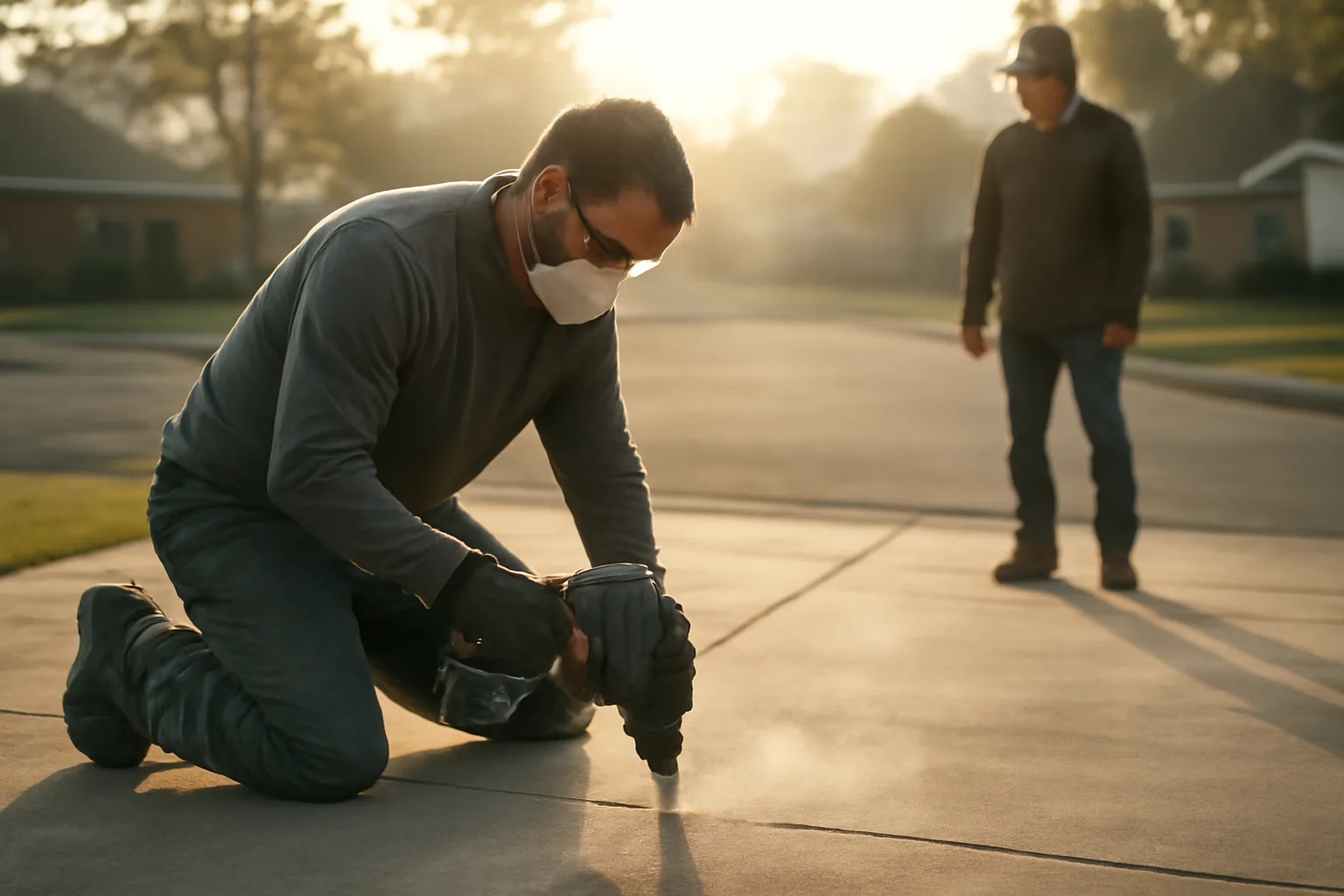
Slab lift is the trade of raising a sunken concrete slab by pumping material underneath it until the panel comes back toward level. You drill a pattern of holes, inject a cement slurry or expanding polyurethane, watch the slab move, then patch the ports. People also call it slabjacking, mudjacking, concrete lifting, or polyjacking. The labels change. The job does not.
You are not selling a boxed product. You are repairing existing concrete.
Highway shops have used slab jacking on pavement for decades. The same physics shows up on driveways, sidewalks, garage floors, pool decks, and warehouse slabs. A four inch patio panel and a loaded dock slab are not the same job. Thickness, joint layout, soil, and live load change how much material you pump and how risky the lift is.
Treat it as construction. California Business and Professions Code section 7026 defines a contractor as a person who undertakes, or offers to undertake, to "construct, alter, repair, add to, subtract from, improve" a building, highway, road, parking facility, or other structure or improvement [3]. A settled driveway sits inside that language. Florida chapter 489 uses its own contractor definition and still pulls repair-for-pay into licensed work [6]. Other states pick different words and different dollar triggers. The pattern holds. If a customer pays you to fix concrete, you are contracting.
Do not confuse lift with overlay or replacement. Overlay hides settlement. Replacement starts over. Lift tries to reuse the slab. If the slab is rubble, lift is a waste of money. If a broken drain is still washing out the base, the panel will drop again. I would walk those jobs, or I would price the drain fix first and say so in the bid.
Census NAICS 238110 covers establishments that pour and finish concrete foundations and structural elements [11]. Plenty of lift shops get coded under 238990 instead. Boards do not assign NAICS codes. Statisticians do. Nobody has a clean public headcount of slab lift outfits. That gap is why national price blogs feel so sure and stay so wrong.
What happens the first time you drill a slab for lift?
You make respirable crystalline silica. Every port you drill in concrete can throw dust that reaches deep in the lung. OSHA sets the construction PEL for respirable crystalline silica at 50 μg/m3 as an 8-hour TWA under 29 CFR 1926.1153 [1]. The same rule sets an action level at 25 μg/m3 as an 8-hour TWA [1]. Those two numbers are not marketing. They are the federal floor if you have employees on a drill.
"The employer shall ensure that no employee is exposed to an airborne concentration of respirable crystalline silica in excess of 50 μg/m3, calculated as an 8-hour TWA." That sentence is the exposure limit in 29 CFR 1926.1153(d) [1].
Table 1 of the same standard lists specified control methods for handheld and stand-mounted drills. Fully follow Table 1 for a listed task and you do not have to run your own exposure monitoring for that task. Water feed or a shroud with a vac is the usual path. Dry drilling in a garage with no controls is how you fail a surprise inspection.
OSHA construction PPE rules still sit next to the silica rule. 29 CFR 1926.95 requires PPE whenever hazards are present that engineering and work practice controls do not handle [15]. I would budget a half-face respirator with P100 filters, hearing protection, and eye protection on day one. Cheap glasses from a gas station are a waste of money.
Work alone with no employees and federal OSHA often does not apply the same way. Your lungs do not care. Silica scar is permanent. Run water. Wear the respirator. Keep the SDS for every chemical on the truck, because 29 CFR 1910.1200 still governs how hazardous chemicals are classified, labeled, and explained to workers [10]. Two-part polyurethane is not water. Isocyanate components deserve the same respect as the dust.
Does a mix and bid-per-sqft kit start a slab lift business?
No. A mix and bid-per-sqft kit is a worksheet. It can hold foam yield notes, slurry recipes, and a square-foot calculator. It cannot issue a license, bind a policy, or make a bid legal in a city that wants a local contractor card.
People buy kits because ads sell a clean story. Drill, pump, invoice a national number per square foot. Real jobs do not price that clean. Void depth under a 10 by 20 patio can double the material. A tight backyard with no hose bib can eat an hour before the first hole. A kit that ignores access, travel, and saw-cut joints will teach you to lose money.
I would use a kit the way I use a notebook. Fine for organizing mix and a first-pass number. Useless as a substitute for the board. The paper path is entity, EIN, local tax, the contractor credential your state or city actually requires, and insurance that names the work you do. The IRS says applying for an EIN is a free service [9]. Paying a random website to "get you an EIN" is a waste of money.
If a sales page tells you the kit is the license, close the tab. Confirm every fee and form with the board that issues the card. I will not invent a current application fee or a processing clock. Those change, and fake clocks are how people plan a first job they cannot legally take.
How do you start slab lift the real way?
You start on paper, not on a foam proportioner. Pick an entity your state recognizes. Get a free EIN from the IRS if you need one [9]. Register the business where your secretary of state and your city tell you to register. Then read the contractor statute that covers repair-for-pay where you will actually work.
License triggers are local. California keeps projects under $500 outside the Contractors State License Law [4]. Virginia starts Class C contracting at $1,000 [14]. North Carolina's general-contractor definition keys off a $40,000 cost figure [13]. Florida runs a certified and registered contractor system under chapter 489, not a single national card [6]. Confirm the current text. Do not memorize a blog.
After the statute comes the boring stack. Local business tax. Fictitious name if you use one. Bank account that is not your grocery card. General liability that states concrete repair or lifting, not "consulting." Workers' compensation the day you hire anyone, unless you are in a state that lets you go bare and you like that risk. I do not.
Only then buy the drill, ports, pump, and material. Equipment before a city card is how you own a shiny idle trailer. Training on a used pump from a reputable dealer beats a weekend "certification" printed on thin card stock.
State walk-throughs help because the myth of one American path dies fast. Read how to start slab lift in California if you will work there. Read how to start slab lift in Alabama, how to start slab lift in Colorado, how to start slab lift in Arizona, or how to start a slab lift business in Connecticut if that is your map. Each one is a different clerk.
Do you need a contractor license for slab lift?
Often yes, once the job is large enough or the city says so. There is no federal slab lift license. States and cities decide who may contract to repair concrete. Arizona makes it unlawful to submit a bid or act in the capacity of a contractor without the required license [8]. California treats unlicensed contracting as a crime under Business and Professions Code section 7028 [5]. Florida Statute 489.127 sets penalties for unlicensed contracting under chapter 489 [7]. Read the current statute. I will not invent jail terms or fine amounts that the legislature can change.
Dollar triggers are the part national courses skip.
| Place | What the law keys on | Figure to confirm with the board |
|---|---|---|
| California | Small-job exemption, BPC 7048 | $500 aggregate [4] |
| Virginia | Class C contractor floor | $1,000 [14] |
| North Carolina | General contractor definition | $40,000 [13] |
| Florida | Certified or registered contractor | Chapter 489 text [6] |
| Arizona | Acting or bidding as a contractor | License required unless an exemption fits [8] |
California Business and Professions Code section 7048 keeps projects under $500 outside the Contractors State License Law [4]. That is not permission to stack five $499 invoices on one driveway. Boards look at the undertaking. Virginia Class C starts at $1,000 [14]. North Carolina's general-contractor statute uses a $40,000 cost threshold [13]. Alabama runs a separate general-contractor board with its own high dollar trigger. Confirm that figure with the board, then read slab lift license in Alabama.
Classification calls are messy. A concrete class, a specialty class, or a local "concrete repair" card may all get argued. I would call the board with a plain description of drilling and injecting under existing slabs and ask which classification they want. Get the answer in writing if you can. For California detail see slab lift license in California. For Colorado's local-card world see slab lift license in Colorado.
What does bid-per-sqft get wrong on slab lift jobs?
Square footage is the area of the lid. You get paid, or you lose, on the volume under the lid and the hours it takes to reach it. Two 200 square foot slabs can take wildly different foam or grout. One sits on a one inch void. The other sits on a washed-out four inch cavern plus a hidden step crack. Same lid. Different job.
National consumer ranges you see on home-service sites are not a bid. Nobody has a clean public dataset of sold slab lift tickets by city, void depth, and material. The closest thing most owners have is their own job cost history. If you have zero history, a per-square-foot starter number is a guess. Treat it as a guess.
I would build every bid from four piles. Material based on estimated void, not lid area. Labor including setup, drilling, lift, patch, and cleanup. Travel and dump fees. Risk for access, interiors, and occupied buildings. Then I would check that number against a per-square-foot sanity range so a decimal error cannot sneak through. The kit is the sanity check. It is not the bid.
Interior slabs cost more. Tight side yards cost more. Night work costs more. Matching an exposed aggregate finish costs more. If your worksheet cannot hold those lines, you will underbid the pretty jobs and chase the ugly ones.
Self-employment tax still sits on the profit you thought you made. The IRS self-employment tax rate is 15.3 percent, split 12.4 percent social security and 2.9 percent Medicare [2]. Price like that tax exists. A bid that only covers resin and diesel is a hobby.
What mix do slab lift crews actually pump?
Two families. Cementitious slurry, often called mudjacking, and two-component polyurethane foam. Slurry is heavy, cheap per pound, and slow. Foam is light, expands, and costs more per pound. Both can lift a slab. Both can also crack a slab if you get greedy on the gauge.
Slurry recipes are not secret, and they are not universal. Sand, cement, and water show up in most versions. Some crews add limestone fines or soil. Water content is the part beginners wreck. Too wet and you have soup that will not hold. Too dry and you stall the pump. I would log every batch against lift, not against a laminated card from a stranger.
Foam is chemistry plus temperature. A winter driveway and a July warehouse slab do not yield the same board feet from the same set of drums. Keep the SDS on the truck. 29 CFR 1910.1200 expects hazardous chemicals to arrive with labels and safety data sheets, and employers who use those chemicals have a program duty [10]. Isocyanate components are not a joke. Gloves that melt are a waste of money. Buy what the SDS names.
Want a one-time mix sheet and a bid-per-square-foot worksheet already laid out? SlabLiftPath sells a $149 Mix + Bid-per-Sqft Kit. It still does not file your license and it does not watch your pressure gauge.
I would not chase a magic proprietary blend in year one. I would pick one method, learn its failure modes, and refuse jobs the method cannot hold. Switching foam brands every month because a salesperson promised more rise is how you own half-full drums you cannot return.
What first-year paper sits next to any kit?
The kit is the thin folder. The fat folder is everything a clerk can ask for.
Entity papers. EIN confirmation if you got one, and that filing is free from the IRS [9]. Local business license or tax certificate. Contractor application, exam scheduling, and bond instructions if your board uses them. Proof of general liability. Workers' compensation when you have employees. Vehicle insurance that covers a loaded trailer, because personal auto policies love to deny commercial lifts.
Chemical paper. SDS for slurry additives and for both foam components [10]. A written silica plan if you have employees and you fall under 29 CFR 1926.1153 [1]. Fit-test records if you require respirators. OSHA does not care that your logo looks sharp.
Tax paper. A method for sales tax if your state taxes repair labor or materials. Quarterly estimated tax if you will owe. That 15.3 percent self-employment tax is not optional for people who work for themselves [2]. I would talk to a real bookkeeper in month one. A box of mixed receipts in December is a waste of everyone's Saturday.
Stormwater paper is usually not your problem on a single patio. EPA's 2022 Construction General Permit covers operators of construction that disturbs one or more acres, and smaller sites that are part of a larger common plan that will hit that acre [12]. A 400 square foot driveway lift is not an acre. Do not buy a CGP consultant for a pool deck. Do read the permit if you start doing site-wide work on a new subdivision.
Confirm every fee with the board. I will not invent a current bond amount or a quota.
What insurance and safety rules hit slab lift work?
General liability is the policy customers and GCs ask for. Say the words "concrete lifting" or "concrete repair" when you bind it. A cheap office policy that excludes exterior construction is a waste of money, because the exclusion shows up after the claim.
Workers' compensation is the policy your employee needs if a drill binds and a wrist breaks. Rules vary by state. Some states come down hard the day you have one employee. I would not hire a helper off a parking lot and hope.
Silica is the safety rule that matches the actual task. OSHA's construction silica standard is 29 CFR 1926.1153, with a 50 μg/m3 PEL and a 25 μg/m3 action level [1]. Table 1 is there so a small shop can follow listed controls instead of hiring an industrial hygienist for every driveway. Follow it. Handheld drills are not a gray area.
Polyurethane adds chemical risk. Keep both component SDS files current under the hazard communication standard [10]. Do not eat lunch with foam on your gloves. I have no patience for tough-guy stories about "just a little splash."
Auto and inland marine matter more than people think. A $20,000 pump that falls off a cheap ramp is a bad afternoon. Ask your agent about tools and scheduled equipment. Skip the Facebook warranty from a stranger.
I would not start marketing until a licensed agent has seen photos of the work. Agents price what they understand. A blurry video of foam coming out of a crack is not a submission.
Why is there no national slab lift license path?
Because contractor law is state and city law. Congress did not write a slab lift title. California built CSLB and a detailed Contractors State License Law [3] [4] [5]. Florida built chapter 489 with certified and registered paths [6] [7]. Arizona built the Registrar of Contractors and a ban on unlicensed bidding [8]. North Carolina defined general contracting around a $40,000 cost figure [13]. Virginia split classes at $1,000 and $10,000 marks [14]. Those systems do not agree with each other, and they were not designed to.
Colorado does not run a statewide general-contractor license the way California runs CSLB. Cities and counties issue the cards. That is why a Denver plan and a rural plan diverge. Confirm with the city you will work in, then use how to start slab lift in Colorado as a starting map, not as a permit.
National "get licensed in 30 days" pitches flatten all of that into one checklist. They have to. The checklist then fails the first time a clerk asks for a local exam, a specific classification, or proof you never worked unlicensed. I would budget time for the slow board, not the fast ad.
Reciprocity is limited and fussy. A card in one state is a nice story in another. It is not a stamp. Always ask the receiving board. Never take a forum post as the rule.
What is worth buying, and what is a waste?
Worth buying: a drill that survives a day of three inch concrete, a pump your supplier will still talk to in six months, PPE that matches the SDS and the silica rule [1] [15], and liability insurance that names the work. A used rig from a shop that will train you on it beats a shiny orphan brand with no spare parts in your time zone.
Also worth buying: an hour with a local construction lawyer or a license expediter who actually files in your state, if the packet is thick. One corrected application is cheaper than a denial you have to explain forever.
Waste of money: paying a website for an EIN the IRS already gives away [9]. Buying a full foam plant before your city will issue a contractor card. Laminated "certification" from a weekend class that no board recognizes. National per-square-foot cheat sheets with no void line. Matching a competitor's Instagram price on a job you have not cored.
A mix and bid worksheet can be cheap insurance against sloppy math. It cannot replace a scale, a moisture meter, or a notebook of what the last ten slabs actually ate. I would rather see ten ugly, honest job-cost sheets than one pretty kit you never update.
If a vendor promises approval, a quota, or a processing time, they are selling comfort. Boards do not outsource their clock to a kit site.
How do you confirm slab lift facts with a licensing board?
Call with a boring, specific script. "I drill existing concrete slabs and inject grout or polyurethane to raise them. Customers are homeowners and small commercials. Which license classification do you want, and what is the current application packet?" Write down the person's name, the date, and the class they name. Then download the statute they cite and read it.
Do not ask the board to bless your marketing. Ask which form, which exam, which bond, and which insurance minimum they want today. Confirm fees on the board's fee page, not on a blog. I will not invent those fees here because they move.
Bring the same honesty to cities. A state card does not always kill a city registration. A city card does not kill a state statute. You can need both. Parking a trailer overnight can also need a zoning answer you will not like.
Still want a worksheet after you have the statute in front of you? The $149 kit lives at /start. SlabLiftPath is an independent publisher, not a law firm and not a service company. Use the kit as paper. Use the board as the law.
Then go lift a slab you priced with void volume, not with a national myth.
Frequently asked questions
What is slab lift?
Slab lift is raising a sunken concrete slab by drilling ports and pumping cement slurry or expanding polyurethane underneath until the panel comes back toward level. It is repair of existing concrete, not a new pour. Licensing boards usually treat paid repair as contracting. Overlay and full replacement are different jobs with different risk.
How do you start slab lift?
Start with paper. Form an entity, get a free IRS EIN if you need one, and register locally. Read your state's contractor statute and dollar trigger, then file the classification the board names. Bind liability insurance that states concrete repair. Buy drills and pumps after the card path is clear. Confirm every current fee with the board.
Is mudjacking the same as polyurethane slab lift?
Both lift a slab by filling the void under it. Mudjacking pumps a heavier cement slurry. Polyurethane pumps a lighter expanding foam. Slurry is usually cheaper per pound and slower. Foam is usually lighter on weak soils and more sensitive to temperature. Neither mix forgives a slab that is already rubble or still losing base to water.
How much does slab lift cost per square foot?
There is no honest national sold-ticket dataset by void depth and city. Consumer sites publish wide ranges with unclear samples. Square footage is only the lid. Void volume, access, interior work, finish match, and travel decide cost. Use per-square-foot figures as a sanity check, not as the bid. Price material, labor, travel, and risk as separate lines.
Do I need a contractor license to lift a driveway?
Often yes once the contract clears your state's dollar trigger or your city requires a card. California's small-job exemption sits at $500 under BPC 7048. Virginia Class C starts at $1,000. Arizona bans acting as a contractor without a license unless an exemption fits. Confirm the current statute and the classification with the board that issues the card.
Is drilling concrete a silica hazard?
Yes. Concrete dust can contain respirable crystalline silica. OSHA's construction PEL is 50 micrograms per cubic meter as an 8-hour TWA, with a 25 microgram action level, under 29 CFR 1926.1153. Table 1 lists controls for handheld drills. Use water or a shrouded vac. A respirator is cheap next to scarred lungs.
Can I bid slab lift as a handyman?
Only if a written exemption in your state and city actually covers the work and the dollar amount. California's $500 figure is an exemption, not a business model. Arizona still treats bidding as a contractor as licensed activity unless you fit a listed exemption. Stacking small invoices on one project is how people get charged for the whole undertaking.
What NAICS code is slab lift?
Boards do not assign NAICS codes. Census NAICS 238110 covers poured concrete foundations and structural elements. Many specialty lift shops get grouped under 238990 instead. Use the code your accountant and insurer prefer for data filings. It does not replace a contractor classification and it does not prove you are licensed.
Do I need an EIN to start slab lift?
Sole owners with no employees can often use a Social Security number, but an EIN is useful the moment you hire, form an entity, or open a business account. The IRS provides EIN application as a free service. Do not pay a third-party site for a number you can get from IRS online or by mail at no charge.
Does OSHA cover one-person slab lift outfits?
Federal OSHA construction rules are written around employers and employees. A true one-person shop may sit outside some duties, but state rules can still apply and silica still harms the person holding the drill. If you hire help, 29 CFR 1926.1153 and hazard communication duties arrive with that person. I would run water and PPE either way.
Is a bid kit a substitute for local pricing?
No. A kit can keep mix notes and stop a decimal error. It cannot see your city's labor rate, your dump fees, or the void under a particular slab. Build bids from material, labor, travel, and risk. Then glance at a per-square-foot range so a math error cannot hide. Update the sheet after every job you actually finish.
What happens if I contract unlicensed in California?
California Business and Professions Code section 7028 makes contracting without the required license a crime. Section 7026 is the definition that pulls repair-for-pay into that system. Section 7048 only parks very small projects outside the chapter. Read the current text for penalties. I will not invent a fine. Confirm enforcement posture with CSLB, not with a forum.
Can I start slab lift in Colorado without a state license?
Colorado does not run a statewide general-contractor license comparable to California's CSLB. Many cities and counties still require a local contractor license, registration, or proof of insurance before you pull a permit or advertise. Confirm with the city you will work in. A state-level gap is not a free pass inside city limits.
Do I need a stormwater permit to lift a patio?
Usually no. EPA's 2022 Construction General Permit applies to construction that disturbs one or more acres, and to smaller sites that are part of a larger common plan that will hit that acre. A typical patio or driveway lift is far under that. If you start doing site-wide work on a new subdivision, read the current CGP before you assume you are exempt.
Sources
- OSHA 29 CFR 1926.1153 Respirable crystalline silica: Construction PEL is 50 μg/m3 as an 8-hour TWA; action level is 25 μg/m3; Table 1 lists drill controls.
- IRS Self-Employment Tax page: Self-employment tax rate is 15.3 percent (12.4 percent social security and 2.9 percent Medicare).
- California BPC section 7026: Defines contractor as a person who undertakes to construct, alter, repair, add to, subtract from, or improve a structure or improvement.
- California BPC section 7048: Contractors State License Law does not apply to a project whose aggregate contract price is less than $500.
- California BPC section 7028: Acting in the capacity of a contractor without the required license is unlawful and subject to criminal penalties.
- Florida Statute 489.105 (2023): Defines contractor and related terms used to regulate construction contracting in Florida.
- Florida Statute 489.127 (2023): Sets prohibited acts and penalties related to unlicensed contracting under chapter 489.
- Arizona Revised Statutes 32-1151: It is unlawful to submit a bid or act in the capacity of a contractor without a license.
- OSHA 29 CFR 1910.1200 Hazard communication: Hazardous chemicals must be classified, labeled, and accompanied by safety data sheets; employers must run a written HazCom program.
- U.S. Census Bureau NAICS 238110 (2022): NAICS 238110 comprises establishments primarily engaged in pouring and finishing concrete foundations and structural elements.
- EPA 2022 Construction General Permit (CGP): Operators of construction that disturbs one or more acres (or smaller sites in a larger common plan that will) need CGP coverage.
- North Carolina General Statute 87-1: Defines general contractor around undertaking construction where the cost is $40,000 or more.
- Virginia Code § 54.1-1100: Class C contractor undertakes construction of $1,000 or more but less than $10,000.
- OSHA 29 CFR 1926.95 Criteria for personal protective equipment: Employers must provide and require PPE when hazards are present that are not eliminated by other controls.