Last updated 2026-08-18
TL;DR
To start a slab lift business in Connecticut you need a Home Improvement Contractor (HIC) registration from the Department of Consumer Protection, general liability insurance, and a registered business entity. Polyurethane foam injection equipment runs $15,000 to $60,000 used to new. Most operators quote $3 to $25 per square foot depending on job size and foam volume. No separate trade-specific slab lift license exists at the state level.
Do you need a license for slab lift in Connecticut?
Connecticut does not issue a license called a "slab lift license." What you actually need is a Home Improvement Contractor (HIC) registration, issued by the Connecticut Department of Consumer Protection (DCP). Under Connecticut General Statutes Section 20-419 through 20-432, any person or business that performs home improvement work for compensation must hold a current HIC registration before signing a contract or doing work. [1]
Slab lifting qualifies as home improvement under that statute because it permanently repairs or alters a structure's foundation or flatwork. Fail to register and you expose yourself to fines and contract voidability, which means a homeowner can refuse to pay and you have almost no legal recourse.
The registration is not a trade license the way an electrical license works. It doesn't require a trade exam. It does require:
- A completed DCP registration application
- A $220 registration fee (confirm current fee with DCP, since it can change between renewal cycles) [2]
- Proof of a $500,000 home improvement guaranty fund contribution bond OR a Certificate of Insurance showing the equivalent commercial general liability coverage
- A valid Connecticut business registration (LLC, corporation, or sole proprietorship registered with the Secretary of State)
Hiring employees to run equipment or mix materials? Connecticut's workers' compensation coverage requirement kicks in the moment you make your first hire. That's a separate obligation, not part of DCP registration, but regulators cross-check. [3]
One more layer. If your slab lift jobs ever touch commercial properties (warehouses, retail slabs, parking decks), the DCP Home Improvement registration does not cover commercial work. Commercial concrete repair on non-residential buildings in Connecticut falls under contractor registration for new construction or under local building permit requirements depending on scope. Check with your local building official before bidding any commercial job.
What are the exact steps to get registered and open for business?
Here's the sequence that actually works, in order. Skip steps and you create delays, because DCP won't process your HIC application without the underlying business entity already registered.
1. Form your business entity. File an LLC or corporation with the Connecticut Secretary of State's online portal (CONCORD). As of 2024, LLC formation costs $120. [4] You'll get a Connecticut Business ID number, which DCP requires on the registration form.
2. Get your federal EIN. Free from IRS.gov, about five minutes online. You need it to open a business bank account and for your workers' comp policy.
3. Buy your general liability insurance. Connecticut's HIC statute requires coverage. Most slab lift operators carry $1 million per occurrence / $2 million aggregate. Expect $1,200 to $3,500 annually for a startup with no claims history, though the range is wide depending on your payroll and equipment schedule. Get a certificate naming the State of Connecticut as an additional interested party, since DCP sometimes requests this.
4. Post a surety bond if you're not using insurance to meet the guaranty fund requirement. The bond is $15,000 for new HIC registrants (confirm current amount with DCP). [2]
5. Submit the DCP HIC application. File online through DCP's eLicensing portal. Attach your COI, bond if applicable, and the Secretary of State business registration. Processing time varies but historically runs 4 to 8 weeks for new applicants. DCP does not guarantee timing. [2]
6. Register with the Connecticut Department of Revenue Services if you'll charge sales tax on materials or have employees. Concrete repair services are generally exempt from Connecticut sales tax if the work is a capital improvement to real property, but the materials distinction matters. Confirm with a CPA or directly with DRS.
7. Pull permits as required. Individual slab lift jobs often don't require a separate building permit if they're repairing existing flatwork without changing grade or drainage. But this varies by municipality. Call your local building department for every new job type before you start work.
That's the full paper path. Most people spend 6 to 10 weeks from decision to first legal job.
How much does slab lift cost in Connecticut?
Two different cost questions live inside this one: what it costs you to start and operate, and what you charge customers.
What customers pay in Connecticut
Connecticut slab lift pricing runs roughly $3 to $25 per square foot of concrete being lifted. The wide range reflects foam volume required, access difficulty, and whether the job is a small residential sidewalk panel or a large driveway or garage floor. A typical residential driveway job (400 to 600 sq ft, moderate settlement) lands somewhere between $800 and $2,500. A large commercial slab repair can hit $10,000 to $40,000. Nobody has good Connecticut-specific survey data on this. The closest national benchmarks come from contractor pricing aggregators like Angi, which reports a national average of $830 to $1,530 for mudjacking and notes polyurethane foam typically runs 25 to 50% higher than mudjacking for equivalent jobs. [5]
Polyurethane foam injection is the dominant slab lift method for new startups because the equipment is lighter and cleanup is faster. It commands a premium in Connecticut's market. Homeowners in Fairfield County and the Hartford suburbs generally have higher willingness to pay than rural or eastern Connecticut markets, though there's no published study on regional price dispersion within the state.
What it costs you to start
Startup costs break into three buckets: licensing/legal, equipment, and working capital.
Licensing and legal is the cheapest part: LLC formation ($120), HIC registration fee (~$220), bond or insurance ($1,200 to $3,500 for the first year), plus maybe $500 for an attorney or accountant to review your contracts. Call it $2,000 to $5,000 all in.
Equipment is where the money goes. A new polyurethane foam injection rig from an established supplier like Alchemy-Spetec, AP Lift, or similar runs $25,000 to $60,000 depending on whether it's a portable unit or a full spray rig. Used equipment from a retiring operator can come in at $10,000 to $25,000, but verify the pump seals and hose condition, because downtime on your first jobs is a reputation killer. Foam material runs $1.50 to $3.00 per pound wholesale depending on formulation and order volume. A typical residential job uses 20 to 80 pounds of foam.
Working capital to cover the first 60 to 90 days of insurance, fuel, and foam before receivables catch up is often underestimated. Budget at least $8,000 to $15,000.
How long does slab lift take in Connecticut?
Two timeframes matter here: how long individual jobs take, and how long before your business is profitable.
Job duration
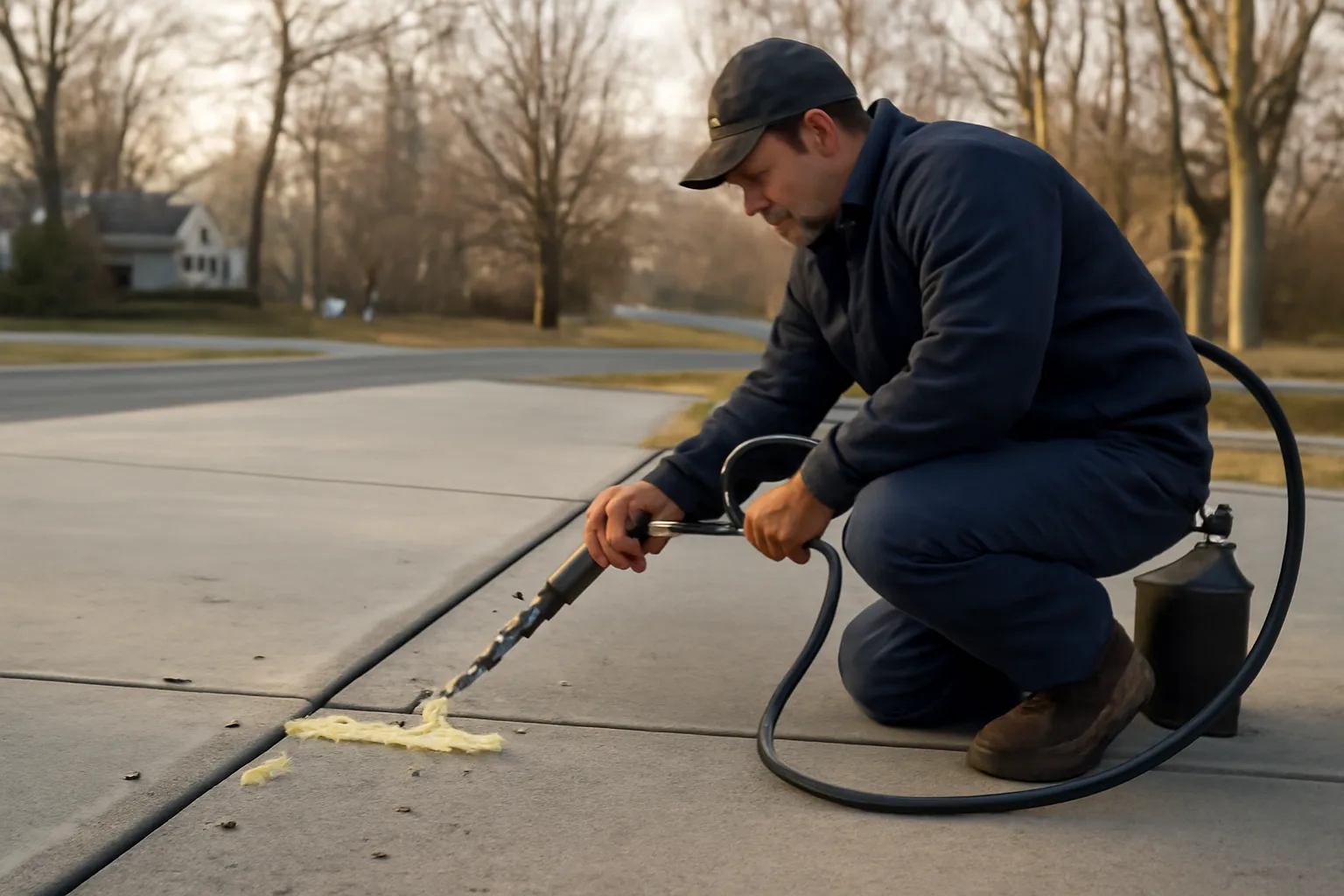
Polyurethane foam slab lifting is fast compared to traditional mudjacking or replacement. A standard residential job, say four to six settled concrete panels on a front walk or patio, takes a two-person crew two to four hours including setup, injection, patching the injection ports, and cleanup. Customers can walk on the surface in 15 to 30 minutes after injection because the foam cures quickly. Driveways can usually handle light vehicle traffic within an hour. [6]
Larger commercial jobs (warehouse floors, loading dock aprons, parking lots) can run multiple days, but that's volume, not process complexity. The foam itself sets fast regardless of pour size.
Business ramp-up
Realistic time from application to first paying job is 8 to 14 weeks for most Connecticut startups, driven mostly by DCP processing time (4 to 8 weeks) plus the time to order and receive equipment if it's not in stock. Buy used equipment locally and get DCP processing in four weeks, and you could be operational in six. If equipment ships from the manufacturer and DCP is backed up, twelve weeks is realistic.
Marketing ramp-up takes longer than anyone wants to admit. In Connecticut's residential market, most slab lift leads come from Google local search, Angi/HomeAdvisor, and word of mouth from real estate agents and home inspectors. Plan on three to six months before you're booking jobs consistently without relying on paid lead services.
What insurance do you actually need in Connecticut?
Connecticut's HIC statute requires proof of insurance or a bond. Beyond that legal minimum, running slab lift equipment creates real exposure that a bare-minimum policy won't cover.
The three policies every Connecticut slab lift operator needs:
Commercial General Liability (CGL): Covers property damage and bodily injury claims. For slab lift, the key exposure is foam injection damaging adjacent structures, a pipe, or a utility line. Minimum $1M per occurrence. Most commercial customers require $2M aggregate. Budget $1,200 to $2,800 annually for a startup. [7]
Commercial Auto: Your truck and trailer are business vehicles. Personal auto policies exclude business use. Hauling a foam rig trailer means you need a commercial auto policy covering the tow vehicle and attached equipment. Budget $1,800 to $4,000 annually depending on driving record and vehicle value.
Workers' Compensation: Required in Connecticut the moment you have any employee, including part-time or seasonal help. Sole proprietors with no employees can exempt themselves but must file for the exemption. The rate varies by classification code. Concrete repair work typically falls under NCCI code 5221 (concrete work). [3] Confirm current rates with your insurer.
Buying expensive equipment? Inland marine coverage (for equipment in transit or on a job site) is worth the relatively small additional premium. A stolen or damaged foam pump can put you out of business for weeks.
What equipment do you need to start slab lift in Connecticut?
You need three things to inject polyurethane foam: a proportioner/pump, hose and fittings, and foam chemicals. Everything else is support.
The proportioner heats and meters the two-part polyurethane foam at a precise 1:1 or 2:1 ratio (depending on formulation). Entry-level electric proportioners suitable for residential work start around $15,000 to $25,000 new. Hydraulic rigs capable of high-volume commercial work run $35,000 to $70,000 or more. The pump is where quality matters most, because inconsistent mixing ratios produce foam that doesn't cure properly, and that's both a quality problem and a liability problem.
Hose sets come in 50-foot and 100-foot lengths. Buy at least two sets so one can be cleaning while you're using the other. Budget $2,000 to $5,000 for hose and fittings.
Foam chemical is the ongoing consumable cost. You'll source this from your equipment supplier or an independent chemical distributor. Two-part polyurethane lift foam formulations vary by density and expansion rate. Higher-density foam costs more but provides more lift per pound. For residential work in Connecticut's climate, you want a foam rated for ground contact and freeze-thaw cycling.
You also need a drill (for injection ports), concrete patching material, safety equipment (respirator, gloves, safety glasses), and a reliable work truck with trailer capacity. Connecticut road salt is hard on trailers, so inspect any used trailer carefully for frame rust.
Comparing capital costs before you commit? The how to start slab lift in Colorado guide covers equipment sourcing considerations that apply across New England and the Mountain West climates.
How do Connecticut's taxes and business filings affect a slab lift startup?
Connecticut has a corporation business tax and an annual report requirement that catch new business owners off guard.
LLCs in Connecticut must file an annual report with the Secretary of State. The fee is $80 per year. [4] Miss it and the state dissolves your LLC, which voids your HIC registration and any contracts you signed under that entity.
Connecticut previously imposed a business entity tax (BET) on LLCs of $250 every two years, but the legislature repealed the BET for taxable years beginning on or after January 1, 2020. Confirm the current status with the Department of Revenue Services before you file, since state tax law changes.
On sales tax: Connecticut generally exempts labor charges for capital improvement work on real property from sales tax under CGS 12-408(1). Slab lifting that permanently repairs and restores a foundation element typically qualifies as a capital improvement. But if you sell foam material separately from labor, that material portion may be taxable. The distinction matters for how you write your proposals. Get a DRS ruling or solid CPA advice before you decide how to price and invoice. [8]
For income tax, a single-member LLC is a disregarded entity for federal purposes, meaning profit flows to your personal return. Connecticut follows federal treatment for pass-through entities in most respects.
What does the Connecticut slab lift market actually look like?
Connecticut is a high-density, aging housing stock state. The median age of a Connecticut home is among the highest in the country, with a significant share of housing built before 1960. [9] That's good for slab lift: older concrete stoops, sidewalks, driveways, and garage floors have had decades to settle.
Frost depth in Connecticut runs 36 to 48 inches in the northern tier and 30 to 36 inches in the southern coastal areas. [10] Freeze-thaw cycling is aggressive. Connecticut gets soil movement from frost heave every winter, and that's the primary driver of residential concrete settlement. This creates a repeatable demand cycle: jobs peak in spring (when homeowners see the damage after winter) and again in late summer before another freeze season.
Competition in Connecticut is moderate relative to southern states where the slab lift market is more saturated. A handful of established operators work the Hartford-New Haven corridor, and some mudjacking companies in Massachusetts and New York also cross into Connecticut. But the state is large enough that a focused operator in, say, the New Haven or Middlesex County area can build a good residential book without immediately competing with the Hartford metro players.
The coastal markets (Fairfield County, New London) have higher average home values, which means homeowners are more likely to spend $1,500 to $3,000 on slab lifting rather than replace concrete or sell as-is. That's the price-premium end of the Connecticut market.
Evaluating neighboring states for comparison or expansion? The how to start slab lift in Alabama guide covers a warmer-climate contrast, and the how to start slab lift in Alaska guide covers extreme freeze-thaw conditions that have some parallels to Connecticut winters.
What contracts and disclosures does Connecticut require for home improvement work?
Connecticut's Home Improvement Act has specific contract requirements that apply to every slab lift job on a residential property. Under CGS 20-429, a home improvement contract must be in writing and signed by both parties before work begins. It must include: [1]
- The contractor's name, address, and HIC registration number
- A start date and substantial completion date
- A description of the work
- The total price
- Notice of the buyer's three-day right to cancel (for contracts signed at the homeowner's home or somewhere other than the contractor's place of business)
The right to cancel is real and courts enforce it. Leave the cancellation notice out of the right format and the contract is voidable by the homeowner even after the work is done. The DCP publishes the required cancellation notice language. Use it verbatim.
A home improvement contract in Connecticut must also not require more than one-third of the total contract price as a deposit before work begins. Collect more than that and you expose yourself to a complaint and potential HIC revocation. [1]
For commercial slab lift jobs, these residential protections don't apply, but you still need a solid written contract. Define the scope clearly, because slab lifting sometimes reveals underlying void conditions that weren't visible before injection. A contract that specifies "lift to within X inches of original grade" and describes what happens if voids exceed a certain volume protects both you and the customer.
How do you find your first slab lift customers in Connecticut?
Your first customers will almost certainly not come from organic Google search, because you have no reviews and no domain authority yet. That's fine. Here's what actually works in the first six months.
Real estate agents and home inspectors are your highest-value referral sources. A home inspector who finds settled walkway slabs or a garage floor with a trip hazard writes it up in the report. That buyer then needs a bid before closing. Respond fast and show up on time, and you get that bid plus a referral relationship that generates jobs for years. Call local inspection companies directly and introduce yourself. Bring a business card and a one-page explainer of the process.
Google Business Profile is free and you should set it up the day you're legally registered. Collect reviews from every job. Five honest reviews in Connecticut will put you ahead of many competitors in local pack rankings for smaller markets like New Britain or Meriden.
Angi and HomeAdvisor generate leads, but the cost per lead ($30 to $80 for concrete repair in Connecticut) is high and the leads are competitive. Use them to fill gaps while building organic traffic, not as a permanent strategy.
For estimating and bidding, SlabLiftPath's Mix + Bid-per-Sqft Kit at $149 one-time (available at /start) covers bid math, material cost per pound, and job margin tracking. That's useful when you're doing your first dozen jobs and building your pricing intuition.
Direct mail to neighborhoods with older homes (pre-1960 housing stock is visible in county assessor parcel data) has worked for several small operators in the Northeast. A postcard campaign targeting zip codes with high concentrations of 60-plus-year-old homes costs $300 to $800 for 1,000 pieces and generates a trackable response.
What are the biggest mistakes Connecticut slab lift startups make in year one?
The most expensive mistake is starting jobs before the HIC registration clears. Unlicensed home improvement contracting in Connecticut is a class A misdemeanor and carries civil penalties. Beyond the legal exposure, an unregistered contract is unenforceable, which means a non-paying customer wins by default. Don't rush this.
The second mistake is underpricing early jobs to win work. Slab lifting has high material and equipment costs. Price at $3 per square foot on a job that requires 80 pounds of foam at $2.50/lb and you're at roughly $1.25/sq ft in material alone before fuel, labor, or overhead. Know your numbers before you quote. Use actual foam volume estimates, not square footage as a proxy.
The third mistake is skipping the commercial auto policy. Personal auto policies have business use exclusions. If your foam rig trailer causes an accident on I-91, your personal policy denies the claim and you're personally exposed.
Fourth: not maintaining the DCP registration renewal. HIC registrations in Connecticut are issued for two years. Miss the renewal and you lapse your right to work legally in the state. Set a calendar reminder 90 days before expiration.
Fifth: taking on jobs outside your equipment capacity too early. Bid a 5,000 square foot warehouse floor when your pump is sized for residential work and you get slow injection, inconsistent mixing ratios, and a frustrated commercial customer. Grow into commercial work as your equipment and crew scale.
For context on how other states structure these entry requirements, the how to start slab lift in Arizona and how to start slab lift in California guides show how licensing complexity varies by state.
Where do you confirm current fees and processing times in Connecticut?
Everything in this guide reflects the legal framework as of the date noted below and publicly available fee schedules. Fees, bond amounts, and processing times change. Always confirm current figures directly with the relevant agency before you apply.
- HIC registration, fees, and renewal: Connecticut DCP, Professional Licensing Division. [2]
- LLC formation and annual report: Connecticut Secretary of State, CONCORD portal. [4]
- Workers' compensation requirements: Connecticut Workers' Compensation Commission. [3]
- Sales tax on construction services: Connecticut Department of Revenue Services, IP 2018(2) or current equivalent. [8]
- Contract requirements: Connecticut General Statutes Title 20, Chapter 400, Sections 20-419 through 20-432. [1]
Working with an accountant or attorney (and for your first year, you should at least consult one for the tax and contract questions)? Point them to these sources rather than relying on general contractor advice from other states, because Connecticut's HIC statute is stricter than many states on deposit limits and contract disclosures.
For background on how licensing requirements differ across state lines, the slab lift license in Alaska and slab lift license in Alabama guides give a useful comparison baseline. SlabLiftPath covers every state and updates guides when regulatory changes are confirmed.
Frequently asked questions
Do you need a license for slab lift in Connecticut?
There is no trade-specific slab lift license in Connecticut. You need a Home Improvement Contractor (HIC) registration from the Department of Consumer Protection under CGS 20-419 to perform slab lifting on residential properties. The registration requires a business entity, insurance or bond, and an application fee (confirm current amount with DCP). Commercial slab lift work has separate requirements based on project scope.
How much does slab lift cost in Connecticut?
Residential customers in Connecticut typically pay $3 to $25 per square foot, with most residential jobs (400 to 800 sq ft) landing between $800 and $3,000. Startup costs for a new operator run $2,000 to $5,000 for licensing and insurance, $15,000 to $60,000 for equipment, and $8,000 to $15,000 in working capital for the first 60 to 90 days. Foam material costs $1.50 to $3.00 per pound wholesale.
How long does slab lift take in Connecticut?
Individual jobs go fast. A standard residential repair of four to six concrete panels takes a two-person crew two to four hours, and the surface is walkable in 15 to 30 minutes after injection. Getting your business operational takes longer: DCP HIC registration historically takes 4 to 8 weeks to process, and equipment lead times add another 2 to 6 weeks, putting most new operators 8 to 14 weeks from decision to first legal job.
What is the Connecticut Home Improvement Contractor registration and how do I apply?
It's the required registration for anyone doing home improvement work for pay in Connecticut, issued by the Department of Consumer Protection under CGS 20-419. Apply through DCP's eLicensing portal. You need a Connecticut business entity registration, general liability insurance or a guaranty fund bond, and the application fee. Confirm current fees and requirements with DCP before applying.
Can a sole proprietor register as a slab lift contractor in Connecticut?
Yes. Sole proprietors can obtain an HIC registration in Connecticut. You still need to register with the Secretary of State as a sole proprietor doing business under a trade name (DBA) if you're operating under a business name. You also need to confirm workers' compensation requirements if you ever hire employees, even part-time. Sole proprietors with zero employees can file for a workers' comp exemption with the Workers' Compensation Commission.
Is slab lift work taxable in Connecticut?
Work that qualifies as a capital improvement to real property is generally exempt from Connecticut sales tax under CGS 12-408(1). Slab lifting that permanently repairs concrete to its original function usually meets that definition. However, if you bill materials separately from labor, the materials may be subject to tax. Confirm your specific billing structure with a Connecticut CPA or a DRS guidance letter before you invoice commercial customers.
How much does the Connecticut HIC registration bond or insurance need to be?
Connecticut's HIC rules require participation in the Home Improvement Guaranty Fund or a Certificate of Insurance demonstrating equivalent coverage. The specific bond amount and insurance minimums are set by DCP and can change at renewal cycles. As a general benchmark, a $15,000 surety bond and $500,000 general liability coverage are commonly cited thresholds, but confirm current requirements directly with the DCP before purchasing.
Do I need a building permit for a slab lift job in Connecticut?
Often no for standard residential concrete repair, but it depends on the municipality and project scope. If the work involves raising concrete without changing drainage, grade, or structural elements, most Connecticut towns don't require a permit. If you're lifting a slab adjacent to a foundation wall or in a situation where settlement has caused structural concerns, a permit or engineering sign-off may be required. Call the local building department before starting any job you're unsure about.
What happens if I do slab lift work in Connecticut without an HIC registration?
Performing home improvement work without an HIC registration in Connecticut is a class A misdemeanor under CGS 20-427. Contracts signed by an unregistered contractor are unenforceable, meaning customers can refuse to pay and courts won't help you collect. DCP can also assess civil penalties. The risk is not worth saving the 4 to 8 weeks of registration processing time.
What's the difference between mudjacking and polyurethane foam lifting in Connecticut?
Mudjacking pumps a cement-sand-water slurry under a slab to raise it. Polyurethane foam injection uses a two-part expanding polymer. Foam is lighter (important near weak or compromised soils), cures in minutes rather than hours, and leaves smaller injection ports. Foam typically costs 25 to 50% more per job than mudjacking. For a new Connecticut startup, foam is usually the better entry point because the equipment is more portable and the process is faster.
How do I find slab lift equipment suppliers that ship to Connecticut?
Most major polyurethane foam equipment suppliers (Alchemy-Spetec, AP Lift, Perma-Pipe, and similar) ship nationally including to Connecticut. Used equipment appears on equipment auction sites and through retiring operators in the Northeast. Budget $15,000 to $25,000 for a functional used residential rig and $25,000 to $60,000 for new equipment. Always verify pump seals and hose condition on used units before buying.
How do Connecticut winters affect slab lift operations?
Cold temperatures affect both foam cure time and injection conditions. Most two-part polyurethane foam requires substrate temperatures above 35 to 40 degrees F to cure properly. Connecticut winters push ground temperatures below that threshold from roughly December through March in most of the state. Many Connecticut slab lift operators treat November through March as their slow season and use that time for marketing, equipment maintenance, and commercial indoor jobs where temperature is controlled.
What are typical profit margins for a slab lift operator in Connecticut?
Nobody has published Connecticut-specific margin data for slab lift. Based on national contractor benchmarks and equipment cost structures, gross margins on residential polyurethane foam jobs typically run 40 to 65% before overhead. Net margins for a one-to-two person operation in year one, after insurance, vehicle costs, and materials, often land in the 20 to 35% range. High-volume days with multiple jobs in the same zip code push margins up by cutting drive time.
Sources
- Connecticut Department of Consumer Protection: HIC registration application process, fee schedule, and bond or insurance requirements
- Connecticut Workers' Compensation Commission: Workers' compensation insurance is required in Connecticut upon hiring any employee; sole proprietors may file for exemption
- Connecticut Secretary of State, business.ct.gov: LLC formation fee and annual report requirement and fee for Connecticut business entities
- Angi (formerly HomeAdvisor), Mudjacking Cost Guide: National average cost range of $830 to $1,530 for mudjacking; polyurethane foam typically 25 to 50% higher than mudjacking for equivalent jobs
- Alchemy-Spetec, Polyurethane Foam Slab Lifting: Polyurethane foam cures in 15 to 30 minutes allowing foot traffic; job durations for residential panels typically two to four hours
- Insurance Information Institute, Commercial General Liability Insurance: CGL policy structure: per-occurrence and aggregate limits; typical contractor coverage requirements
- Connecticut Department of Revenue Services: Capital improvement work on real property in Connecticut is generally exempt from sales tax under CGS 12-408(1); labor vs materials billing distinction
- U.S. Census Bureau, American Community Survey 2022, Selected Housing Characteristics Connecticut: Median age and vintage of Connecticut housing stock; significant share built before 1960
- NOAA National Weather Service, Frost Depth: Frost depth in Connecticut ranges from 30 to 36 inches in southern coastal areas to 36 to 48 inches in northern tier