Last updated 2026-08-20
TL;DR
Slab lift insurance is a stack, not one policy. Buy commercial general liability, workers' compensation if you have employees, commercial auto on work trucks, and equipment cover for pumps and injectors. Foam work raises chemical and pollution questions. California's contractor bond is $25,000 by statute. Confirm every limit and class code with your state board and a construction broker. Nobody has a clean national premium.
What is slab lift?
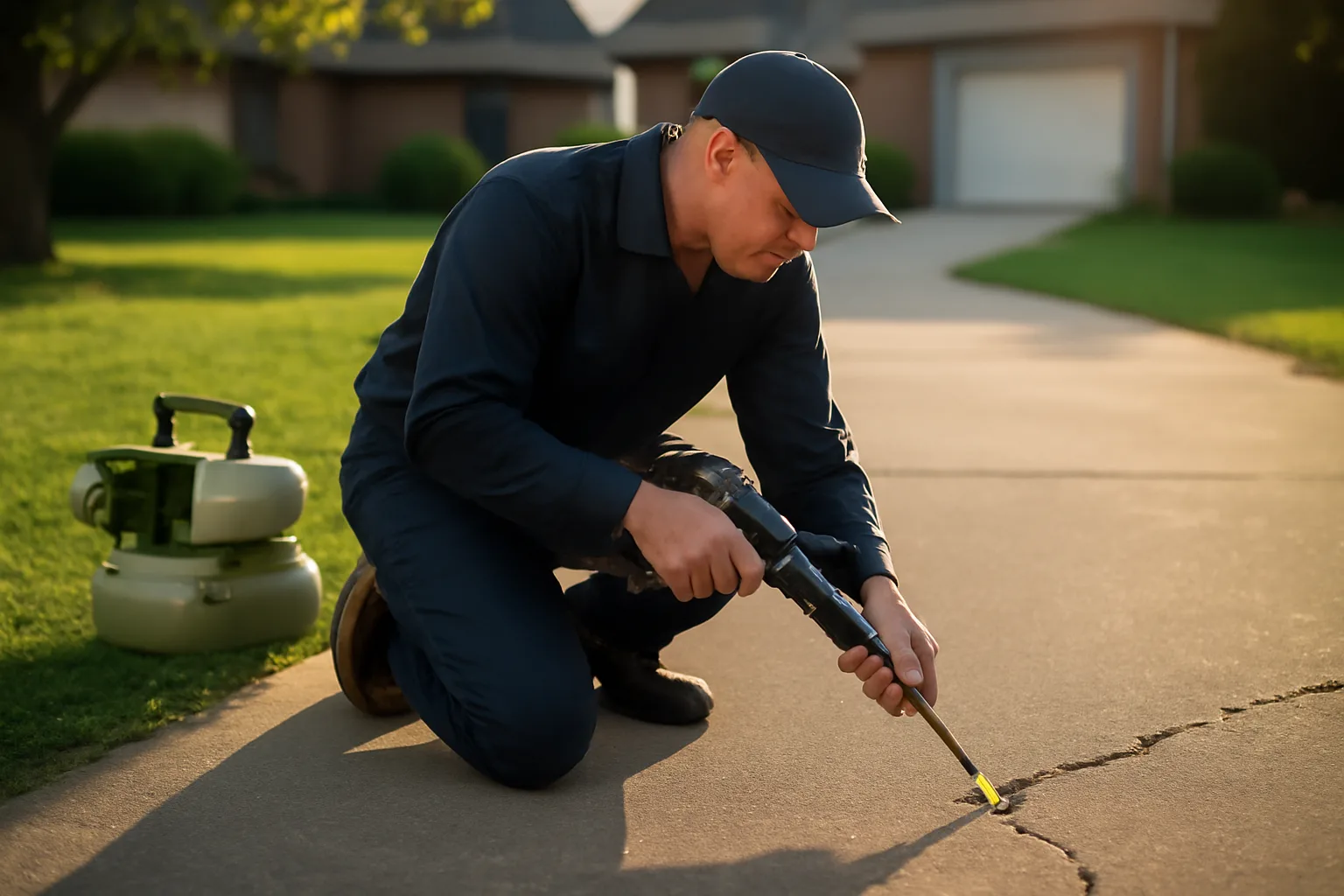
Slab lift raises a sunken slab by pumping material underneath it until the panel moves back toward level. Crews drill small ports, inject either expanding polyurethane foam or a cement slurry (the older method people still call mudjacking), then patch the holes.
That is the whole trade. Driveways, garage floors, sidewalks, patios, and pool decks. You are moving a structure. Insurers treat it as specialty concrete work because you apply pressure under someone else's finished surface, you drill into concrete, and you may handle isocyanate-based foam.
Foam is light and expands into voids. Slurry is heavier and can be cheaper on big, open slabs. Both can crack a panel if you push too hard. Both create silica dust when you drill. Foam adds a chemical exposure that mudjacking does not. Those facts, not marketing names, are what an underwriter cares about.
If a homeowner's policy adjuster calls it "leveling" and your invoice says "polyjacking," you still did construction. Call it what it is when you apply for coverage.
What insurance do you need for a slab lift business?
You need a stack. Commercial general liability for third-party injury and property damage. Workers' compensation if you have employees (and in some states on a tighter trigger than you think). Commercial auto on every vehicle that hauls gear. Inland marine or contractors equipment cover for pumps, hoses, generators, and injectors. A license bond is often separate from insurance. The U.S. Small Business Administration lists general liability, commercial property, and workers' compensation among the covers most businesses actually buy [1].
That is the working set. Everything else is a maybe.
General liability responds when you crack a client's tile, hit a buried line, or someone trips on your hose. Workers' compensation pays medical and wage replacement when an employee is hurt on your job. Commercial auto covers the truck, not your personal car policy. Equipment cover follows the injector when it leaves the shop. A surety bond, common on contractor licenses, pays certain claims if you fail to follow license law. It is not a substitute for liability insurance.
Skip the fantasy package on day one. You do not need cyber, employment practices, or a fat umbrella until you have payroll, a real book of work, and a contract that asks for it. You do need the four covers above before you take a deposit.
Read your state license page next to your insurance application. California's license file requires a contractor bond. It does not, by itself, force you to carry a general liability policy [5]. Plenty of general contractors will still refuse your bid without a certificate. Those are different problems. For the actual license path in a given state, start with a state guide such as how to start slab lift in California or the California license breakdown.
How much does slab lift insurance cost in the first year?
Nobody publishes a clean national premium for slab lift contractors. Carriers price by payroll, receipts, claims history, state, vehicle schedule, and whether you inject foam or pump slurry. Anyone quoting a single number on a blog is guessing.
What you can know is the cost drivers. Workers' compensation is usually a rate per $100 of payroll on a construction class code. General liability is often a rate against receipts, sometimes with a per-job minimum. Commercial auto follows the vehicle, drivers, and radius. Equipment cover follows stated values. A license bond is a premium on the penal sum, not a policy limit.
I would budget insurance as a real line on every bid, then get three quotes on identical limits before I locked a price list. Do not let a broker package you into a businessowners policy that quietly excludes underground work, exterior work over a certain height, or chemical injection. Read the exclusions. If the form will not cover lifting a slab, the cheap premium is worthless.
Premiums are ordinary and necessary business expenses when they protect the trade. The IRS says you can generally deduct the ordinary and necessary cost of insurance as a business expense [7]. That does not make an overbuilt policy smart. It just means the right policy is a cost of goods, not a vanity line.
Confirm current class codes and minimum premiums with a construction-specialty broker. Surplus lines markets write a lot of this work. Admitted markets sometimes will not. That is normal. It is also why a personal-lines agent who writes homeowners is the wrong call.
Do you need workers compensation for slab lift work?
If you have employees, you almost certainly need workers' compensation. Several states go further for construction. California Labor Code 3700 states, "Every employer except the state shall secure the payment of compensation in one or more of the following ways" [4]. Florida counts construction employment at one or more employees, not the four-employee threshold used in much of non-construction private industry [6].
Texas is the loud exception. Private employers there may elect not to carry workers' compensation, with a different liability exposure if they opt out [9]. That is not a free pass. It is a different lawsuit.
Owner-only shops get messy. Some states let a true sole owner exclude themselves. Some do not treat members of an LLC the same as a sole proprietor. Do not take a Facebook answer. Ask the state workers' compensation agency how they treat your entity type. Then put it in writing from the carrier.
Slab lift is physical. Drilling, lifting hoses, working on slopes, and handling pressurized systems produce the kind of strains and struck-by injuries construction already knows. OSHA's construction PPE rule requires appropriate protective equipment wherever hazards exist [10]. A comp claim on an uninsured payroll can close a new shop. I would not run a helper off the books to dodge the premium. That is how people lose the truck.
If you use 1099 labor who look like employees (your schedule, your equipment, your jobsite control), a state auditor can reclass them. Then you owe premium plus penalty. Cheap labor is not cheap after that.
Does slab lifting need general liability insurance?
Yes if you want to get paid by anyone serious. General liability is the policy that answers when your injection lifts a slab into a door jamb, you stain a facade, or a visitor steps in a wet patch. It is third-party cover. It is not your medical bill and it is not your broken pump.
A license bond is not general liability. California requires a contractor's bond of $25,000 as a condition of issuing or maintaining a license [5]. That bond responds to certain license-law and consumer claims up to the penal sum. It does not defend you in a civil suit the way a CGL policy does. People mix these up and then stand in a living room with no defense counsel.
I would carry CGL before the first paid job, even in a state that only asks for a bond. Write the operations description in plain language: polyurethane concrete lifting, cementitious slab jacking, drilling and patching of exterior flatwork. If the application says "handyman" or "consulting," you invited a denial.
Watch for exclusions on underground work, pollution, exterior work, and "your work." The your-work exclusion is why a redo of your own bad lift may not be covered. That is a warranty problem, not an insurance problem. Price a callback reserve into the job.
What commercial auto and equipment cover do you actually need?
Personal auto policies drop work use fast, especially if you haul a compressor, foam sets, or a trailer. Put every work vehicle on a commercial auto policy. Add hired and non-owned auto if anyone runs a rental or a personal car to the depot or the job.
If a truck or combination hits a gross vehicle weight rating of 10,001 pounds or more in interstate commerce, federal rules can require a USDOT number [8]. Confirm the current FMCSA test for your exact vehicle and trip pattern. Do not guess from a forum post.
Equipment cover, often written as inland marine or contractors equipment, is what pays when the injector is stolen off the driveway or the generator dies in a rollover. CGL will not replace your tools. Auto physical damage will not follow a pump that was sitting on the lawn. Schedule the real replacement cost, not what you paid for a used unit in 2019.
I would insure the foam proportioner, hoses, generators, core drills, and trailer as scheduled equipment on day one. I would not buy an expensive installation floater for a trade that does not install kitchens. Match the form to the gear.
Photograph serial numbers. Keep a simple schedule. Claims stall when you cannot prove what you owned.
Do polyurethane foam chemicals change your slab lift insurance?
They can. Two-component polyurethane systems use isocyanates. OSHA says, "Isocyanates are powerful irritants to the mucous membranes of the eyes and gastrointestinal and respiratory tracts" [2]. NIOSH has warned for years about asthma and sensitization in workers who handle these chemicals [11]. EPA also manages risk around methylene diphenyl diisocyanate used in polyurethane systems [12].
That is not a reason to panic. It is a reason to tell the truth on the application and to run the product SDS, PPE, and hazard communication like a real contractor. A pollution exclusion on a cheap CGL form can leave you uncovered for a chemical spill, off-ratio foam that stains, or a vapor complaint. Ask for the actual pollution wording. If the broker cannot show it, get another broker.
Drilling concrete also puts respirable crystalline silica in the air. OSHA's construction silica standard sets an action level of 25 micrograms per cubic meter as an 8-hour time-weighted average [3]. Wet methods, shrouds, and respirators are operations facts. They are also underwriting facts. A shop that cannot describe its dust controls looks like a claim waiting for a date.
Mudjacking shops still have silica and slurry mess. They usually do not have the isocyanate question. Price and coverage will follow the process you actually run, not the name on the van.
How do you start slab lift?
You start with the legal shell, then the license path in your state, then the insurance stack, then equipment you can actually pay for, then jobs you can finish without callbacks. That order matters. Gear first is how people end up uninsured on a driveway they already collected on.
Pick an entity your state recognizes. Apply for the contractor classification that actually covers concrete lifting, concrete, or specialty structure work. The name of the class is not the same in Alabama, Arizona, and Colorado. Use the state pages, not a national myth. How to start slab lift in Alabama, the Alabama license notes, Arizona startup steps, and Colorado startup steps are the kind of board-level reading that saves a rejected application.
Buy the insurance described above so you can issue a certificate the same week you bid. Set a written bid method (area, void assumptions, foam or slurry, traffic control, patch). If you need a simple mix and bid-per-square-foot worksheet so the insurance load sits inside the number, SlabLiftPath sells a $149 one-time Mix + Bid-per-Sqft Kit. That is optional paper. The license and the policies are not.
Train on pressure, lift sequence, and when to stop. Your first ten jobs should be flat exterior panels with easy access. Leave structural foundations and interior slabs until you have reps and a carrier that knows what you do.
Confirm every fee, exam, and proof-of-insurance item with the board that will print the card. No article can promise an approval date.
What licenses and bonds go with slab lift insurance?
Insurance and licensing are paired paperwork, not the same product. Many states will not issue or keep a contractor license without a surety bond on file. California's statute is blunt. The board requires a contractor's bond in the sum of twenty-five thousand dollars [5]. Other states set different penal sums, and some tie the number to volume or classification. Confirm the current figure on the statute or the board fee page before you pay a bond producer.
A bond can pay a consumer or the board when you break license law. It does not defend a negligence suit. You can be bonded and uninsured. You can also be insured and improperly licensed. Either gap can stop a job.
Some municipalities add their own business license, right-of-way permit, or extra liability limit for work in the street. Those sit on top of the state card. Read the permit, then send it to the broker so the certificate matches.
If you are comparing states, read the license article next to this one. Slab lift license in Arizona and slab lift license in Colorado show how classification language changes. Do not assume a concrete license in one state covers foam injection in another.
What insurance mistakes waste money on a first-year slab lift shop?
The expensive mistakes are predictable. Buying a homeowners rider and calling it a business policy. Listing the work as "consulting" so the premium looks small. Putting a helper on a 1099 and skipping workers' compensation. Hauling a $20,000 proportioner on a personal auto policy. Signing a GC contract that asks for additional insured, waiver of subrogation, and primary wording you never bought.
I would not buy an umbrella in month one unless a written contract forces it. I would not buy professional liability for a lift that is not design work. If you stamp engineering, that is different. Most residential slab lifts are means-and-methods, not sealed design.
Another waste: over-insuring junk equipment at replacement cost you will never spend, while leaving the truck uninsured for hired drivers. Move money to the losses that actually close shops. Auto and employee injury sit at the top of that list.
Certificates that lie are not a strategy. If the certificate says $1 million and the policy is $300,000, you created a fraud problem on top of a coverage problem. Issue what you bought.
How do you buy slab lift insurance without getting played?
Call two or three brokers who already write concrete, foundation, or waterproofing contractors. Give them the same operations paragraph, the same payroll, the same receipts estimate, and the same equipment list. Compare forms, more than the monthly draft.
Ask four questions out loud. Does the CGL cover polyurethane injection and cementitious slab jacking? Is there a pollution exclusion that kills a chemical claim? Are employees and 1099s described the way the state will audit them? Will the auto policy cover a trailer and non-owned cars?
Bring the SDS for your foam system and a photo of the drill setup. Serious underwriters like boring detail. Vague applicants get surplus-lines junk or a decline.
When a general contractor asks for additional insured status, use the endorsement the contract names. Blanket additional insured is easier than a one-off if you bid a lot of GC work. Do not promise primary and noncontributory wording you have not bought.
Revisit the program at renewal with real receipts. A first-year audit that doubles premium is often just honest volume. Budget for it.
What happens if you do slab lift work uninsured?
You pay the loss yourself. A cracked tile floor, a cut irrigation main, a helper's shoulder, a stolen injector. Any one of those can exceed a year of premium.
You can also lose the job before you start. Property managers and GCs pull certificates. Municipal permits often ask for proof. A license board can move on a complaint faster if you also ignored a bond or workers' compensation rule [4] [5].
Uninsured work is not a lean startup tactic. It is a bet that nothing happens on a pressurized hose next to someone else's house. I would not take that bet.
If cash is tight, buy the four-cover stack on modest limits, drive one truck, and turn down jobs that demand an umbrella you cannot fund. Small and insured beats busy and exposed.
Frequently asked questions
What is slab lift?
Slab lift raises a sunken concrete panel by injecting polyurethane foam or a cement slurry under it through small drilled ports. It is used on driveways, sidewalks, patios, and garage floors. It is construction work, not a cosmetic product. Insurers class it with specialty concrete because you apply pressure under finished slabs and you may handle isocyanates or silica dust.
How do you start slab lift?
Form an entity, get the contractor classification your state actually uses for concrete or specialty structure work, buy GL, workers' compensation if required, commercial auto, and equipment cover, then buy gear you can insure. Confirm fees and proof items with the board. Do not take deposits until you can issue a certificate. State startup guides beat any national checklist.
Is slab lift the same as mudjacking?
Mudjacking is slab lift with a cementitious slurry. Polyurethane lifting is slab lift with expanding foam. Both raise concrete. Foam is lighter and uses smaller ports. Slurry is older and heavier. Your insurance application should name the process you run. Foam can trigger chemical and pollution questions that slurry usually does not.
Can I use a homeowners policy for slab lift jobs?
No. Homeowners forms exclude business pursuits and most work away from the residence. A claim on a client's driveway will not wait while you argue with a personal-lines adjuster. Buy a commercial general liability policy written for concrete lifting. Keep the house policy on the house.
Can I drive the work truck on a personal auto policy?
You should not. Personal auto policies restrict business use and often exclude vehicles that haul equipment or trailers. Put work trucks and trailers on a commercial auto policy. Add hired and non-owned cover if anyone uses a rental or a personal car for shop errands.
Do I need both a surety bond and liability insurance?
Often yes. A license bond satisfies the board up to a penal sum, such as California's $25,000 contractor bond under BPC 7071.6. General liability defends and pays third-party injury and property damage claims. One does not replace the other. Confirm the current bond amount with the board that issues your card.
Is workers' compensation required if I work alone?
It depends on the state and your entity. Many states let a true sole owner exclude themselves. Employees flip the switch. Florida construction employment starts at one employee. California requires employers to secure compensation. Texas lets many private employers opt out, with different lawsuit risk. Confirm with the state agency, not a group chat.
Does polyurethane foam require pollution insurance?
Not always as a stand-alone policy, but you must read the CGL pollution exclusion. Isocyanates are irritants and sensitizers, and a spill or off-ratio mess can be denied if the form excludes chemical releases. Ask the broker to show the wording. If they cannot, get another broker before you load the first set of drums.
What limits do general contractors usually want on a certificate?
Read the written contract. Many GC exhibits ask for additional insured status, waiver of subrogation, and primary wording. Limits vary by owner and job. Do not invent a number on the certificate. Issue only what the policy actually provides, then buy the endorsement if the job is worth it.
Do I need professional liability for residential slab lift?
Usually no if you are executing means and methods, not stamping engineering. Professional liability is for design errors. If a structural engineer designs the repair and you only pump, your exposure is CGL and workmanship, not E&O. If you sell engineering, buy the professional cover and stay in your lane.
What is inland marine insurance on a slab lift truck?
In this trade it usually means contractors equipment or an inland marine floater that follows pumps, injectors, generators, and tools off premises. Auto physical damage covers the truck. CGL does not replace stolen gear. Schedule replacement cost and keep serial numbers. That claim file is boring on purpose.
Will a claim make slab lift insurance impossible to buy?
One small property-damage claim rarely ends a program. A pattern of over-lifts, unpaid additional insured endorsements, or an uninsured employee injury will. Report claims early, document photos, and fix the process that caused it. Carriers punish silence and sloppy operations more than a single honest loss.
Can I work under a general contractor's insurance policy?
Almost never as your only cover. A GC policy protects the GC. Additional insured status, if they even offer it, is narrow and does not replace your CGL, auto, or workers' compensation. You still need your own stack. Ask for the additional insured endorsement in writing and keep your own policy in force.
Sources
- U.S. Small Business Administration, Get business insurance: SBA identifies general liability, commercial property, and workers' compensation among the insurance types most businesses need to consider.
- OSHA, Isocyanates safety and health topics: OSHA states that isocyanates are powerful irritants to the mucous membranes of the eyes and gastrointestinal and respiratory tracts.
- OSHA, 29 CFR 1926.1153 Respirable crystalline silica: The construction silica standard defines an action level of 25 μg/m3 as an 8-hour TWA.
- California Labor Code section 3700: Every employer except the state shall secure the payment of workers' compensation in specified ways.
- California Business and Professions Code section 7071.6: The Contractors State License Board requires a contractor's bond in the sum of $25,000 as a condition of license issuance or maintenance.
- Florida Statute 440.02 (2023), Definitions: In the construction industry, Florida defines employment for workers' compensation as private employment with one or more employees.
- IRS Publication 535, Business Expenses: Businesses can generally deduct the ordinary and necessary cost of insurance as a business expense.
- FMCSA, Do I need a USDOT number: A USDOT number can be required when a vehicle or combination has a GVWR or GVW of 10,001 pounds or more in the covered interstate operations.
- Texas Labor Code Chapter 406, Workers' Compensation Insurance Coverage: Except for public employers and as otherwise provided, a Texas private employer may elect whether to obtain workers' compensation coverage.
- OSHA, 29 CFR 1926.95 Criteria for personal protective equipment: Construction employers must provide and require PPE wherever hazards of processes or environment make it necessary.
- NIOSH Publication 2006-149, Preventing Asthma and Death from MDI Exposure: NIOSH documents asthma, sensitization, and death risk from occupational exposure to methylene diphenyl diisocyanate used in polyurethane systems.
- U.S. EPA, Risk management for MDI and related compounds under TSCA: EPA assesses and manages risk for methylene diphenyl diisocyanate used in polyurethane production and related uses.