Last updated 2026-08-20
TL;DR
There is no official ranking of the hardest states for slab lift. Friction is contractor licensing, often 4 years of experience, a surety bond, workers' compensation, and city permits. Hawaii, California, and Nevada usually hurt most because they license the trade itself. New York City, Massachusetts, and New Jersey stack agencies. Confirm every classification and fee with the board before you pay.
What is slab lift?
Slab lift is the work of raising a sunken concrete slab back toward level. You drill small holes, pump polyurethane foam or a cement grout under the slab, let expansion or hydraulic pressure move the panel, then patch the holes. People also call it foam jacking, polyjacking, or mudjacking. You are not pouring a new driveway. You are correcting settlement on an existing slab.
Most residential calls are driveways, garage floors, sidewalks, and patio slabs. Some crews also lift warehouse floors and pool decks. The chemistry changes the risk. Cement grout (classic mudjacking) is heavy and messy. Polyurethane is lighter, expands, and brings isocyanate handling into the job.
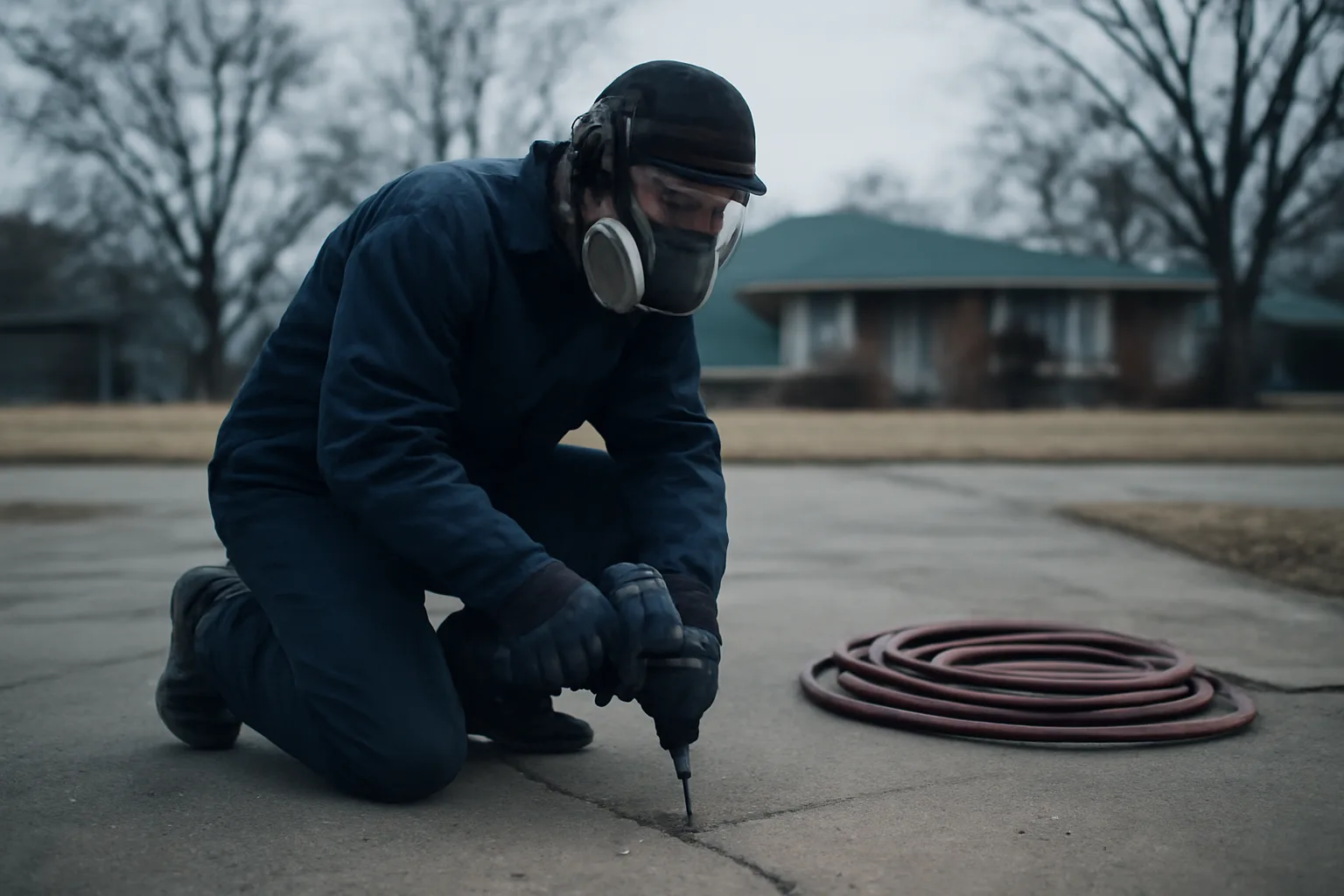
Drilling concrete kicks up silica. OSHA sets a numeric limit on that dust, which we get to later. Foam work also means you store two-part resin, keep SDS sheets in the truck, and train people not to breathe the off-gas like it is air freshener.
If you came here from a national “anyone can buy a pump” ad, pause. In the hard states, slab lift is contractor work. The board does not care what the foam maker called the training weekend.
What makes a state hard for slab lift work?
Hard means paper friction before you ever inject a slab. A state gets on this list when it licenses the contracting trade (not a cheap registration), wants years of documented experience, sits you for exams, requires a surety bond, and then lets cities pile permits on top. Workers' compensation and chemical rules add cost even after the license prints.
Boards do not rank trades. Nobody publishes a clean “hardest states for slab lift” index. The closest honest method is to stack the rules you can actually read: experience years in statute, a named bond amount, a trade exam, and a second agency in the same city. That is the method used here. It is imperfect. It is still better than a national myth.
Registration states feel different. You file, you post a bond or insurance, you go to work. License states ask who supervised you, in which classification, for how many years, and they will reject a thin affidavit. Hawaii, California, and Nevada live in that second group. New York City, Massachusetts, and New Jersey add agency stacking even when the “license” is a home improvement registration.
Logistics count too. Alaska is not Hawaii’s twin on exams, but freight, freeze-thaw, and short seasons make first-year operations ugly. I would rather fight a California exam than a January job in Fairbanks with resin that will not flow.
Insurance is part of hardness. If the state makes you carry workers' compensation as soon as you have a helper, your first-year number is more than the application fee. Confirm current premium with a construction broker. Do not use a blog rate.
Which states are the hardest for slab lift contractors?
Hawaii, California, and Nevada sit at the top for most crews. They license contractors by classification, they want about 4 years of experience, and they test you. New York City, Massachusetts, and New Jersey belong on the next shelf because you deal with more than one office. Alaska and Connecticut feel hard in operations and home-improvement paper even when the statute is a registration. Arizona and Florida add trade exams and a certified-versus-registered split that eats months if you guess the class wrong.
California’s contractor bond is $25,000 under Business and Professions Code section 7071.6. [1] That single number is why California belongs on any hardness list even before you talk exams. Hawaii’s statute is blunter about the license itself. Nevada writes the 4-year clock into NRS 624.260. [8]
Read this table as friction, not a score. Fees change. Classifications get interpreted by staff who have never injected foam. Confirm the class with the board before you pay.
| State | Main friction | Experience you can cite | Extra overlay |
|---|---|---|---|
| Hawaii | Contractors License Board, exams | 4 years in the classification (HRS 444-11) [7] | Island freight, local permits |
| California | CSLB C-8 or B, two exams | 4 years journey-level (CSLB) [4] | $25,000 bond, workers' compensation, city permits |
| Nevada | NSCB classification (often concrete) | 4 years in a 15-year window [8] | Financial responsibility |
| New York City | DCWP Home Improvement Contractor [15] | Confirm with DCWP | DOB permits on many jobs |
| Massachusetts | Home improvement registration | Confirm with the office | Construction Supervisor License on many jobs |
| New Jersey | Statewide home improvement registration | Confirm with Consumer Affairs | Municipal permits |
| Alaska | Contractor registration (AS 08.18) [12] | Confirm with CBPL | Season, freight, remote sites |
| Arizona | ROC contractor license [11] | Confirm with ROC | Residential versus commercial classes |
| Florida | DBPR certified or registered contractor | 4 years for many certified classes [10] | County permitting |
| Connecticut | DCP home improvement registration [13] | Confirm with DCP | Local permits |
If you live in Texas and you only do slab lift, you are not on this list. Texas does not run a statewide general contractor license the way California does. That is the contrast. It is also why people on forums treat California like a personality test.
Why is California so hard for slab lift?
California licenses the person and the company through the Contractors State License Board. Slab lift usually gets steered toward a C-8 Concrete Contractor classification, or a B General Building license if you already hold one. Ask CSLB which class they want for polyurethane injection. Do not let a foam vendor pick it for you. The Description of Classifications booklet is the starting point, not a court order. [5]
CSLB wants four years of journey-level experience for a contractor license. [4] Business and Professions Code section 7068 tells the board to require knowledge and experience in the classification. [3] You sit a law exam and a trade exam. You post a $25,000 contractor bond. [1] If you have even one employee, Labor Code section 3700 still says you secure workers' compensation. [14]
Unlicensed contracting is not a cute warning. “It is a misdemeanor for a person to engage in the business of or act in the capacity of a contractor within this state without having a license therefor, unless the person is particularly exempted from the provisions of this chapter.” That is Business and Professions Code section 7028(a). [2]
Cities then add permits, encroachment rules on sidewalks, and noise windows. Los Angeles is not Redding. Plan for that. The license is statewide. The job is local.
I would not buy a foam rig before the application is in. I would not pay a “we write your experience” mill. CSLB has seen those packets. If you actually need the California path, start with how to start slab lift in California and the classification notes in slab lift license in California. Renewal is its own calendar. See slab lift renewal in California.
Is Hawaii harder than California for slab lift?
For a lot of mainland crews, yes. Hawaii licenses general engineering, general building, and specialty contractors, and it is not optional advertising copy. HRS 444-9 says: “No person within the purview of this chapter shall act, or assume to act, or advertise, as general engineering contractor, general building contractor, or specialty contractor without a license previously obtained under and in compliance with this chapter and the rules of the contractors license board.” [6]
HRS 444-11 is the experience gate. The statute wants four years’ experience as a contractor in the classification you are seeking, or equivalent experience the board accepts. [7] Classification is the trap. Slab lift might land in a concrete-related specialty. It might not. Confirm with the Hawaii Contractors License Board. I will not invent a C-number for you.
Then you still have ocean freight for pumps, resin totes, and replacement parts. A missed barge is a missed week. Housing for a helper costs more than the application. None of that is in the statute. All of it is why Hawaii belongs at the top of a hardness list even if California’s bond number is larger.
If you already live on Oahu and this is the work you want, you get the license. You do not open “from the mainland” as a weekend idea. That plan dies in the experience affidavit.
How hard are Nevada, Arizona, and Florida for slab lift?
Nevada writes a hard clock. NRS 624.260 requires at least 4 years of experience as a journeyman, foreman, supervising employee, or contractor in the specific classification, inside the 15 years before you file. [8] Concrete work often sits in a C-5 type classification. Polyurethane injection may or may not match staff’s mental picture of “pouring and finishing.” Call the Nevada State Contractors Board and ask. Get the answer in writing if you can.
Nevada also cares about financial responsibility. Some applicants face more paper than a simple bond. Confirm current financial exhibits with the board. I will not guess a net-worth number.
Arizona makes it unlawful to act as a contractor without the license. A.R.S. 32-1151 is the blunt statute. [11] The Registrar of Contractors splits residential and commercial paths. Dual licenses exist. Dual paper exists too. If Arizona is home base, read how to start slab lift in Arizona and slab lift license in Arizona before you order resin.
Florida splits certified (statewide) and registered (local) contractors under chapter 489. For many certified classes, section 489.111 wants about 4 years of active experience, with education substitutions the statute allows. [10] County permitting still sits on every driveway. Miami-Dade is not a rural county. Treat them as different businesses that share a state exam.
I would take Arizona or Florida over Hawaii. I would still not treat them as easy. Wrong classification is how you pay twice.
Do New York, New Jersey, and Massachusetts belong on the hard list?
Yes, with a different kind of pain. New York State does not run a California-style statewide general contractor license for driveway work. New York City does run a Home Improvement Contractor license through DCWP, and the city’s own checklist is the document you should print. [15] Many jobs also touch the Department of Buildings. Two agencies, one sunken stoop. That is stacking.
New Jersey registers home improvement contractors statewide. Local building departments still permit the work. Insurance questions get picky on polyurethane because some carriers hear “chemical injection” and stall. Confirm registration steps with the New Jersey Division of Consumer Affairs. Confirm the permit with the township. I am not going to invent a processing time.
Massachusetts layers a home improvement contractor registration under G.L. c. 142A with a Construction Supervisor License on a lot of jobs that look “simple” to a foam tech. Local building officials decide what they want to see. Boston is not the Berkshires. If an inspector has never seen polyjacking, budget time for a conversation, not an argument on the driveway.
These states are hard because you cannot point to one board and be done. California is one board with teeth. NYC is several desks with overlapping forms.
Why do Alaska and Connecticut still feel hard?
Alaska requires contractor registration under AS 08.18.011. [12] That is not Hawaii’s exam gauntlet. The hardness is the work. Resin sits in cold trucks. Daylight disappears. A failed fitting is a week out of Anchorage, not an afternoon from a Midwest warehouse. Bonding and insurance still apply. Confirm current registration steps with Alaska CBPL. Do not copy a Lower 48 checklist and hope.
If Alaska is the plan, read how to start slab lift in Alaska and slab lift license in Alaska. Seasonality will hurt your first-year cash more than the registration form.
Connecticut requires a home improvement contractor certificate of registration before you hold yourself out as a contractor. CGS 20-420 is the section. [13] Town permits still apply. The state is small. Inspectors talk. A sloppy unregistered job in one town follows you.
Connecticut is on this list because people treat New England as “just register and go.” The statute is short. The local overlay is not. For the actual start path, use how to start a slab lift business in Connecticut.
How do you start slab lift in a hard state?
You start with the board, not the pump. Pick the state you actually live in, or the state where you can prove experience. Form an entity your insurer will write. Get general liability quotes that mention polyurethane injection or cement grout by name. If you will have help, price workers' compensation before you hire. Then file the license or registration in the right classification.
Document experience while you still remember job names. Hawaii and Nevada will ask. California will ask. Florida certified classes will ask. A manufacturer weekend does not equal 4 years. If you lack the years, work under a licensed contractor and keep W-2s and a log. That is slower. It is how people get licenses that survive an audit.
Equipment comes after the class is confirmed. A used grout pump is a different business than a two-component foam rig. Foam means heaters, hoses, gun maintenance, and storage that does not freeze or cook the drums. I would rent or subcontract a few lifts before I finance a truck build. Plenty of first-year operators skip that and then sell the rig.
Bid math is a separate skill from licensing. If you already know the paper path and you want a simple mix and bid-per-sqft worksheet, SlabLiftPath sells a $149 one-time Mix + Bid-per-Sqft Kit. It is not a license, and it does not talk to CSLB for you.
First jobs should be ugly driveways for people who will let you take photos, not a historic stoop in a protected district. Start with access, utilities, and a written lift tolerance. Missed underground lines are how “easy foam” becomes an insurance claim.
What insurance and chemical rules add friction?
Workers' compensation is the quiet killer in California. Labor Code section 3700 requires employers to secure compensation. [14] CSLB will want proof or a valid exemption if you truly have no employees. Other hard states still expect GL at construction limits. Pollution or “chemical” endorsements show up when the carrier reads “isocyanate.”
Drilling is a silica job. OSHA’s construction silica rule says: “The employer shall ensure that no employee is exposed to an airborne concentration of respirable crystalline silica in excess of 50 μg/m3, calculated as an 8-hour TWA.” [9] That is 29 CFR 1926.1153. Water on the bit, a vac, and a respirator program are not optional theater. They are the rule.
Polyurethane systems use diisocyanates. Heat, skin contact, and cheap dust masks are how techs get asthma and then cannot work. Keep SDS on the truck. Train mixing. Do not treat the A-side like motor oil.
City stormwater rules can also bite if you let grout run to a gutter. That is not a license exam topic. It is a fine. Hard states tend to have inspectors who will write it up.
Nobody has good public data on slab-lift-specific claim rates. The closest honest move is to send your actual process (foam versus grout, residential versus commercial) to a construction broker and let them fight the underwriter.
Which hard-state costs are a waste of money?
Paying a third party to invent experience is a waste, and it can become a crime. Boards compare affidavits. If your “supervisor” cannot pick you out of a lineup, do not file.
National foam “certifications” are useful for mix temperatures. They do not replace a C-8, a Nevada classification, or a Hawaii specialty license. I would take the manufacturer class after the state exam, not instead of it.
Oversized rigs are a waste in year one. You do not need a 2,000-pound output fantasy to lift a two-car driveway. You need a license, a wet-vac, and a way to not crack the slab past the lift point. Buy capacity when you have a commercial floor that needs it.
Multi-state license packages sold on social media are usually a waste if you cannot show experience in each state. Reciprocity is narrower than the ads. Confirm with each board. California is not going to rubber-stamp a blog coupon.
I would also skip fancy office leases. Hard-state money belongs in the bond, the insurance, and the exam prep. A polished lobby does not lift concrete.
How should you pick a first state if you want less pain?
Pick the state where your experience already happened. Boards want local-looking years. If those years were in a registration state, stay there until the affidavit is thick. Then expand.
I would not open first in Hawaii. I would not open first in NYC if I have never pulled a DCWP license. I would not chase Nevada from a laptop in another time zone without a Nevada qualified individual who actually ran jobs.
If you already live in California, you do the California paper. There is no clever out-of-state loophole for a driveway in Sacramento. If you can choose, a registration state lets you learn lift control before you learn exam psychometrics.
Colorado is a middle path for some crews (state plumbing and electrical are separate, contractor rules still exist). If you are comparing mountain states, read the Colorado start notes rather than assuming it is Nevada. Use how to start slab lift in Colorado only as a next click, not as proof Colorado is “easy.”
Hardness is not morality. A hard state is just a state that wants years, a bond, and an exam before you advertise slab lift. Plan for that, or pick a different state.
What paper should you confirm with the board before you apply?
Confirm the classification for polyurethane injection versus cement grout. Confirm whether a specialty class is enough or whether they want a broader concrete license. Confirm experience years, who may sign the affidavit, exam subjects, and the current bond amount. Confirm workers' compensation rules if you have helpers. Confirm whether a city home-improvement license sits on top of the state paper.
Do not trust a vendor chart for fees. Boards change amounts. SlabLiftPath is an independent publisher, not a law firm and not a service company, and we will not invent a current fee, quota, or processing time. If you still want the kit after you talk to the board, the start page is /start.
Print the statute. Print the board’s classification page. Bring both to the phone call. Staff give better answers when you are not asking them to design your business.
If the board says your work is unlicensed handyman territory under a small-job exemption, get that in writing. Hard states shrink those exemptions. Betting your company on a hallway answer is how people meet 7028 the hard way. [2]
Frequently asked questions
What is slab lift?
Slab lift raises a sunken concrete slab by pumping polyurethane foam or cement grout through drilled holes. Expansion or hydraulic pressure moves the panel, then you patch the holes. It is repair of an existing slab, not a new pour. In hard states it is usually licensed contractor work, not a gadget demo.
How do you start slab lift?
Prove which state board owns the work, then match a classification (often concrete). Document experience, buy GL and workers' compensation if you have help, file the license or registration, and only then buy or rent a pump. Manufacturer foam classes do not replace a state license. Confirm fees with the board. Do not copy another state’s packet.
Is California the hardest state for slab lift?
It is in the top group with Hawaii and Nevada. California wants journey-level experience, law and trade exams, a $25,000 contractor bond under BPC 7071.6, and workers' compensation once you have employees. Cities add permits. Hawaii can feel worse because of the four-year classification rule plus island freight.
Do I need a C-8 license for foam jacking in California?
Often C-8 Concrete Contractor is the class people discuss, or a B license if you already hold one. CSLB staff decide how injection lift is read. Ask the board before you apply. A foam vendor certificate is not a classification. Wrong class means you pay again.
Is mudjacking licensed the same as polyjacking?
Usually the board sees both as concrete raising or concrete-related contracting. The insurance market does not. Polyurethane brings isocyanate handling and sometimes extra underwriting questions. Confirm the classification once, then tell your broker which process you actually run. Do not assume grout and foam are identical on a policy.
Can I work in Nevada with a California license?
Not as a substitute. Nevada licenses contractors under NRS 624 and wants classification-specific experience, including a 4-year clock in NRS 624.260. Reciprocity, if any, is a board question, not a social media fact. Confirm with the Nevada State Contractors Board before you bid a Las Vegas driveway on a California number.
How many years of experience do Hawaii and Nevada want?
Hawaii’s HRS 444-11 points at four years in the classification you want, or equivalent experience the board accepts. Nevada’s NRS 624.260 wants at least 4 years as a journeyman, foreman, supervising employee, or contractor in that classification within the prior 15 years. California’s board practice is also four journey-level years. Confirm details when you file.
Does New York State license slab lift contractors statewide?
There is no California-style statewide general contractor license for this work. New York City does license Home Improvement Contractors through DCWP, and DOB permits still appear on many jobs. Upstate rules are more local. If the job is in the five boroughs, use the DCWP checklist and confirm DOB needs before you drill.
What bond does California require for a contractor license?
Business and Professions Code section 7071.6 sets the contractor’s bond at $25,000. That is statute, not a forum rumor. Other states use different amounts or a registration bond. Confirm any non-California figure with that board. Do not reuse the California number on an Arizona or Nevada application.
Is workers' compensation optional if I have no employees?
Sometimes you can file an exemption, but only if you truly have no employees. California Labor Code section 3700 still requires employers to secure compensation. CSLB will want a policy or a valid exemption. A helper you pay in cash is still a helper. Ask the board and your broker, not a Facebook group.
Do I need EPA approval to inject polyurethane under a driveway?
You do not get a personal EPA “slab lift permit.” You still follow chemical rules, SDS, OSHA silica limits while drilling, and any state or local rules on waste and runoff. Foam blowing-agent rules exist at the federal level for manufacturers. Your job is handling, training, and not dumping grout in a gutter.
Which states are easier than the hard list?
States that use contractor registration instead of a trade exam, or that do not license general contracting at the state level, are easier on paper. Texas is the usual contrast because it does not run a statewide general contractor license like California. Easier paper is not easier concrete. You still need insurance, skill, and local permits.
Can I start as a subcontractor under someone else's license?
Yes, and in Hawaii, California, and Nevada that is often the only honest way to collect the years. Stay on payroll or a documented subcontract the board will recognize. Keep job lists, photos, and W-2s. Working “under the table” does not build an affidavit. It builds a rejection.
What should I confirm with the board before I pay an application fee?
Classification for foam versus grout, who may sign experience, exam subjects, current bond and fee amounts, workers' compensation proof, and any city home-improvement overlay. This site does not invent fees or processing times. If staff give you a verbal exemption, ask for it in writing. Then apply.
Sources
- California Legislature, Business and Professions Code § 7071.6: California contractor’s bond amount is $25,000.
- California Legislature, Business and Professions Code § 7028: Acting as a contractor in California without a license is a misdemeanor unless exempt.
- California Legislature, Business and Professions Code § 7068: CSLB must require knowledge and experience in the classification applied for.
- CSLB, Application Requirements: CSLB contractor license applicants need four years of journey-level experience.
- CSLB, Description of Classifications: CSLB publishes C-8 Concrete Contractor among its license classifications.
- Hawaii Revised Statutes § 444-9: Hawaii forbids acting or advertising as a contractor without a license from the contractors license board.
- Hawaii Revised Statutes § 444-11: Hawaii contractor license qualifications include four years’ experience in the classification sought or equivalent experience.
- Nevada Revised Statutes § 624.260: Nevada contractor applicants need at least 4 years of classification-specific experience within the prior 15 years.
- OSHA, 29 CFR 1926.1153 Respirable crystalline silica: Construction silica PEL is 50 μg/m3 as an 8-hour TWA.
- Florida Statutes § 489.111: Many Florida certified contractor applicants must show about 4 years of active experience (with statute-allowed substitutions).
- Arizona Revised Statutes § 32-1151: Arizona makes it unlawful to act in the capacity of a contractor without the required license.
- Alaska Statutes § 08.18.011: Alaska requires contractor registration under AS 08.18.
- California Legislature, Labor Code § 3700: California employers must secure workers' compensation.
- NYC DCWP, Home Improvement Contractor license checklist: New York City requires a Home Improvement Contractor license with a published DCWP checklist.