Last updated 2026-08-18
TL;DR
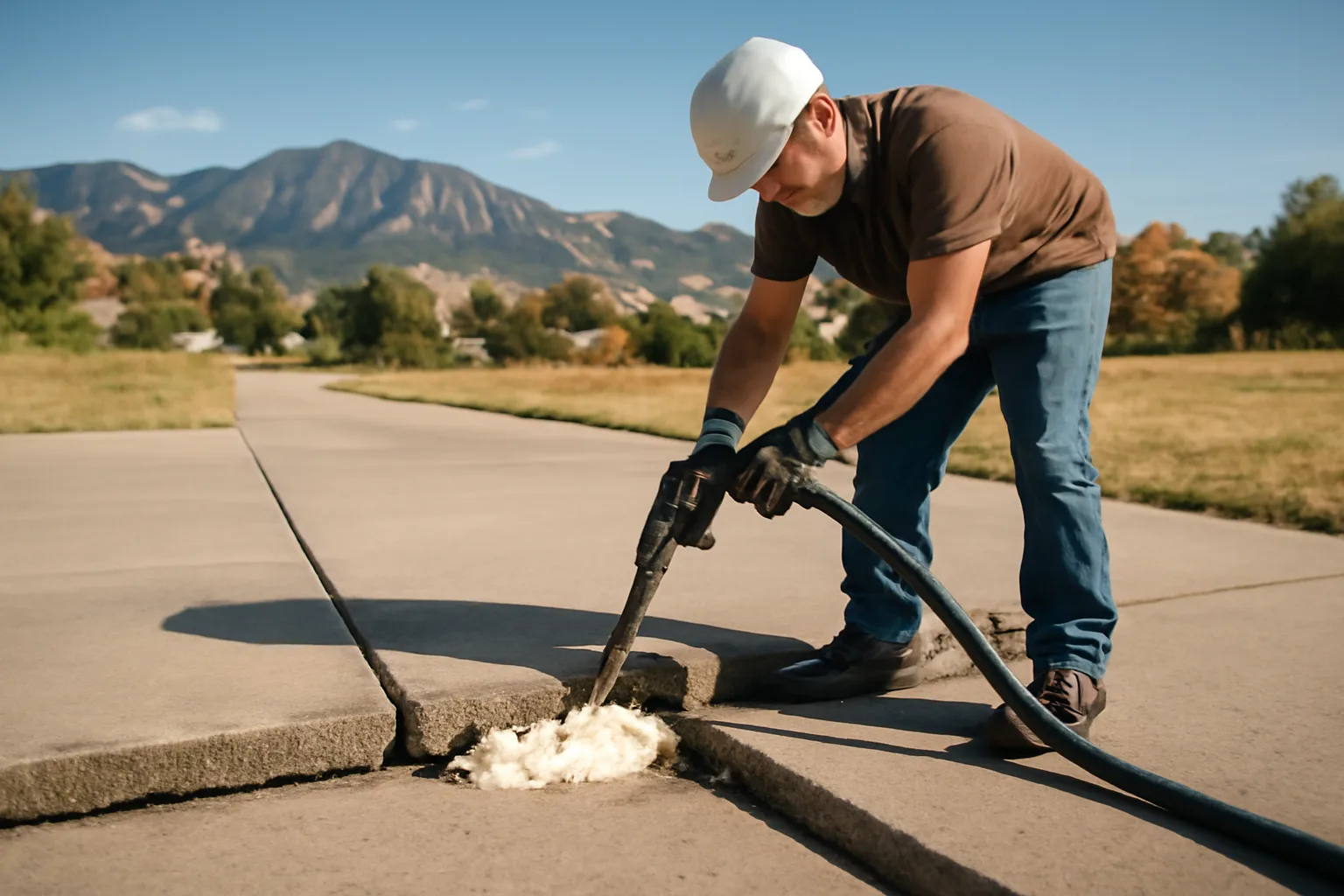
Slab lifting in Colorado typically costs $3, $10 per square foot for mudjacking and $5, $25 per square foot for polyurethane foam injection, depending on slab thickness, access, and how bad the settlement is. Most residential jobs finish in a few hours to one day. Colorado contractors generally need a state contractor registration through DORA plus local licenses. Confirm current fees with DORA.
How much does slab lift cost in Colorado?
The honest answer is a range, not a single number. Mudjacking (pumping a cement-soil slurry under a sunken slab) runs roughly $3, $10 per square foot in Colorado. Polyurethane foam injection runs roughly $5, $25 per square foot [1]. A standard two-car driveway is around 400 to 500 square feet, so a moderate job could land anywhere between $1,200 and $12,500 depending on the method and how bad the settlement is.
Colorado's Front Range cities are the most competitive markets. In Denver, Colorado Springs, Fort Collins, and Pueblo you're more likely to get four or five bids and talk prices down. In mountain towns or on the rural eastern plains you may see 15 to 25% higher rates, simply because the contractor is hauling equipment further and has less local competition.
Soil type matters a lot here. Colorado has heavy clay across much of the Front Range and expansive bentonite in parts of the Denver metro. Expansive soils shift, heave, and settle over and over, which means the root cause of a sunken slab sometimes doesn't fully go away after one lift. Ask any contractor bidding your job whether they expect the fix to be permanent or whether re-treatment is likely. Get that answer in writing.
Polyurethane costs more per square foot, but the material weighs far less than mudjacking slurry, which matters on slabs sitting over failing soils. It also cures in minutes rather than hours. On driveways or garage floors that need to be back in service fast, that time difference is real money. Neither method wins everywhere. The right call depends on soil conditions, slab thickness, and your budget.
For a rough pre-bid estimate, contractors quote most residential Colorado jobs between $500 for a small patio section and $8,000 to $15,000 for a long settled driveway or a set of failing interior floor sections. Pool decks and commercial slabs run higher.
See how Colorado pricing compares to neighboring states: slab lift cost in Arizona and slab lift cost in Idaho.
What factors push the price up or down in Colorado specifically?
Elevation is a real factor. Above roughly 6,500 feet, temperature swings are more extreme and freeze-thaw cycles hit harder. Mountain contractors work shorter usable seasons, so demand bunches up in late spring and summer, and peak-season pricing reflects that. If your property is in Summit, Eagle, or Pitkin County, expect to pay more than you would in the metro.
The Denver metro's expansive soils deserve their own mention. Bentonite-rich clay in the Denver Basin is notorious for moving foundations and slabs. Some contractors here won't guarantee results past two or three years because the soil keeps shifting. That's not dishonesty. It's the geology [2]. A geotechnical report, or a contractor with documented work in your specific neighborhood, is worth more than a cheap bid from someone who's never touched that soil type.
Permit costs are usually modest but real. Colorado municipalities vary. Denver, for example, may require a permit for slab work above certain thresholds. Confirm with Denver Community Planning and Development before starting any job [3]. A permit typically adds $50 to $300 to a residential project and protects you at resale.
Access difficulty changes prices fast. A slab tucked against a fence, under a deck, or reachable only through a gate that equipment can't clear costs more to lift. Some polyurethane crews work with a small drill and a handheld injection gun, but mudjacking equipment is bulky. Tight access adds time, and time adds money.
The number of holes and the patching quality matter too. Every lift method requires drilling. Mudjacking uses larger holes (1.5 to 2 inches) and more of them. Poly foam uses smaller holes (5/8 inch or so) but still needs patching. Ask what patching material a contractor uses and whether it's color-matched, especially on visible finished concrete.
Mudjacking vs polyurethane foam: which costs less over time in Colorado?
Up front, mudjacking almost always wins. The materials cost less and the equipment is simpler. For a large, flat, accessible surface like a municipal parking apron or a farm equipment pad, mudjacking's cost efficiency is hard to beat.
Colorado's expansive soils add a wrinkle. Mudjacking slurry is heavy. On soil already struggling to hold the existing slab, adding more mass can speed up future settlement. Polyurethane foam weighs roughly 2 to 4 pounds per cubic foot versus 100 pounds or more for mudjacking slurry [1]. On slabs over chronically wet or shifting soil, the lighter material may hold longer, which means fewer repeat treatments.
Nobody has clean, large-sample long-term data comparing the two methods in Colorado's Front Range clay. The closest the industry has is manufacturer data and small regional contractor studies, which carry obvious bias. The honest position: on stable, well-drained soil, mudjacking is a fine economical choice. On expansive clay or fill, polyurethane's longevity claim is plausible but not guaranteed.
If you're a contractor deciding which method to offer, weigh the entry cost. Poly equipment is expensive up front (injection systems and foam run $15,000 to $50,000 or more for a capable rig), but the per-job material cost is lower by volume and you can charge a higher price point. Mudjacking equipment is cheaper to buy. See startup cost comparisons in slab lift cost in Illinois and slab lift cost in Florida for regional equipment context.
Do you need a license to do slab lifting in Colorado?
Yes, in practice. Colorado regulates contractor licensing at both the state and local level, and concrete repair work including slab lifting generally falls under contractor work that requires proper credentials.
The main licensing body for construction trades is the Colorado Department of Regulatory Agencies (DORA), through its Division of Professions and Occupations. Colorado requires contractors to register through DORA and, in many cases, hold a specific license depending on the trade category [4]. Concrete lifting isn't always called out as its own license category, so most operators hold a general contractor license or a specialty registration.
Some municipalities add their own requirements. Denver, for instance, requires a City and County of Denver contractor license for most construction work, separate from any state credential [3]. Aurora, Colorado Springs, and Fort Collins each have their own licensing or registration rules. If you operate in multiple Front Range cities, you may need separate local licenses for each. Confirm the specific requirement with each city's building or licensing department before bidding work there.
Colorado also requires contractors to carry general liability insurance and, once you have employees, workers' compensation. The workers' comp requirement comes from Colorado Revised Statutes Title 8, which requires employers to cover employees from day one [5].
If you're a homeowner wondering whether a contractor lifting your slab needs a license, the short answer is yes, they should. Ask for the license number and verify it on DORA's contractor lookup before you sign anything [4].
The licensing map here is genuinely fragmented across state and local levels. Confirm current requirements directly with DORA and with the municipal licensing office for your work area. Requirements change, and this article can't substitute for that confirmation.
How long does slab lifting take in Colorado?
Most residential slab lifting jobs in Colorado take a few hours to one full day on-site. A settling front porch section might take 90 minutes. A long settled driveway, or an interior floor with multiple problem areas, can take a full day or spill into two days if access is complicated.
Polyurethane foam cures in minutes. The contractor injects the foam, it expands and lifts the slab, and you can typically walk or drive on the surface within 15 to 30 minutes of the last injection [1]. That speed is one of the real selling points for occupied homes and commercial properties that can't afford downtime.
Mudjacking slurry takes longer. Most contractors want 24 hours before you park a vehicle on a lifted driveway, and some want 48 to 72 hours in cold weather. Colorado's high-altitude cold and overnight temperature swings can stretch that cure window. A job done in September in Denver might set overnight fine. The same job in March could need more time.
If your project requires a permit, add processing time to the timeline. Denver's online permitting portal handles straightforward residential permits within a few business days, but confirm current processing times with Denver Community Planning and Development [3]. Complex or commercial jobs may need plan review, which takes longer.
From first call to finished job on a typical Colorado residential lift, the realistic window is one to two weeks: time to get bids, schedule the crew, pull any permit, and do the work. In peak season (late spring through summer), schedule further ahead. Crews fill up fast during the short high-altitude work season.
What does slab lifting cost per square foot in Colorado? (Comparison table)
Here's a clean breakdown of typical cost ranges by method and project type in Colorado. These figures reflect regional contractor pricing and published industry ranges. Actual bids will vary.
| Method | Typical cost per sq ft | Notes |
|---|---|---|
| Mudjacking | $3, $10 | Lower upfront, heavier material, longer cure |
| Polyurethane foam | $5, $25 | Faster cure, lighter material, higher upfront |
| Self-leveling overlay (not a lift) | $2, $7 | Cosmetic only, does not address void or settlement |
| Project type | Estimated total range (Colorado) |
|---|---|
| Small patio or step section (50 to 100 sq ft) | $200, $1,500 |
| Residential driveway (400 to 500 sq ft) | $1,200, $12,000 |
| Garage floor (400 to 600 sq ft) | $1,500, $15,000 |
| Pool deck (500 to 800 sq ft) | $2,000, $20,000 |
| Interior floor section (variable) | $500, $8,000+ |
These ranges reflect published industry estimates and regional pricing data [1]. Mountain Colorado jobs typically land in the upper half of each range because of access, elevation, and seasonality. Get at least three bids before committing, and ask each contractor to itemize material, labor, and patching separately so you can compare apples to apples.
For pricing in neighboring states, see slab lift cost in Arizona, slab lift cost in California, and slab lift cost in Idaho.
Is slab lifting cheaper than slab replacement in Colorado?
Almost always, yes. Full concrete replacement in Colorado runs roughly $6, $15 per square foot for residential work, including demolition and haul-off, new pour, and finishing [1]. On a 500-square-foot driveway, that's $3,000 to $7,500 at the low end, and it can reach $12,000 to $20,000 for complex projects.
Slab lifting at $3, $25 per square foot sounds close to replacement at the high end, but most jobs land well below the top of that range. A realistic poly foam job on a 400-square-foot driveway with moderate settlement might cost $4,000 to $6,000. Full replacement of the same driveway would likely run $6,000 to $10,000. The savings are real.
The catch: lifting doesn't fix a slab that's structurally shot. If there are large cracks, spalling, rebar corrosion, or freeze-thaw deterioration (common at Colorado elevations), lifting won't solve those problems. You might raise a slab that then keeps cracking and crumbling, wasting the lift entirely. Have any contractor assess slab condition, more than voidfill capacity, before lifting.
There's also a curb appeal question. Lifted slabs almost always show patched drill holes. On a highly visible front walk or entry area, some homeowners prefer the cleaner look of a fresh pour. That's a legitimate reason to replace rather than lift, even when lifting would work mechanically.
What insurance does a Colorado slab lift contractor need?
Two non-negotiable policies: general liability and workers' compensation (once you have employees).
General liability covers property damage or injury caused during your work. For a slab lifting contractor, coverage typically starts at $1 million per occurrence and $2 million aggregate, though larger commercial clients often require higher limits. The Colorado construction market expects this as a baseline.
Workers' compensation in Colorado is required by statute for any employer with one or more employees. Colorado Revised Statutes Section 8-40-202 defines who counts as an employee, and the definition is broad [5]. Even a single part-time worker triggers the requirement. Coverage comes through a licensed insurer or through Pinnacol Assurance, Colorado's state-designated insurer of last resort [6].
Some slab lift operators run as sole proprietors with no employees and use subcontractors. That doesn't automatically exempt you from workers' comp, and misclassifying workers as subcontractors is a real legal risk in Colorado. Confirm your classification with an employment attorney or the Colorado Division of Workers' Compensation before assuming you're exempt [9].
For liability coverage, a small slab lift operation can expect to pay $1,500 to $4,000 per year for a $1M/$2M general liability policy, depending on annual revenue and claims history. Workers' comp rates vary by payroll and experience modification factor. Confirm current rates with your insurer.
How does Colorado's freeze-thaw cycle affect slab lift pricing and results?
Colorado's climate is one of the biggest variables in both the cause of slab settlement and the cost of fixing it. The Front Range gets a lot of sunshine but also dramatic temperature swings, sometimes 40 or 50 degrees in a single day [7]. Those swings drive freeze-thaw cycles that stress concrete and the soil under it, over and over across a season.
When water in the soil beneath a slab freezes, it expands. When it thaws, the soil may not return to exactly where it was. Over seasons and years, this carves voids under slabs, which then settle when the support collapses. That's why settled concrete is so common on Colorado's Front Range, and it's why some lifts don't hold permanently on poorly draining sites.
For contractors, this means two things. Demand for slab lifting is predictable and seasonal: the phone rings most in spring, after freeze-thaw damage becomes visible, and crews book out fast. And jobs done while soils are still frozen (late winter) may shift again as the ground thaws, so most experienced contractors prefer to work after the soil has fully thawed and stabilized.
For homeowners, the takeaway is that drainage improvements alongside a slab lift often make the repair last longer. If water pools under or around your slab, a grading fix or French drain paired with the lift is worth the added cost. A lift alone on a site with chronic moisture may need to be repeated.
If you're starting a slab lift business in Colorado, what are your real first-year costs?
Starting a slab lift operation in Colorado means paying for equipment, licensing, insurance, and working capital before you collect a dollar. Here's a realistic breakdown.
Equipment is the biggest variable. A used mudjacking rig with pump and hose runs $15,000 to $40,000 for a trailer-mounted setup. New equipment can run $50,000 to $80,000. Polyurethane injection equipment starts around $15,000 for a basic system and climbs to $60,000+ for a heated, high-output rig capable of a full commercial job. If you're starting lean, used mudjacking equipment is the lower-risk entry point.
Licensing fees at the state level through DORA and any required local licenses vary by municipality. Budget $200 to $800 for state registration and application fees, plus separate costs for each city license if you operate across multiple municipalities [4]. Confirm current fee schedules directly with DORA and your city's licensing office.
Insurance, as described above, runs roughly $3,000 to $6,000 per year combined for liability and workers' comp on a small operation.
A vehicle (a truck and trailer that can haul your rig) adds $15,000 to $40,000 used, more new, if you don't already own one.
Materials for your first jobs are pay-as-you-go. Poly foam material runs roughly $1 to $2 per board foot from major manufacturers, and you'll typically apply several hundred to a few thousand board feet per job.
If you want a structured path through the paper side of setup, SlabLiftPath sells a one-time starter kit at /start covering the licensing paper path and bid framework for Colorado and other states. That's one option. The Colorado SBDC network also offers free business advising for new contractors, which is worth using [8].
First-year all-in cost for a legitimate one-person Colorado slab lift startup: figure $40,000 to $120,000, depending on whether you buy new or used equipment and how hard you market.
How do you find and vet a slab lift contractor in Colorado?
Start with DORA's license lookup to confirm any contractor is currently licensed in Colorado [4]. It takes two minutes and filters out unlicensed operators immediately.
Then ask three questions before you accept any bid. What's the warranty? Reputable contractors offer at least a one-year workmanship warranty, and some offer two to five years depending on soil. Get the terms in writing, not a verbal handshake. What exactly are you injecting? Ask for the material data sheet on whatever they're pumping under your slab. For polyurethane, ask whether it's a hydro-insensitive (closed-cell) foam, which holds up better in wet soils. Do you carry general liability insurance, and can I see the certificate? Any contractor who hesitates on that one is a skip.
The Better Business Bureau and Google Reviews are imperfect but useful as signal. Look for reviews that mention Colorado-specific conditions (expansive soil, freeze-thaw, mountain access) rather than generic praise. That local context tells you the contractor actually knows the regional variables.
Get at least three bids. The spread tells you a lot. If one bid is 50% below the others, ask why. Sometimes it's a real efficiency advantage. More often it's a corner cut on materials or a contractor who underdelivers and disappears. The middle bid on a three-bid set is usually the most defensible choice.
Frequently asked questions
Do you need a license for slab lift work in Colorado?
Yes. Colorado requires contractors doing concrete repair and slab lifting to hold a state registration through DORA and, in many municipalities, a separate local license. Denver, Colorado Springs, and Fort Collins each have their own licensing rules. Confirm the specific credentials required with DORA and your local city licensing office before taking any paid work.
How much does slab lift cost in Colorado per square foot?
Mudjacking runs roughly $3, $10 per square foot in Colorado; polyurethane foam injection runs roughly $5, $25 per square foot. Most residential jobs total $500 to $12,000 depending on method, area, and access. Mountain communities and areas with expansive clay tend to land in the upper end of those ranges. Get at least three bids before committing.
How long does slab lifting take in Colorado?
Most residential slab lift jobs take a few hours to one full day on-site. Polyurethane foam cures in 15 to 30 minutes, so you can use the surface the same day. Mudjacking slurry needs 24 to 48 hours before vehicle traffic, and Colorado's cold overnight temperatures can stretch that. From first call to finished job, plan on one to two weeks in peak season.
Is mudjacking or polyurethane foam better for Colorado's expansive clay soils?
Polyurethane foam's lighter weight (roughly 2 to 4 pounds per cubic foot vs 100+ for mudjacking slurry) is an advantage on expansive or failing soils because it adds less load. But neither method permanently fixes soil that keeps moving. On chronically shifting bentonite clay, drainage improvements alongside the lift often matter more than which foam or slurry you use. Ask your contractor which method they'd choose for your specific site.
Will Colorado's freeze-thaw cycles cause my lifted slab to settle again?
Possibly, yes. Colorado's repeated freeze-thaw cycles, especially on the Front Range, can cause continued soil movement under slabs. If water infiltration is the root cause, a lift alone may need repeating within a few years. Improving drainage around the slab (grading, French drains) gives the lift a much better chance of holding long-term. Ask your contractor to assess drainage before and after the job.
Is slab lifting cheaper than concrete replacement in Colorado?
Almost always. Full concrete replacement in Colorado runs roughly $6, $15 per square foot including demolition and new pour. Slab lifting runs $3, $25 per square foot but most jobs land well below the high end. On a 400-square-foot driveway, lifting might cost $3,000 to $6,000 while replacement runs $6,000 to $12,000. The exception is a structurally deteriorated slab, where lifting wastes money and replacement is the right call.
What insurance does a slab lift contractor in Colorado need?
General liability insurance (typically $1M per occurrence minimum) and workers' compensation once you have one or more employees. Workers' comp is required under Colorado Revised Statutes Title 8 from the first employee. Operating without it exposes you to fines and personal liability. Some sole proprietors with no employees may be exempt, but confirm that classification with the Colorado Division of Workers' Compensation.
Do Colorado slab lift jobs require a permit?
It depends on your municipality. Some Colorado cities require a permit for slab lifting above certain project sizes; others don't. Denver requires permits for most concrete work and runs an online permitting portal. Confirm requirements with your city's building department before starting. A permit typically adds $50 to $300 to a residential project but protects you legally and at resale.
How do I verify a slab lift contractor's license in Colorado?
Use DORA's contractor license lookup. Enter the contractor's name or license number to confirm the license is active and in good standing. Also ask for their certificate of general liability insurance before signing any contract. Both steps take a few minutes and filter out most bad operators.
What is the typical startup cost for a slab lift business in Colorado?
Realistically $40,000 to $120,000 for a one-person operation in year one. Equipment is the biggest item: used mudjacking rigs start around $15,000 to $40,000; polyurethane systems start around $15,000 to $60,000+. Add $3,000 to $6,000 for insurance, $200 to $800 for state and local licensing fees, and working capital for materials, fuel, and marketing. Equipment condition and whether you already own a truck move that number a lot.
Can a homeowner do their own slab lifting in Colorado?
DIY polyurethane products exist for small repairs, but they're not the same as professional-grade injection systems. For anything beyond a small step or hairline crack repair, professional equipment delivers meaningfully better results. On a commercial property, or for work you plan to sell the home with, unlicensed work can create liability and disclosure issues. For significant settlement, hire a licensed contractor.
How does slab lift pricing differ between Denver and mountain towns in Colorado?
Denver and Front Range cities have competitive contractor markets and easier logistics, which keeps prices closer to the middle of the range. Mountain towns like Breckenridge, Aspen, or Glenwood Springs have fewer contractors, shorter work seasons, and higher travel costs. Expect mountain pricing to run 15 to 25% higher than equivalent Front Range jobs, with summer being peak season and the least likely time to negotiate.
How long does a slab lift repair last in Colorado?
On well-drained, stable soil, a professional slab lift can last 5 to 10 years or more. On Colorado's expansive clay or in areas with chronic moisture, 3 to 5 years is more realistic before some re-treatment. No contractor can guarantee a permanent result on active or poorly drained soil. Ask about warranty terms and what conditions void them before signing.
What questions should I ask before hiring a Colorado slab lift contractor?
Ask: Is your state contractor registration current with DORA? Do you carry general liability insurance and workers' comp? What exactly are you injecting, and can I see the material data sheet? What warranty do you offer, and what voids it? Will you assess drainage as part of the job? Do you recommend lifting or replacement for my specific slab condition? Get all answers in writing.
Sources
- Angi (formerly Angie's List), Slab Jacking Cost Guide: Mudjacking costs $3, $10 per square foot; polyurethane foam injection costs $5, $25 per square foot; polyurethane foam weighs roughly 2 to 4 pounds per cubic foot vs 100+ for mudjacking slurry; concrete replacement runs $6, $15 per square foot
- Colorado Geological Survey, Swelling Soils in Colorado: Bentonite-rich clay soils in the Denver Basin cause repeated heave and settlement of structures including concrete slabs
- City and County of Denver, Community Planning and Development: Denver requires permits for concrete repair work and contractor licensing for most construction activity within the city and county
- Colorado Department of Regulatory Agencies (DORA), Division of Professions and Occupations: Colorado requires contractors to register and maintain active licensure through DORA; license status can be verified through DORA's lookup
- Colorado Revised Statutes, Title 8, Article 40, Section 202 (Workers' Compensation): Colorado requires employers with one or more employees to carry workers' compensation insurance beginning with the first employee; the definition of employee is broad under Colorado law
- Pinnacol Assurance, Colorado Workers' Compensation: Pinnacol Assurance is Colorado's state-designated insurer of last resort for workers' compensation coverage
- NOAA National Centers for Environmental Information, Climate at a Glance: Colorado's Front Range experiences significant daily and seasonal temperature swings contributing to freeze-thaw cycles that stress concrete and subsurface soils
- Colorado Small Business Development Center Network: Colorado SBDC offers free business advising to new and existing small businesses including contractors
- Colorado Division of Workers' Compensation: The Colorado Division of Workers' Compensation governs employee classification rules and employer compliance for workers' comp coverage