Last updated 2026-08-20
TL;DR
Slab lift is raising settled concrete by injecting grout or expanding foam under the slab until it returns toward grade. Start by confirming the license class with your state board, forming an entity, applying for a free IRS EIN if you need one, and matching a pump to the method. Skip national no-license myths. Confirm exemptions with the board that can fine you.
What is slab lift?
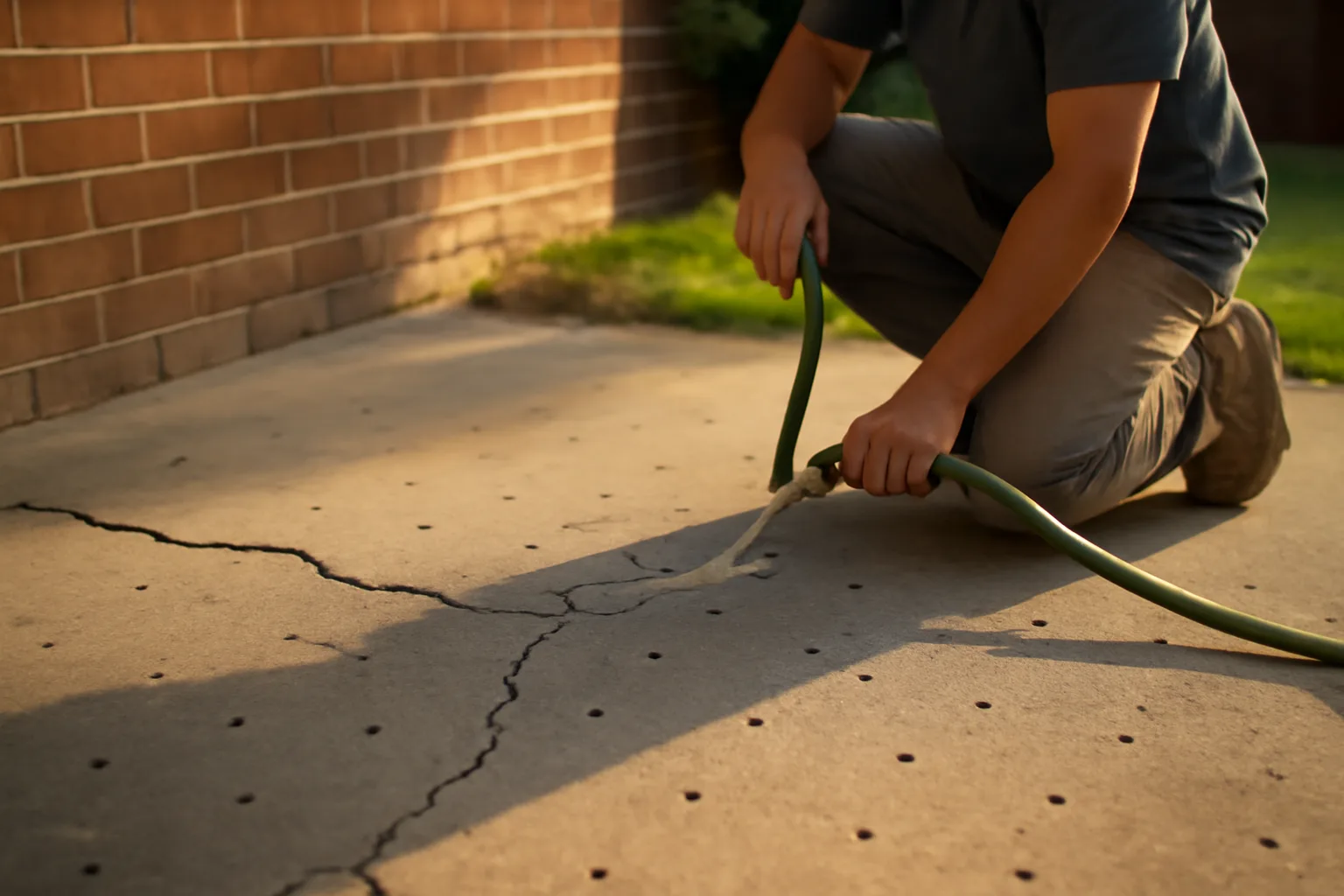
Slab lift is raising a settled concrete slab by injecting material under it until the panel moves back toward its original grade. You fill voids and apply pressure. You do not tear the slab out and pour a new one.
People use a pile of names for the same family of work. Mudjacking. Slabjacking. Foam jacking. Poly lifting. Pressure grouting. If the slab stays in place and something goes under it to lift it, you are doing slab lift.
Settled slabs show up as trip edges on a sidewalk, a patio that holds a pond after rain, a garage floor that dropped at the control joint, or a warehouse aisle that is no longer flat. The concrete can be sound. The support under it is not.
Why it dropped decides whether a lift will hold. A downspout that washed fines out from under the edge. Poor compaction when the pad was poured. A leaking lateral. Roots that dried a clay. Freeze and thaw. Expansive clays that swell and shrink with moisture. The U.S. Geological Survey mapped swelling clays across the lower 48 on Map I-1940, and a large share of the country sits on soils that can move with water [12].
A lift does not fix a broken sewer. It does not make a shattered panel new. If the slab is broken into loose pieces, or if the load path of a building is involved, you stop. Flatwork on grade is one job. A house foundation is another.
I treat slab lift as a repair of support, not a cosmetic grind. Grind only the trip edge and the void is still down there. Water keeps moving soil. The edge comes back.
How do you start slab lift?
You start slab lift by confirming the contractor class with your state board, forming a legal entity, getting insurance, applying for a free IRS EIN if you need one, and matching a pump to mudjack or foam before you take money. That is the whole spine. Marketing comes last.
Write the board name down. Not a Facebook group. The agency that can cite you. California funnels a lot of this work toward a C-8 concrete class, and unlicensed contracting there is a misdemeanor under Business and Professions Code 7028 [8][9]. Florida runs contractors through Chapter 489 [10]. Other states have no statewide contractor license and push the question to cities or dollar thresholds. Confirm the current rule. Do not copy a national script.
Form the entity your accountant actually wants. Then get the EIN. The IRS page is blunt: "Applying for an EIN is a free service offered by the Internal Revenue Service. Beware of websites on the Internet that charge for this free service." [7]
Buy general liability before the first hole. If you will have employees, workers compensation is not optional in most states. Commercial auto on the truck that hauls the rig is its own policy. A weekend hobby policy on a personal pickup is a bad bet.
Pick a method and a pump you can run well. A cheap used slurry pump can put you on exterior sidewalks. A dedicated foam rig is a different capital stack. Manufacturer training is worth the trip. A new CRM is not.
Your first jobs should be simple exterior flatwork with a clear cause, not a house that is still moving. Photograph elevations. Fix the water path or you will be back. If you want a state-by-state paper path, start with how to start slab lift in California or how to start in Arizona and treat those pages as checklists, not permission.
Do you need a contractor license for slab lift work?
Often yes, and the only honest answer is the class and dollar threshold your state board publishes this year. There is no single federal slab lift license. Local permit offices can still stop a job even when the state is quiet.
California is the example people under-read. Contracting without a license is a misdemeanor unless a stated exemption applies, and the statute says it in plain language: "It is a misdemeanor for a person to engage in the business of, or act in the capacity of, a contractor within this state without having a license therefor, unless the person is particularly exempted from the provisions of this chapter." [8] CSLB's Description of Classifications is the document you read for C-8 concrete scope, then you confirm with the board whether your exact mix of injection, sawing, and replacement sits inside that class [9].
Florida requires certification or registration for contracting under Chapter 489, with listed exemptions you should read yourself rather than take from a sales call [10]. Some states leave specialty concrete work to municipal licenses or to a dollar cap. A few have almost no statewide contractor scheme. That is not the same as "anyone can advertise lift work."
I would not hang a truck wrap until I have the class name in writing. If a helper says "it's just foam, not construction," ignore them. You are altering a structure and taking payment.
Use the state pages as a starting map, then call the board. Slab lift license in California, Arizona license notes, and what Colorado actually asks are the right next clicks if those are your markets. Confirm fees and exam outlines on the live board site. I will not invent a current fee or wait time.
Is slab lift the same as mudjacking or foam jacking?
Yes in the family, no in the material. Slab lift is the job. Mudjacking and foam jacking are two ways to do it. Both inject through drilled ports. Both can raise a panel. They fail for the same reason when water keeps cutting soil out from under the slab.
Mudjacking pumps a cementitious slurry. Holes are larger. The fill is heavy. It can make sense on thick exterior slabs and big voids if you can live with the patches. Foam uses a two-component polyurethane that expands. Ports are smaller. Cure to light load is often measured in minutes, not a long wet set. Interior floors and tight access are where foam earns its keep.
Sales decks love to call one of them permanent. Soil is not permanent. If the downspout still dumps at the corner, both methods can settle again. I spend more time on drainage than on brand names.
| Method | What you pump | Typical setting | Where I use it |
|---|---|---|---|
| Cementitious mudjack | Sand-cement slurry | Hours, weather matters | Thick exterior slabs, large voids, budget work |
| Polyurethane foam | Two-component expanding foam | Often minutes to light load | Interiors, tight access, lighter fill |
Holes, mix, and lift sequence come from the material supplier and, on anything structural, from the engineer of record. Do not copy a YouTube grid and call it a spec.
Foam chemistry is not paint. Diisocyanates are a known asthma hazard. NIOSH has been blunt about that for decades [5]. EPA also manages MDI and related diisocyanates under TSCA risk rules [6]. Read the SDS before you buy a drum.
What equipment do you actually need to start?
You need a way to measure elevation, a way to drill ports, a pump matched to slurry or foam, hoses you trust, PPE, and a truck that is insured to haul it. That is the starter kit. Everything else is optional until the work demands it.
A rotary laser or a good digital level is not a luxury. Guessing lift with your boot is how you crown a patio and lose the callback. A hammer drill or core rig sized to the method comes next. Then the pump. Used slurry units show up across a wide street-price band. Dedicated foam proportioners are a different check. I will not publish a fake "average rig price." Call two dealers the week you buy. Prices move.
I would not finance an $80,000 foam plant in month one unless I already have contracted work and a place to store chemicals. Starting on exterior mudjack, or running as a trained sub on someone else's foam rig, is a saner first year for a lot of people.
Skip the wrap, the drone, and the custom app. Buy extra hose, extra PPE, and a wet-vac. Keep SDS sheets in the cab, not in a junk drawer [3].
Lift near a building and OSHA's concrete rule applies: you do not place construction loads on a structure unless a qualified person says it can take them [13]. A pump and a slab that is already cracked is not a toy.
What safety rules hit a slab lift crew first?
Silica from drilling, isocyanates from foam, and basic PPE are the first three rules that can shut you down. OSHA sets the construction silica PEL at 50 micrograms per cubic meter as an 8-hour TWA [1]. The action level is 25 micrograms per cubic meter [1]. Those are not suggestions.
Drilling concrete makes respirable dust. OSHA's construction silica standard is 29 CFR 1926.1153, and it says: "The employer shall ensure that no employee is exposed to an airborne concentration of respirable crystalline silica in excess of 50 μg/m3, calculated as an 8-hour TWA." [1] Table 1 in that rule is how most small crews stay legal if they follow the listed controls. A shop vac with a HEPA filter and water on the bit beats a speech about toughness. OSHA's silica fact sheet (OSHA 3681) is the short version you can hand a new hire [15].
Foam work adds diisocyanates. NIOSH Alert 96-111 exists because people get asthma and, in rare cases, worse [5]. Gloves, eye protection, and the respirator the SDS names are the job. "I only do a few shots a week" is not a control method.
Hazard communication still applies. Labels, SDS, and training are required under 29 CFR 1910.1200 [3]. PPE rules for construction sit in 1926.95 [4]. None of this is exotic. Crews skip it because the driveway looks easy.
I would rather lose a half day setting up dust control than explain a silica citation. If you cannot name your silica method and your foam respirator cartridge, you are not ready for a paid hole.
How much does it cost to start a slab lift business?
It costs whatever your state license path, insurance binder, entity filing, and first pump add up to, and that spread is wide on purpose. Nobody publishes a clean national startup total for this trade. Anyone who gives you one number is selling something.
Entity filing is a state fee you confirm with the secretary of state. An EIN from the IRS is $0 if you use the IRS site [7]. License application fees, exam fees, and bond amounts change and are board-specific. I will not invent them. Pull the live fee page.
Insurance is usually the first real check after the rig. General liability for construction is priced on revenue, claims, and whether you do residential interiors. Workers compensation, if you have employees, is its own bill. Commercial auto is separate. Get quotes. Do not use a number you saw on a forum in 2019.
Equipment is the swing factor. A serviceable used slurry setup can be a fraction of a new foam plant. Chemical startup stock for foam is another line, and drum pricing moves with the petrochemical market. Training from the foam supplier is money I would spend. A custom trailer wrap in month one is money I would not.
SBA's register-your-business walkthrough is a decent federal checklist for entity, tax ID, and licenses, but it will not name your concrete class [11]. Pair it with the board, not with a guru PDF.
How do you bid slab lift by the square foot?
You bid the lift, the cause, and the risk, not a national per-foot myth. Square footage is a starting unit. It is a bad sole unit when one patio has a washed-out corner and the next has a live plumbing leak.
Measure the panel. Shoot elevations. Find the water. Note thickness if you can see an edge. Note access, indoor vs outdoor, and whether a vehicle or rack load comes back the same day. Then price mobilization, ports, material, lift time, patching, and a contingency for a slab that will not move.
I do not use a single published "industry average" per square foot. Those consumer sites mix mudjack, foam, and full replacement, and they go stale. Your number has to cover your chemical or slurry cost, your labor, your insurance, and a callback reserve. If a competitor is 40 percent cheaper, they are often skipping one of those.
Refuse jobs where the slab is rubble, the building is still moving, or the owner will not fix the downspout. A cheap lift on a wet clay corner is how you fund someone else's lawsuit.
If you want a worksheet for mix and bid-per-sqft math, SlabLiftPath sells a $149 one-time Mix + Bid-per-Sqft Kit at /start. You can run this entire trade without it. A laser and honest notes beat a pretty spreadsheet you do not trust.
What paper do you file before the first check?
You file the entity, the EIN if you need one, the contractor application your board requires, local business tax or permit registrations, and your insurance certificates. Then you keep job records that would make sense to a claims adjuster.
Sole proprietors who operate under their own legal name may not need an EIN. The moment you have a partnership, an LLC taxed as a corporation, or employees, get the number. Apply on the IRS site. It is free [7]. Sole props still report on Schedule C with Form 1040 [14].
State contractor paper is the slow step. Applications, experience affidavits, exams, and bonds are board work. Processing times change. I will not quote a current wait. Confirm with the board the week you apply. Local building departments may still want a permit for public-sidewalk work or for anything tied to a building.
Keep before-and-after elevation shots, a note on the suspected cause, the mix or foam batch, and the SDS for what you pumped [3]. If a homeowner later says you cracked the slab, that folder is the job.
Sales tax on repair labor is a state question. Do not guess. Ask the state revenue department, not a competitor.
When should you refuse a slab lift job?
Refuse when the slab is structurally failed, when the support problem is still active, or when you cannot name who is responsible if the panel does not move. Walking away is cheaper than a free redo plus a lawyer.
Shattered slabs with loose pieces do not lift as a unit. You are making gravel. A house that is still dropping on expansive clay after a drought is not a patio. Get an engineer or send the owner to one. I do not "see how it goes" on a foundation.
Active leaks are a no. Lift, then the water cuts a new void. Tree stumps that are still rotting under a slab are a no until someone deals with the organic material. Public sidewalks with city specs you have not read are a no until you have the spec.
OSHA's concrete load rule is a useful pause even on private work: do not put construction loads on a structure unless a qualified person says it can take them [13]. Your pump is a load. So is a truck on a garage slab you just drilled.
If the owner wants a warranty that ignores drainage, decline. You can warrant workmanship. You cannot warrant the weather and a clogged gutter.
What does first-year slab lift work look like day to day?
First-year work is a lot of small exterior slabs, a few indoor garage floors, and more time on estimates that die than you expect. You drill, inject, watch a laser, patch ports, and then spend the afternoon chasing a downspout the owner promised to move.
Mornings start with a call to confirm access. You load drums or bags, water, PPE, and the laser. On site you mark high and low points, look for the wet corner, and decide if the story you were sold matches the dirt. Then you drill. Then you lift in short shots. Fast lifts crack panels. Slow is the point.
Afternoons are patches, photos, and invoices. Evenings are callbacks about a door that still rubs because the owner also has a swollen wood jamb. That is the job.
I would stay off multi-story structural work and municipal bid lists until the crew can hit grade on a patio without drama. Simple work done clean beats a hero job that moves a column.
Track silica controls and foam PPE like they are billable. A first-year citation costs more than a HEPA vac [1][15]. Read NIOSH 96-111 before you let a new helper "just hold the gun" on foam [5].
Which state rules change the whole plan?
State contractor law, local permits, and soil climate change the plan more than any pump brand. A crew that is legal in one state can be advertising a misdemeanor in another.
California's license culture is strict, and C-8 is the classification most people start with for concrete flatwork [8][9]. Read how to start slab lift in California before you assume a handy-person exemption covers injection. Florida's Chapter 489 is its own maze [10]. Colorado, Arizona, Alabama, and Connecticut each split the question differently across state boards and cities. Use Colorado start steps, Alabama start steps, and Connecticut start steps as maps, then confirm every fee and class on the live board page.
Expansive clay country (see USGS I-1940) means more seasonal movement and more honest talk about what a lift cannot hold [12]. Freeze-thaw country means more joint work and more spring callbacks. Coastal fill soils mean washout. The chemistry of the foam does not care. The dirt does.
SlabLiftPath is an independent publisher, not a law firm and not a service company. Nothing here is a license, an approval, or a timing promise. Confirm the class, the bond, and the current fee with the board that will hear the complaint.
Frequently asked questions
What is slab lift?
Slab lift is raising a settled concrete slab by injecting grout or expanding polyurethane under it until the panel returns toward grade. The slab stays in place. You are restoring support, not pouring a new pad. It will not fix a live plumbing leak or a shattered panel. Those need a different repair.
How do you start slab lift?
Confirm the contractor class with your state board, form an entity, apply for a free IRS EIN if you need one, bind liability insurance, and match a pump to mudjack or foam. Take simple exterior jobs first. Do not copy a national no-license claim. Confirm exemptions and dollar caps with the board that can fine you.
Is slab lift the same as mudjacking?
Mudjacking is one slab lift method. You pump a cementitious slurry through larger holes. Foam jacking is the other common method, using expanding polyurethane through smaller ports. Both are slab lift. Both fail if water keeps removing soil. Choose the method for access, load, and the void, not for a sales slogan.
Do I need an engineer for slab lift?
For ordinary exterior flatwork with a clear washout, many jobs run without a design engineer. For house foundations, racks, vehicle lifts, or any slab that is part of a building load path, get an engineer. OSHA also expects a qualified person before you place construction loads on a concrete structure. When in doubt, stop.
What license class covers slab lift?
It depends on the state. California readers often start with CSLB's C-8 concrete classification and then confirm injection work with the board. Florida runs contractors through Chapter 489. Other states use municipal licenses or dollar thresholds. There is no federal slab lift card. Read the board's classification text, not a forum post.
Can I lift a garage floor or interior slab?
Yes, if the panel is intact enough to move as a unit and you can control dust and chemicals indoors. Foam is often the practical indoor choice because ports are smaller and cure is faster. You still need silica controls when you drill and the respirator the foam SDS names. Vehicle loads after the lift are a separate check.
How soon can someone drive on a lifted slab?
Foam often reaches a light-load state in minutes, which is why crews like it for driveways. Cementitious mudjack needs more set time and depends on weather and mix. I would not publish a single hour count for every product. Use the supplier's current technical sheet and keep traffic off until that sheet says so.
Is foam slab lift permanent?
No honest crew should call soil permanent. Foam can last a long time when the void is filled and water is redirected. It can settle again if a downspout, leak, or expansive clay keeps moving the support. Warrant workmanship. Do not warrant the weather or a gutter the owner will not fix.
Do I need EPA approval to pump polyurethane foam?
You do not get a special EPA "slab lift permit" for ordinary contracting. You do have to handle diisocyanates as the SDS and OSHA hazard communication rules require. EPA has TSCA risk-management work on MDI and related chemicals. Read the current EPA page and the product SDS. Do not invent a registration number you do not have.
Can I start as a one-truck mobile crew?
Yes, and that is how a lot of first-year operators start. You still need the license your state requires, insurance, and a pump you can run. Stay on simple exterior slabs until your elevations are boringly consistent. A one-truck crew that documents cause and drainage will beat a big rig that sells permanence.
When should I replace the slab instead of lifting it?
Replace when the slab is shattered, too thin to survive a lift, heaved in a way injection cannot correct, or tied into a failed foundation. Lift when the concrete is sound and the problem is lost support. If you cannot tell which you have, do not bid a lift. Send it to an engineer or a replacement crew.
What insurance does a slab lift startup need?
Start with general liability written for construction, commercial auto on the truck, and workers compensation if you have employees. Inland marine or equipment coverage matters once the pump is worth stealing. A personal auto policy is the wrong tool. Get quotes. I will not invent a premium.
Sources
- OSHA 29 CFR 1926.1153 Respirable crystalline silica: Construction employers must keep respirable crystalline silica at or below 50 μg/m3 as an 8-hour TWA; action level is 25 μg/m3.
- OSHA 29 CFR 1910.1200 Hazard Communication: Employers must maintain labels, safety data sheets, and employee information and training on hazardous chemicals.
- OSHA 29 CFR 1926.95 Criteria for personal protective equipment: Construction employers must provide and require PPE wherever hazards are encountered in a manner capable of causing injury or impairment.
- NIOSH Alert 96-111 Preventing Asthma and Death from Diisocyanate Exposure: Diisocyanates used in polyurethane foams are a recognized cause of occupational asthma and require exposure controls.
- EPA Risk Management for MDI and TDI under TSCA: EPA addresses methylene diphenyl diisocyanate (MDI) and related diisocyanates under TSCA risk-management work.
- IRS Apply for an Employer Identification Number (EIN) Online: Applying for an EIN is a free IRS service; the IRS warns that other websites charge for that free service.
- California Business and Professions Code section 7028: Acting as a contractor in California without a license is a misdemeanor unless a statutory exemption applies.
- CSLB Description of Classifications (C-8 Concrete): CSLB publishes official classification language for the C-8 Concrete Contractor used to scope concrete flatwork.
- Florida Statutes section 489.113 (2023): Florida Chapter 489 requires certification or registration to engage in contracting, subject to listed statutory rules and exemptions.
- U.S. Small Business Administration, Register your business: SBA outlines federal and state registration steps including tax ID and licenses for a new business.
- OSHA 29 CFR 1926.701 Concrete and masonry construction, general requirements: No construction loads may be placed on a concrete structure unless a qualified person determines it can support the loads.
- IRS About Schedule C (Form 1040): Sole proprietors report business profit or loss on Schedule C with Form 1040.
- OSHA Fact Sheet OSHA 3681, OSHA's Crystalline Silica Rule for Construction: OSHA's construction silica fact sheet restates the 50 μg/m3 PEL and points employers to Table 1 exposure-control methods.