Last updated 2026-08-20
TL;DR
Slab lift raises a sunken concrete slab by pumping grout or expanding polyurethane under it. You start by confirming which contractor board owns the work in your state, posting the statutory bond, buying insurance, and setting chemical and silica rules before the first hole. There is no national license. Confirm fees and class names with the board that will fine you.
What is slab lift?
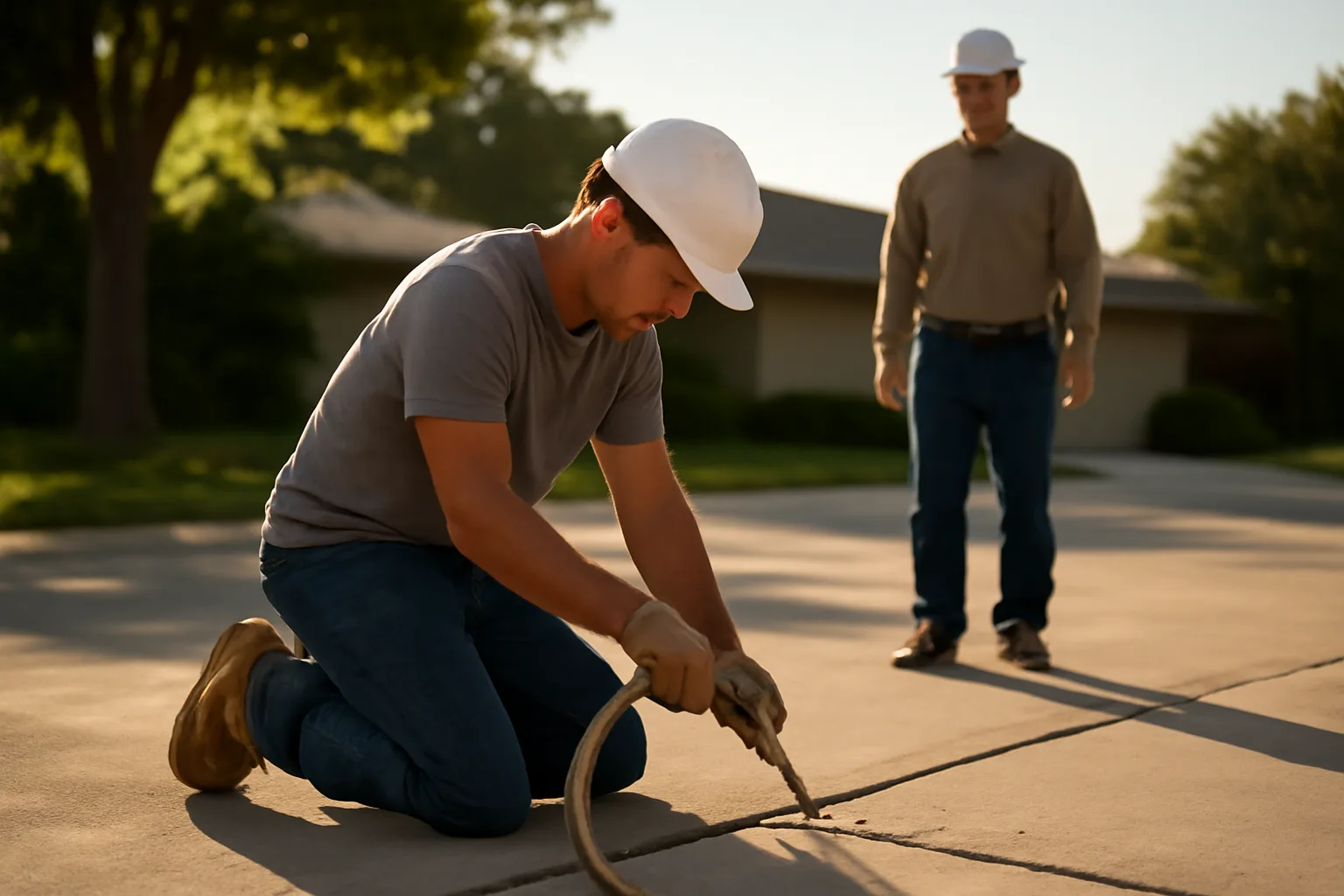
Slab lift raises a sunken concrete slab by pumping material under it until the slab comes back toward the elevation you want. Crews drill holes, inject cement grout or expanding polyurethane, then patch. The slab moves because the material fills voids and then pushes up.
It is a repair of an existing slab. It is not a new pour. It is not a deep foundation system. Driveways, sidewalks, garage floors, patios, and some warehouse floors are the usual private-property jobs. Highway crews have used the same idea on concrete pavement for decades. The Federal Highway Administration publishes slabjacking as a pavement repair method, not as a gadget. [14]
Foam jobs often use holes around 5/8 inch. Mudjacking holes run larger, often 1 to 2 inches. I won't pretend every crew uses one pattern. Slab thickness, soil, and void size change the shot plan. There is no clean public dataset for the average residential lift. Highway manuals are the closest official writeups you can actually read.
Foam expands as it reacts. Cement grout does not. That single difference changes the pump, the chemical rules, and how picky an insurer gets. Both still read as an alteration or repair of a structure once a contractor statute is in play.
If the slab is rubble, walk. You can't float loose pieces and call it a lift.
How do you start slab lift?
Start by confirming the contractor board that owns the work in your state. Then form the business, get the license or registration that board actually issues, post the bond, buy insurance, and only then spend real money on a pump. Do not buy the rig first.
There is no federal slab lift card. OSHA does not license contractors. EPA does not either. The state board (or a city, in some places) is the one that can shut a job down. California's Business and Professions Code section 7026 says a contractor is any person who "undertakes to or offers to undertake to, or purports to have the capacity to undertake to, or submits a bid to, or does himself or herself or by or through others, construct, alter, repair, add to, subtract from, improve" a structure or project. [1] That sentence is why a paid driveway lift is usually contracting.
Form an LLC if that fits how you want to hold risk. Get an EIN. Open a bank account that is not your rent account. IRS Publication 334 is the small-business tax guide I would actually read, because it is written for people who invoice jobs and buy materials. [13]
Then call the board. California and Arizona license. Florida licenses a lot of this work under Chapter 489. Washington registers contractors under RCW 18.27.020 before you advertise or bid. [7] Texas has no statewide general contractor license, which is a real difference if you moved from the West Coast.
Train on the chemical after the paper is moving. Buy insurance before the first hole. That order is dull on purpose.
Do you need a contractor license for slab lift?
Most of the time, yes. If you take money to repair someone else's concrete and your state licenses or registers that work, treat slab lift as construction repair until the board tells you otherwise in writing. Owner-builder and tiny-dollar exceptions exist, but they are narrower than internet posts claim.
California readers usually look at the C-8 Concrete class. CSLB's Description of Classifications is the document that states what a C-8 may do, and it includes concrete work and repair. [3] You still need a qualifier who can prove the experience the board asks for. I won't invent the application fee. Confirm it on the board fee page the week you file.
Florida defines contractor categories in section 489.105 and requires certification or registration in section 489.113 before you engage in the contracting business. [4] [5] Whether a foam lift sits under concrete or a general contractor class is a board question. Ask them. Save the email.
Arizona's ARS 32-1151 makes it unlawful to act in the capacity of a contractor without the license. [6] Washington's RCW 18.27.020 makes it unlawful to engage in the business of contracting without registration. [7] Georgia uses a state residential or general contractor license above statutory project amounts, then piles local business licenses on top. Confirm both layers.
I would not run ads in a license state until the number is issued. Bidding dark is how you give the deposit back and still meet the investigator.
| State | Paper you actually file | First statute to read |
|---|---|---|
| California | CSLB contractor license | Bus. & Prof. Code 7026 |
| Florida | CILB certify or register | Fla. Stat. 489.113 |
| Arizona | ROC contractor license | ARS 32-1151 |
| Washington | L&I contractor registration | RCW 18.27.020 |
| Texas | no statewide GC license | city or county rules |
If you want the local packet, start with the notes on the slab lift board in california, the slab lift board in arizona, and the slab lift board in florida.
What insurance do you need before the first job?
You need general liability that actually names concrete lifting or concrete repair, plus whatever the board or a hiring GC wants on the certificate. Add workers' compensation if you have employees, and auto on the truck that carries chemical. That is the real stack. An umbrella can wait until you have revenue.
I won't invent premium numbers. They move with claims, county, and whether you disclose isocyanates. Tell the underwriter you inject polyurethane. Hide it, and the exclusion shows up after a claim.
Some states tie the license to a bond, which is not insurance. California sets the contractor license bond at $25,000 in Business and Professions Code 7071.6. [2] Washington sets the registration bond in RCW 18.27.040 at twelve thousand dollars for a general contractor and six thousand dollars for a specialty contractor. [8] Read the live section before you buy, because legislatures do amend face amounts.
A bond pays certain claimants. It does not pay your defense the way a GL policy does. Buy both if the board asks for a bond.
Ask your broker if the GL carries a total pollution exclusion. Many do. Foam or grout that migrates is the exact claim people skip coverage on. If you have no employees, confirm whether your state still wants a workers' comp exemption filing. California and several others do.
What equipment and chemicals trigger extra rules?
The foam is the trigger. Two-component polyurethane systems use methylene diphenyl diisocyanate (MDI) or a related isocyanate on the A-side. NIOSH's alert on diisocyanates documents asthma and other respiratory harm in workers who handle these materials, including MDI used in polyurethane systems. [12]
That means Hazard Communication under 29 CFR 1910.1200. You need SDSs on site, labels, and training. [10] If vapor or aerosol is reasonably expected, read the Respiratory Protection Standard at 29 CFR 1910.134 and build a written program around the supplier SDS. I am not writing that program for you.
Drilling and grinding the patch puts respirable crystalline silica in the air. OSHA sets the respirable crystalline silica PEL at 50 μg/m3 as an 8-hour TWA in 29 CFR 1926.1153. The rule text says: "The employer shall ensure that no employee is exposed to an airborne concentration of respirable crystalline silica in excess of 50 μg/m3, calculated as an 8-hour TWA." [9]
Table 1 in that standard lists tasks and controls. If your drill-and-patch method fits a row, follow it. If it does not, you are in the assessment column. A cheap dust mask is not a program.
Mudjacking grout is messy and alkaline. Eye wash and gloves are not optional. The chemical paper is lighter than foam, but the silica rules do not go away. Compressed air, heated hoses, and proportioners bring ordinary machine and electrical rules. Lockout still applies when you open a pump.
How much does first-year paper and setup cost?
I won't invent a national startup cost. Anyone who gives you one number is selling a course. The honest range is wide because license class, bond, insurance, and whether you buy a used proportioner or a new truck-mounted rig dominate the total.
Paper itself is cheap next to the rig. Statutory bond face amounts in the states above run from the low thousands up to the $25,000 California floor in BPC 7071.6. [2] You pay a surety premium for that face amount, not the full face, unless you post cash. Confirm the current premium with a surety. License application fees change. Confirm them on the board fee page the week you apply.
Insurance will likely outrun the license fee in year one if you tell the truth about chemical and concrete work. Again, no fake premium here.
Equipment is where people light money on fire. A used mudjacking pump and a mixer can be a small trailer package. A foam proportioner, heated hoses, generator, and transfer pumps is a different budget. I would rent or sub the first few foam jobs if the board and the supplier allow it, just to see if you like the work. Buying a shiny rig before you have three paying jobs is a waste of money for most new operators.
Add a moisture meter, a rotary laser or good levels, an SDS binder, respirator fit testing, and a simple job-cost sheet. That kit is dull. It keeps you from guessing lift and from failing an inspection. SlabLiftPath publishes a $149 one-time Mix + Bid-per-Sqft Kit for people who want a starting sheet. Build your own if you would rather. Track material yield per hole either way.
Which state boards regulate slab lift work?
The contractor licensing board, registrar, or department of labor and industries, depending on the state. Not the foam manufacturer. Not a Facebook group. Confirm the class name with that office before you print yard signs.
In California it is the Contractors State License Board. In Arizona it is the Registrar of Contractors. In Florida it is the Construction Industry Licensing Board under DBPR, plus local licensing for registered contractors. In Washington it is L&I contractor registration. In Georgia you may need the state licensing board for residential or general contracting plus a local business license.
We keep board-level notes for readers who want the local paper path, including the slab lift board in georgia, slab lift board in alabama, slab lift board in colorado, slab lift board in connecticut, and the slab lift board in alaska. Read the one for your state. City permit offices still matter. A driveway approach on a right-of-way can need a public-works permit even when the house slab does not.
Work as a sub to a licensed GC and you may still need your own number. California is famous for that. Do not assume the GC's card covers your crew.
What safety rules apply on a typical lift job?
The short list: silica control while you drill and grind, isocyanate controls while you shoot foam, eye and hand protection around grout, and ordinary struck-by rules around the truck and hoses. OSHA's concrete construction rules in 29 CFR 1926 Subpart Q still apply when you are on or next to concrete structures.
Section 1926.701(b) says no construction loads go on a concrete structure unless the employer determines, based on information from a person qualified in structural design, that the structure can support the loads. [11] That matters more on an elevated slab than on a driveway, but it is the federal text.
For a house slab on grade, your real risks are usually dust, chemical, trips, and hitting a utility. Call 811 before you drill. A 5/8 inch hole through a gas line is a career event.
Keep pedestrians off the slab while it is moving. Foam can lift fast. Doors, pool decks, and brick ledges bind. Watch adjacent structures. Have a spill plan for A-side and B-side. Isocyanate on skin is not a wipe-it-on-your-jeans event. Follow the SDS, not shop lore.
Employ anyone and you need a written hazard communication program. Require respirators and you need a written respiratory program with medical evaluation and fit testing. Solo operators still have to follow the same exposure limits. OSHA does not give you a pass because the LLC has one member.
Does mudjacking vs foam change the paper path?
Mostly no. The license and bond usually do not care whether the pump pushes grout or polymer. Both are repairs to an existing slab. The chemical and shipping paper does change.
Foam brings isocyanate SDSs, more insurer questions, and possible DOT rules if you haul a reportable quantity of hazardous material. Grout brings bulk sand and cement, mixer cleanup, and leftover slurry you have to dispose of legally. Do not dump grout in a storm drain. Municipal code will find you.
Some owners ask for foam because holes are smaller. Some engineers still specify cementitious slabjacking on pavement because the highway specs were written that way. FHWA's pavement repair chapter treats slabjacking as an established method. [14] Follow the spec you were hired under.
I would learn grout first if money is tight. The pump is simpler. Then add foam when you have a supplier who will train you on ratio, temperature, and flush procedure. A bad ratio is how you inject expensive junk and still have a low corner.
Do not tell customers foam waterproofs the soil or lasts forever. You do not have that data. Bid the lift and the patch. Warrant the workmanship for a period you can stand behind, in writing.
What records should you keep from day one?
Keep the license, bond continuation, certificates of insurance, SDSs, fit tests, job photos, shot logs, and invoices where you can find them in a hurry. That is the list.
A shot log is a notebook or sheet with hole count, mix or foam set used, approximate lift at each control point, and weather. When a customer calls in six months, you want that page. Boards like paper more than memory.
Photograph the slab with a level or laser readout before and after. Photograph adjacent cracks so they cannot become new later. Keep the signed proposal that limits the work to lift and patch, not soil engineering. If you did not write a limit, you own the argument.
IRS Publication 334 walks through the records a small contractor is expected to keep for income and expenses. [13] You do not need fancy software in month one. You need a separate account and a habit.
If a city issued a permit, keep the signed-off card. If they did not require one, keep the email that said so.
How do you bid slab lift without guessing?
You bid from yield, access, and risk, not from a national per-square-foot myth. Measure the slab. Probe or drill a test hole if the board and the owner allow it. Guessing void depth from the curb is how you lose money.
Material cost is real. Labor and drive time are real. Mobilization on a tiny patio can cost more than the foam. I would rather decline a one-slab, 40-minute-away job than invent a price that skips travel.
Build a simple sheet: setup hours, drill time, inject time, patch time, cleanup, material at a conservative yield, waste, and a contingency for a hidden void. Then add the margin you need after insurance and the truck payment. If that number scares the owner, good. They can call the cheaper guesser.
Never guarantee a perfect match to adjacent slabs that have themselves moved. Write that down.
Public pavement work is a different bid world. Prevailing wage, traffic control, and agency specs will eat a residential price list. Do not use a driveway sheet on a county road.
What first-year mistakes get new operators cited?
Working before the license or registration posts. Using the GC's number as if it were yours. Calling yourself a consultant to dodge the statute. Boards have seen that trick.
The next cluster is safety paper: no SDSs, no silica plan, dust masks instead of the respirator the SDS points to. Those are easy citations. Then come the money mistakes: no written scope, no change order when the slab takes three times the foam, no photos. That is how you fund someone else's lawyer.
Skip the brand-new truck wrap. Skip the warehouse. Work out of a trailer you can park legally. Spend on the bond, the policy, and training from the chemical supplier.
Confirm every fee, class name, and processing step with the board that will fine you. Nobody can promise you an approval date. SlabLiftPath is an independent publisher, not a law firm and not a service company. The start page is /start if you want the kit after you have read the statutes.
Frequently asked questions
What is slab lift?
Slab lift is a repair that raises a settled concrete slab by injecting cement grout or expanding polyurethane under it, then patching the holes. It is not a new pour and it is not a deep foundation system. Highway manuals treat the same idea as slabjacking. If the slab is broken into loose pieces, lift is the wrong call.
How do you start slab lift?
Confirm which state or city board owns contractor work, form the entity, get the license or registration that board issues, post the statutory bond, buy insurance that names the work, then buy or rent equipment. There is no federal slab lift license. Read the contractor statute first. Confirm fees with the board. Do not buy a foam rig before the paper exists.
Is slab lift the same as mudjacking?
Mudjacking is slab lift with a cementitious grout. Foam lift is slab lift with expanding polyurethane. The license path is usually the same because both are repairs to an existing slab. The chemical paper, hole size, and insurer questions are not the same. Foam brings isocyanate SDSs. Grout brings slurry disposal and larger holes.
Do I need a license to lift a neighbor's driveway?
If you take money and your state licenses or registers contractors, assume yes until the board says otherwise in writing. California BPC 7026 and Florida chapter 489 sweep in paid repair work. Tiny-dollar and owner-builder exceptions exist, but they are narrow. A favor with no invoice is a different fact pattern. Confirm with the board, not a forum post.
What contractor class covers polyurethane slab lift?
There is no national class named slab lift. California readers usually start with C-8 Concrete in CSLB's Description of Classifications. Florida and Arizona assign the work by scope under their contractor categories. Ask the board which class they want before you study for the wrong exam. Get the answer in writing if you can.
Does OSHA require a respirator for foam injection?
OSHA requires you to follow the SDS, Hazard Communication (29 CFR 1910.1200), and, if you require respirators, the written program in 29 CFR 1910.134. NIOSH documents serious respiratory harm from diisocyanates. Whether a given shot needs a respirator depends on the product, ventilation, and exposure. Build the program from the supplier SDS, not shop lore.
How big are the holes in a slab lift job?
Foam crews often drill holes around 5/8 inch. Mudjacking holes are commonly 1 to 2 inches. Those are typical shop sizes, not a code requirement. Slab thickness, void size, and the spec you were hired under change the pattern. Patch every hole. Do not invent a national hole schedule and call it a standard.
Can I do slab lift in Texas without a state license?
Texas has no statewide general contractor license, which is a real difference from California or Arizona. Cities and counties can still require registrations, permits, and bonds. Specialty trades such as electrical still have state licenses, but a driveway lift is usually not those trades. Confirm the city or county before you advertise.
What bond amount does California require for a contractor license?
Business and Professions Code 7071.6 sets the contractor bond at twenty-five thousand dollars. That is a face amount, not what you pay a surety. You still need whatever insurance the board or a hiring GC asks for. Confirm the live statute and CSLB instructions the week you apply, because forms and related fees change.
Is a handyman exemption enough for slab lift?
Usually no, once the work is a structural or concrete repair offered to the public. Handyman dollar caps, where they exist, are easy to blow on a two-car driveway. Boards look at the work, the bid, and advertising. I would not build a business on an exemption. Ask the board how they read your exact job.
Do I need a permit for a residential driveway lift?
Sometimes. A slab on private property may need nothing from the building counter. A driveway approach in the right-of-way often needs a public-works permit. HOA rules are not statutes, but they can still stop you at the gate. Call the city permit desk and keep the email. Do not guess from the last town you worked.
What is the OSHA silica limit when I drill and patch?
OSHA's construction silica rule, 29 CFR 1926.1153, sets the PEL at 50 micrograms per cubic meter as an 8-hour time-weighted average. Table 1 lists specified controls for some tasks. If your method is not on Table 1, you assess exposure. A hardware-store dust mask is not a silica program.
Should I start with foam or grout?
If cash is tight, I would start with grout. The pump is simpler and the chemical paper is lighter. Add foam when a supplier will train you on ratio and temperature and your insurer has the work on the policy. Do not buy a new foam rig to learn whether you like the trade. Rent or sub the first jobs if the board allows it.
Where do I confirm fees and processing times?
On the fee page and application instructions of the board that will issue the license or registration. Fees and timelines change. This site will not invent a current fee, quota, or processing time, and it cannot approve an application. If a number is not in a statute you can read, treat it as confirm-with-the-board.
Sources
- California Legislative Information, Business and Professions Code 7026: California defines a contractor to include a person who undertakes, offers, or bids to construct, alter, repair, or improve a structure or project.
- California Legislative Information, Business and Professions Code 7071.6: California sets the contractor license bond amount at $25,000.
- CSLB, Description of Classifications: CSLB's classification guide describes the C-8 Concrete class, including concrete work and repair.
- Florida Senate, 2023 Florida Statutes section 489.105: Florida Statute 489.105 defines contractor categories used by the Construction Industry Licensing Board.
- Florida Senate, 2023 Florida Statutes section 489.113: Florida Statute 489.113 requires certification or registration to engage in the contracting business.
- Arizona State Legislature, ARS 32-1151: Arizona law makes it unlawful to act in the capacity of a contractor without a license.
- Washington State Legislature, RCW 18.27.020: Washington requires contractor registration before a person engages in the business of contracting.
- Washington State Legislature, RCW 18.27.040: RCW 18.27.040 sets the contractor registration bond at $12,000 for a general contractor and $6,000 for a specialty contractor.
- OSHA, 29 CFR 1926.1153 Respirable crystalline silica: OSHA sets the construction silica PEL at 50 μg/m3 as an 8-hour TWA.
- OSHA, 29 CFR 1910.1200 Hazard communication: OSHA's Hazard Communication Standard requires SDSs, labels, and employee training for hazardous chemicals.
- OSHA, 29 CFR 1926.701 Scope, application, and definitions applicable to this subpart: OSHA 1926.701(b) bars construction loads on a concrete structure unless a qualified person in structural design determines it can support the loads.
- NIOSH, Preventing Asthma and Death from MDI Exposure (Publication 2006-149): NIOSH documents asthma and other serious respiratory harm from occupational diisocyanate exposure, including MDI used in polyurethane systems.
- IRS, Publication 334 Tax Guide for Small Business: IRS Publication 334 is the tax guide for small businesses that invoice work and deduct ordinary job costs.
- FHWA, Concrete Pavement Repair Manual chapter on slab stabilization and slabjacking: FHWA treats slabjacking as an established concrete pavement repair and preservation method.