Last updated 2026-08-21
TL;DR
Slab lift is raising a settled concrete slab by pumping cement grout or expanding polyurethane through drilled holes. No federal slab-lift license exists. You start by checking your state's contractor class, forming an entity, getting an EIN, and setting OSHA paper for silica and isocyanates. Year-one work is mostly flatwork. Confirm every fee with the board that licenses your trade.
What is slab lift?
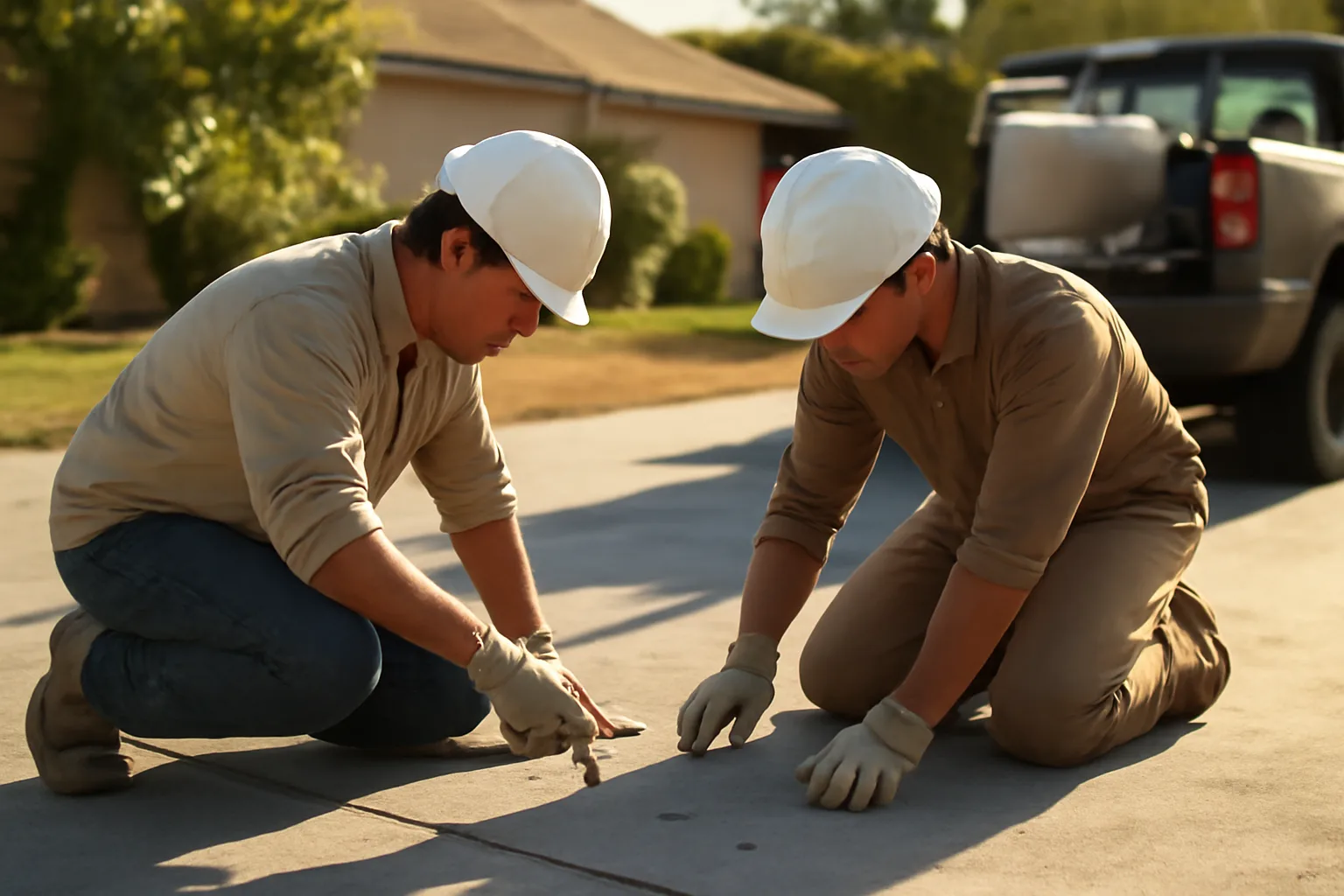
Slab lift is raising a sunken concrete slab back toward level by pumping material under it through drilled holes. Crews use a cement grout mix (often called mudjacking or slabjacking) or an expanding polyurethane foam. The material fills the void. Pressure then moves the slab.
That is the whole job, mechanically. You are not pouring a new driveway. You are not replacing the soil profile under a house. You are injecting something that occupies space and then controlling the lift so the slab does not crack worse than it already did.
People mix up three different products when they say slab lift. Exterior flatwork (driveways, sidewalks, patio slabs, some garage floors) is the common start. Interior floor lift inside a finished house is the same physics with worse access and worse dust rules. Structural foundation work (pier and beam, pushed footings, a house that moved) is a different trade even if the pump looks similar. Treat those as separate offers.
Foam is light and it expands. Grout is heavy and it does not. Foam usually needs smaller holes. Grout usually needs a mixer and a mess plan. Neither one “fixes clay.” If water is still cutting a channel under the slab, the slab can move again. I would write that on the bid in plain English.
A lot of national content talks like slab lift is a patented secret. It is not. It is concrete repair plus a pump plus chemical handling. The hard parts are reading the slab, not overlifting a corner, and staying legal on the paper your state actually asks for.
How do you start slab lift?
You start slab lift by confirming whether your state treats the work as licensed contracting, then you form a business, get an EIN, buy insurance, and set OSHA hazard paper before you inject anything. There is no national slab-lift card. Buy equipment after the paper, not before.
Walk it in this order. First, read the contractor definition in your state and see if raising and repairing concrete is inside it. California’s definition of a contractor is broad. Business and Professions Code section 7026 covers a person who undertakes or bids to “construct, alter, repair, add to, subtract from, improve” a structure or improvement [9]. If your state sounds like that, assume you need a class until the board says otherwise. Second, pick an entity. The IRS lays out sole props, partnerships, corporations, and LLCs on its business structures page. Read that page before you file anything with your secretary of state [7]. Third, get an EIN if you need one. The IRS assigns that number in the format XX-XXXXXXX and the online application is the document you use [6]. Fourth, call a commercial insurance broker about general liability, hired auto, and workers’ compensation. Fifth, put a hazard-communication program on paper because you will handle isocyanates or cement dust, and often both [3].
The SBA’s 10-step start guide is a decent federal checklist for the boring pieces (structure, licenses and permits, finances). Use it as a sequence, not as a license opinion [8]. It will not tell you whether foam injection is a C-8 concrete job in California or unlicensed handyman work in a state with no statewide general contractor class. That answer lives at the board.
I would not buy a foam rig in month one unless I already had paid work. Learn to read a slab with a straightedge and a water level on a few small sidewalks first. If you cannot explain why the low corner moved, you are not ready to sell a “permanent” lift.
State paths diverge fast. If you are actually filing, skip the national blogs and open a state page such as how to start slab lift in California, how to start in Colorado, how to start in Alabama, or how to start in Connecticut. Confirm every fee and class name with that board. Nobody can honestly publish a current processing time that stays true next month.
Do you need a license for slab lift, or is that a myth?
There is no federal slab-lift license. Whether you need a state contractor license depends on the state, the contract amount, and whether the work is structural. Confirm the class and the current exemption amount with the board that licenses concrete or general contracting where the job sits.
The national myth is that “concrete lifting is unlicensed everywhere because you are only injecting foam.” That sentence is false in any state that defines contracting as repairing or improving a structure. It may be true, or partly true, in a state that does not license general contractors at the state level. Local business tax certificates and permits can still apply even then.
California is the clean example because the statutes are public and specific. Section 7026 is the definition [9]. Section 7048 is the minor-work exemption. Do not trust a blog for the dollar figure. The legislature has changed that number more than once, so read 7048 and the current CSLB note before you treat a small driveway as unlicensed work [11]. Section 7031 is the one that hurts. In California, a person acting as a contractor generally may not “bring or maintain any action… for the collection of compensation” on a job where a license was required [10]. That is why the paper path matters more than the pump.
If you work in California, the classification people look at first for flatwork is C-8 Concrete. CSLB’s C-8 description is the page to read, not a franchise brochure [12]. Foundation and structural repair can sit in a different class. Ask the board in writing if your offer includes house leveling.
Other states use other names. Arizona uses ROC classes. Some states lean on local licensing only. Use the state license pages on this site (slab lift license in California, Colorado, Alabama) as a map, then confirm the live class list. I would rather spend a morning on the phone with a board analyst than discover 7031-style rules after a bad check.
What paper do you file before the first hole?
Before the first hole you want entity documents, an EIN if you need one, whatever contractor license your board requires, a business tax certificate if the city asks, insurance certificates, a written hazard-communication program, safety data sheets for every chemical on the truck, and a silica plan that matches how you drill. That stack is the real start. The pump is not.
OSHA’s hazard-communication rule states the purpose in plain language: “The purpose of this section is to ensure that the hazards of all chemicals produced or imported are classified, and that information concerning the classified hazards is transmitted to employers and employees” [3]. For a slab lift truck that means SDS binders that people can actually find, labels that stay on transfer jugs, and training that names isocyanates and cement dust. Do not keep the SDS as a PDF graveyard on your phone.
If you have employees, workers’ compensation is usually not optional. Confirm with your state WC agency. If you have a crew of one, you still need a plan for what happens if foam hits an eye. OSHA makes the employer responsible for requiring PPE “in all operations where there is an exposure to hazardous conditions” [4]. That is 29 CFR 1926.95. Read it. Then read the SDS PPE section and buy that, not the cheapest glove at the gas station.
Census NAICS 238110 (poured concrete foundation and structure contractors) is the box many concrete shops check on tax and insurance forms. Some lifting-only shops use a specialty-trade code instead. Use the Census NAICS detail page and ask your accountant which one matches the work you actually sell [13].
| Paper | Who issues it | What to confirm |
|---|---|---|
| Entity filing | State secretary of state | Name, registered agent, annual report |
| EIN | IRS | Whether you need one for your structure [6] |
| Contractor license | State or local board | Class, exemption dollar amount, bond |
| SDS and HazCom | You, from the supplier | Matches the foam or grout you actually pump [3] |
| Silica written program | You | Fits 29 CFR 1926.1153 and how you drill [1] |
I keep that table on one page in the job binder. Inspectors ask for simple things. Fancy binders do not impress anyone if the SDS is for last year’s chemical.
Mudjacking or foam: what should you buy first?
Buy the method that matches the jobs you can actually sell in the next 90 days. If your first work is cracked city sidewalks and old driveway panels, either method can lift them. If you are selling interior garage floors and HOA pool decks that hate 2-inch holes, foam is easier to justify. I would not finance a foam plant to chase a method you saw in an ad.
Grout is messy and heavy. You add weight to a slab that already settled. You also deal with leftover slurry and washout. Foam is lighter and it expands, which is why people like it under a slab that cannot take more load. Foam brings isocyanates. That is not a marketing footnote. MDI (methylene bisphenyl isocyanate) has an OSHA ceiling limit of 0.02 ppm in Table Z-1 [2]. NIOSH’s pocket guide on MDI is the health page I would make a new hire read on day one [5].
Common shop practice (not a code) is smaller holes for foam and larger holes for grout. Treat any published “standard hole size” on a sales site as vendor talk. Your bit size follows the port and the packer you bought.
Cure time is also vendor talk. Some foams support foot traffic in minutes. Grout can take hours. Read the technical data sheet for the lot you purchased. If the TDS does not state compressive behavior and reaction profile, do not buy that drum to put under someone’s garage.
A franchise starter package is often a waste if you do not already have a way to get leads. You are paying for a logo and a chemical contract. You can buy a used grout pump, learn lift control, and keep your first-year cash. Switch to foam when a real customer mix pays for the chemical handling program you will owe OSHA anyway.
What does first-year equipment really cost?
Nobody publishes a clean public series for “average slab lift rig cost.” Manufacturer quotes move with proportioner size, generator, heated hose, and whether the deck is built on a new truck. Used Facebook plants look cheap until the pumps are out of calibration. I will not invent a national average. Get three written quotes and a wet test on the chemical you will run.
Think in systems, not in one magic machine. You need a way to drill, a way to inject, a way to patch holes, a mixer if you run grout, containment for chemicals, PPE that matches the SDS, water or HEPA dust control for silica, and a truck that stays under the CDL threshold if you do not want a commercial license. A vehicle with a GVWR of 26,001 pounds or more is a commercial motor vehicle under 49 CFR 383.5, which is the definition that pulls in CDL rules [14]. Weigh the built truck. Do not guess from the brochure.
I would spend money first on a straightedge, a good rotary hammer with a shroud, wet-or-vac dust control, and a small mixer or a small foam setup you can calibrate. Lights and cameras for before/after photos pay for themselves. Chrome toolboxes do not.
Used two-component foam units show up from the low five figures to well past six. That spread is why a single “startup cost” number on a blog is mostly fiction. Ask what rebuilds cost and how you verify ratio. A plant that is 10 percent off ratio wastes chemical and can leave a soft lift. That is how you buy a callback.
Skip the branded trailer wrap in year one. Neighbors hire the person who showed up, explained the void, and put the slab within a quarter inch. Paint is not a license.
What insurance do slab lift crews actually carry?
Most crews that last carry general liability, commercial auto (or hired and non-owned if they are truly in a pickup they own personally, which I would not do for long), and workers’ compensation once they have employees. Pollution or contractor’s pollution coverage comes up when you store isocyanates. Inland marine covers the pump when it is off the truck. Confirm every limit with a broker who has written concrete repair accounts. Premiums are not a public federal number, so I will not fake one.
Commercial clients often write $1,000,000 per occurrence into the subcontract. That is a contract term you will see, not a law. Read the additional-insured and waiver-of-subrogation language before you sign. If you cannot get the certificate they asked for, you do not have that job.
Workers’ compensation class codes for concrete and specialty trades vary by state rating bureau. Your payroll in a lifting crew may not land in the same code as a form-and-pour crew. That is a question for the carrier, not for a Facebook group.
I would not start injecting next to a finished interior floor on a $300,000 policy you bought online and never read. One foam blowout into a living room costs more than a year of a real policy. If a carrier will not touch isocyanates, that is information. Change the chemical or change the work. Do not hide the foam on the application.
Bonding is separate. License bonds are a board issue. Contract bonds are a project issue. California and other license states publish bond amounts on the license record. Confirm the current amount on the board site. It changes.
How do you bid slab lift without guessing?
Bid the area you will lift, the likely void, the chemical or grout yield from the technical data sheet, drill and patch time, travel, and a contingency for a void that is bigger than the story the homeowner told. Then decide if you can live with the number if the slab takes 30 percent more material. If you cannot, raise the bid or walk.
There is no trustworthy national price-per-square-foot series from a government agency. Homeowner prices you see online are marketing. Thickness, access, indoor vs outdoor, and how dead the soil is will move a number more than your logo will. I price from yield and hours, then check nearby completed jobs. I do not start from a national “average.”
Read the TDS for pounds per cubic foot and reaction profile. Do the cubic-foot math. Foam that expands a lot on a sales slide can still take more sets than you planned if the void connects to a porch stem wall. Grout estimates fail the same way when an old driveway is a shell over dirt.
If you want a simple mix and bid-per-sqft worksheet, SlabLiftPath sells a $149 one-time Mix + Bid-per-Sqft Kit. You can also build the same sheet from the TDS and your labor burden. Either way, the bid is only as honest as the void guess.
Write exclusions. Radiant heat, post-tension cables, plumbing in the slab, and “we will make it look new” are how small jobs become lawsuits. Offer lift and hole patch. Sell grinding or overlay as a separate line. I would rather lose a picky patio than own a cracked finish I did not budget to replace.
What safety rules apply on a lift day?
On a lift day the rules that actually show up are silica from drilling, chemical exposure from foam or cement, eye and hand protection, and ordinary construction PPE. OSHA sets the construction PEL for respirable crystalline silica at 50 μg/m3 as an 8-hour TWA under 29 CFR 1926.1153 [1]. The same standard sets the action level at 25 μg/m3 as an 8-hour TWA [1]. Those two numbers belong on your drill plan.
The standard says, in the employer-duty sentence on the PEL, “The employer shall ensure that no employee is exposed to an airborne concentration of respirable crystalline silica in excess of 50 μg/m3, calculated as an 8-hour TWA” [1]. Outdoor drilling of a handful of holes is not a free pass. 1926.1153 Table 1 has a row for handheld and stand-mounted drills. Use the shroud and dust collection (or wet methods) that Table 1 describes. Indoor work is stricter on respirators. Read the table. Do not invent your own version.
Foam days add isocyanates. OSHA’s chemical table lists a 0.02 ppm ceiling for MDI [2]. A ceiling is not an 8-hour average you can dilute with a long lunch. If the SDS calls for specific gloves, splash goggles, and ventilation, that is the rule for that drum. Sensitization is ugly. I would keep untrained helpers away from the gun.
PPE is not optional theater. 29 CFR 1926.95 puts the duty on the employer to require the right equipment where hazardous conditions exist [4]. Hard hats near a low garage door matter less than gloves that actually resist the iso. Change them when they soak through.
Have water, an eyewash that you can reach, and a spill plan that does not say “call someone” with no number. Cement burns skin. Foam on skin is a different problem. Train both.
When is a slab lift actually a foundation job?
A driveway panel that dropped two inches after a water-line leak is a slab lift. A living room floor that fell because a footing rotated is a foundation job. If the load path of the house depends on what you are about to move, stop selling “foam leveling” and bring in a design professional. I would not lift a bearing wall on a YouTube cross-section.
Signs I treat as a walk-away unless an engineer is already on the ticket: doors that will not close through the whole house, stair separation from a wall, a chimney pulling away, a slab that is broken into a map of structural cracks rather than a few settlement cracks, and any talk of “we think the pier is gone.” Photos of a garage apron are not enough.
License classes split here. Flatwork and structural concrete are not always the same box. California’s C-8 page is about concrete work as CSLB defines that class, not a blank check for underpinning [12]. Other states split residential remodeling, concrete, and foundation repair. If your offer says “house leveling,” ask the board which license they want to see. Get the answer in writing.
Insurance splits here too. A carrier that is fine with sidewalk foam may exclude foundation repair. Read the exclusions. A callback on a patio is painful. A callback on a house is existential.
For year one I would stay on isolated exterior slabs and free-floating garage floors. Learn lift control where a mistake costs a panel, not a structure. The money in structural work is real. So is the paper.
What does a first year of operations look like?
A first year looks like uneven weeks. You spend more hours on estimates, photos, and follow-up than on the gun. The work you win is mostly driveways, sidewalks, patio corners, and the occasional garage. Rain shuts you down. Chemical lead times will bite you if you only keep one set of drums.
Crew size is often one or two people. One person can drill and lift a small sidewalk. A driveway goes faster with a second person on the straightedge and traffic. I would not send a brand-new helper to run iso alone.
Operations paper that actually matters week to week: job photos before and after, a written void note, gallons or pounds used, lot numbers from the drums, and a one-page change order if the void is bigger than bid. Keep lot numbers. If a batch behaves badly, you need to know which jobs got it.
Sales advice from national “done for you lead” vendors is usually a bad buy in year one. Knock the streets where you already lifted a panel. Leave a door hanger that says what you did, plain and specific. Talk to property managers who already pay for concrete repair. They care about trip hazards and closeout photos.
Winter in a cold state changes the chemical and the grout. Some foams have substrate temperature limits on the TDS. If the slab is below that number, you do not inject. You reschedule. Pushing a cold job to hit a monthly revenue target is how you own a soft lift until spring.
Which state rules change the paper path?
The paper path changes at the state line, and sometimes at the city line. License class names change. Exemption dollar amounts change. Workers’ compensation rules change. A few states have no statewide general contractor license and still have local permits. That is why a single national “start today” script fails.
If you are comparing states, open the start guides and the license guides rather than rereading this page. California is statute-heavy (license, renewal). Colorado is a different stack (start, license). Alabama and Connecticut are different again. Confirm fees, exams, and proof of experience with the live board. I will not invent a current fee or a processing clock.
Reciprocity is rarer than people hope. A license in one state is a useful exhibit, not a stamp that opens the next state. Ask each board how they treat out-of-state experience. Get the answer in an email you can keep.
Remember one thing from this guide. Slab lift is a field method. The thing that keeps you in business is the paper your board and OSHA can ask for on a random Tuesday.
More start checklists sit at /start. SlabLiftPath is an independent publisher, not a law firm and not a service company. Nothing here is a license approval or a timing promise.
Frequently asked questions
Is slab lift the same as mudjacking?
Mudjacking is one kind of slab lift. It uses a cement-based grout pumped under the slab. Polyurethane foam lifting is the other common kind. Both raise concrete by filling a void and applying pressure. Hole size, weight added, mess, and chemical hazards differ. Call the method by the material you will pump, not by a brand name.
How much does a typical residential slab lift cost a homeowner?
There is no solid public national price series. Bids move with access, slab thickness, void size, indoor vs outdoor work, and how you patch holes. Online per-square-foot figures are usually marketing. An honest shop prices from material yield and hours, then says what is excluded. Ask for the void assumption in writing before you compare two numbers.
Can you start slab lift without a contractor license?
Only if your state and city treat that job as unlicensed work. There is no federal slab-lift card. Some states license almost any repair over a dollar threshold. Others do not license general contractors at the state level. Confirm the class and any minor-work exemption with the board. In California, collecting on unlicensed work can fail under BPC 7031.
How small are the holes for foam versus grout?
Shops often drill smaller ports for foam and larger ports for grout, but hole size is equipment practice, not a building-code number. Follow the packer and port the manufacturer ships. Patch quality matters more to the owner than a 1/8-inch difference. Confirm utilities, radiant heat, and post-tension cables before you pick a bit.
How soon can cars drive on a lifted slab?
It depends on the product, temperature, and the TDS, not on a national rule. Some polyurethane systems are sold as supporting traffic in minutes. Cement grout often needs a longer wait. Read the sheet for the lot on the truck. If the TDS is silent on traffic time, do not guess. Keep cars off until you can stand on the panel yourself.
Do you need a CDL to haul a slab lift rig?
You need a CDL when the vehicle meets the federal commercial motor vehicle definition, including a GVWR of 26,001 pounds or more under 49 CFR 383.5, plus any stricter state rule. A one-ton pickup under that weight is a different question than a built heavy truck. Weigh the finished rig. Confirm with your state driver-license agency, not with the equipment dealer.
Does slab lift fix the soil that caused the settlement?
Usually no. Slab lift fills a void and raises the panel. It does not rewrite clay, a leaking gutter, or a broken irrigation line. If water is still cutting under the slab, the panel can move again. I would refuse to warranty “forever level” unless the water path is fixed. Write that limit on the bid.
What if the slab has radiant heat or post-tension cables?
Stop and locate. Radiant tubing and post-tension cables turn a routine drill pattern into a punch-through claim. Ask for as-builts. Use a locator. If nobody knows what is in the slab, treat it as a decline or as an engineer-directed job. Do not grid-drill a post-tension slab because a foam ad showed a driveway.
How do you dispose of leftover iso and polyol?
Read the SDS disposal section and ask your state environmental agency. Leftover two-component chemicals are not household trash. Empty drums and off-ratio waste may be hazardous waste depending on the product and your generator category. Do not wash iso into a storm drain. Budget disposal before you stock six extra sets “just in case.”
Can one person run a foam lift day?
A small sidewalk, yes, if that person can drill, watch the lift, and still shut the gun down safely. A driveway or an interior floor goes better with a second set of eyes on the straightedge. I would not leave a new helper on the chemical side alone. Isocyanates and overlift are both one-person failure modes.
Do you need a contractor license bond for slab lift?
If your state license requires a bond, yes. The amount is a board rule, not a national number, and it changes. Contract performance bonds are a separate project demand. Confirm the current license-bond figure on the board’s fee or bond page. Do not copy a dollar amount from an old blog post.
What changes on an indoor slab lift versus a driveway?
Dust, odor, finish protection, and silica rules get tighter indoors. Table 1 respirator notes in 29 CFR 1926.1153 matter more in enclosed space. Foam smell will get you thrown off a finished house if you did not talk about ventilation. Covering baseboards and HVAC returns is part of the job. Price the plastic and the extra hours.
What NAICS code do slab lift shops use?
Many concrete firms use 238110, poured concrete foundation and structure contractors, which Census defines on the 2022 NAICS detail page. A lifting-only specialty shop sometimes lands in another specialty-trade code. Ask the accountant and the insurance auditor which code matches the work you invoice. The code affects how carriers and tax forms see you.
How do you get the first ten slab lift jobs?
Lift one visible sidewalk well, then knock the next twenty doors with photos. Talk to property managers who already pay for trip-hazard work. Skip national lead vendors until you can close a job you found yourself. First-ten work is ugly, close, and local. A wrapped trailer does not replace a straight panel and a clean patch.
Sources
- OSHA 29 CFR 1926.1153 Respirable crystalline silica: Construction silica PEL is 50 μg/m3 as an 8-hour TWA and the action level is 25 μg/m3; Table 1 covers handheld drills.
- OSHA 29 CFR 1910.1000 Table Z-1: Methylene bisphenyl isocyanate (MDI) has an OSHA ceiling limit of 0.02 ppm.
- OSHA 29 CFR 1910.1200 Hazard Communication: Employers must classify chemical hazards and transmit SDS, label, and training information to employees.
- OSHA 29 CFR 1926.95 Criteria for personal protective equipment: The employer must require appropriate PPE where employees are exposed to hazardous conditions.
- NIOSH Pocket Guide to Chemical Hazards, MDI: NIOSH publishes exposure and health-effect data for methylene bisphenyl isocyanate used in many polyurethane systems.
- IRS Apply for an Employer Identification Number (EIN) Online: An EIN is a nine-digit IRS number in the format XX-XXXXXXX, applied for on the IRS EIN page.
- IRS Business Structures: The IRS describes sole proprietorships, partnerships, corporations, and LLCs as the basic business structures.
- U.S. Small Business Administration, 10 steps to start your business: SBA lists a federal startup sequence that includes choosing a structure and applying for licenses and permits.
- California Business and Professions Code section 7026: California defines a contractor to include a person who undertakes or bids to construct, alter, repair, or improve a structure or improvement.
- California Business and Professions Code section 7031: An unlicensed person acting as a contractor generally cannot sue in California to collect compensation on work that required a license.
- California Business and Professions Code section 7048: California’s contractor law includes a minor-work exemption whose current dollar limit must be confirmed on the live statute and CSLB.
- CSLB C-8 Concrete classification page: CSLB publishes the C-8 Concrete classification used for much forming, placing, and finishing of concrete flatwork.
- U.S. Census Bureau 2022 NAICS 238110 detail: NAICS 238110 is the poured concrete foundation and structure contractors industry code many concrete shops use.
- 49 CFR 383.5 Definitions (FMCSA / eCFR): A vehicle with a GVWR of 26,001 pounds or more is a commercial motor vehicle under the CDL definitions.