Last updated 2026-08-20
TL;DR
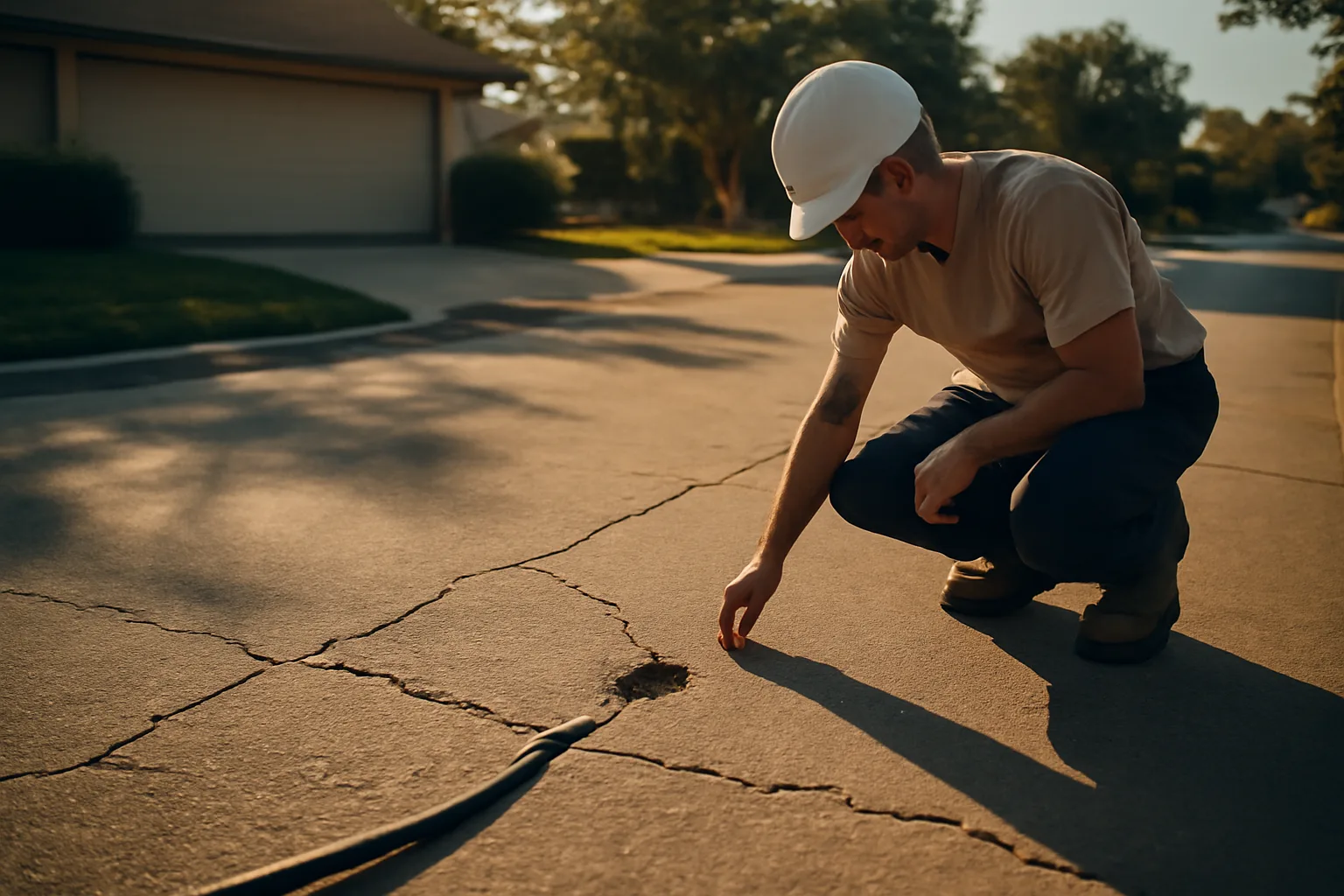
The expensive slab lift mistakes are not exotic. Operators skip the one-call ticket, lift without the right contractor class, inject over a live leak, and crank the gun until the slab cracks. Foam does not fix drainage or expansive clay. Start with a soil and water diagnosis, confirm your state license with the board, call 811, then lift in short shots. Paper first. Chemistry second.
What is slab lift?
Slab lift raises a settled concrete slab back toward its old elevation by pumping material under it. Most crews drill a grid of small holes and inject expanding polyurethane foam. Other crews still pump a cement slurry. People call that mudjacking or slabjacking. Both methods fill a void and push the panel up. Neither one rebuilds native soil.
You see the work on driveways, garage floors, sidewalks, pool decks, warehouse aisles, and some interior slabs if the finish can take the holes. It is not house lifting. It is not a pier job. If the footing moved, you are in foundation repair. Foam under a kitchen slab will not pick a dropped grade beam.
The names get sloppy in ads. Polyjacking, foam lifting, pressure grouting, and mudjacking get treated as one trick. They are not. Foam is light and sets in minutes. Slurry is heavier, cheaper per cubic foot on a big cavern, and messy. Pick the material for the void and the finish, not for the brochure.
If you cannot say what failed under the slab, you are not ready to drill. Washout, poor compaction, a plumbing leak, expansive clay, and tree roots each leave a different next step. Slab lift is a correction. It is not a soils report, and it is not a plumbing repair.
What slab lift mistakes show up most on first-year jobs?
The first-year list is boring, and that is why crews repeat it. They drill before they know why the slab dropped. They skip the one-call ticket because the bit is only 5/8 inch. They lift until the high corner looks proud, then a control joint blows. They bid a driveway by the square foot with no probe of the void. The foam truck runs empty and the margin is gone.
Diagnosis and paper beat gun skill. A steady injector over a wet leak still owns the callback. An unlicensed crew in a license state can do pretty work and still lose the invoice. California Business and Professions Code section 7028 makes unlicensed contracting a misdemeanor.[3]
Over-lift is the on-site mistake that photographs badly. Concrete does not stretch. A long continuous shot under one panel can hinge the slab, crack it, or pop a joint. Short shots. Recheck the laser. Stop if the panel is moving faster than you can measure.
The other pattern is a permanent-sounding pitch on expansive clay, or on a slope that still dumps roof water at the edge you just raised. USGS Map I-1940 has shown swelling clays across large parts of the United States since 1989.[9] Foam does not change the clay. If the water path is still there, the slab can move again. Say that before you take the deposit.
| Mistake | What actually happens | Better move |
|---|---|---|
| Skip 811 | Line strike and you own the repair | Ticket every drill pattern and wait the legal window |
| Lift over a leak | The slab dishes again in months | Plumber or dye test first |
| One long injection | Crown, cracks, blown joints | Short shots, elevation check every pass |
| No license check | Stop-work, fines, a weak invoice | Confirm the class with the state board |
| Square-foot bid, no void check | Chemical cost eats the job | Probe, then price pounds or void volume |
How do you start slab lift without skipping the paper?
You start slab lift like a contractor trade, not like a gadget purchase. Form an entity if that fits your risk. Get an EIN. Then find out which license class your state and city actually want. That class is not national. California operators often end up reading the C-8 Concrete write-up in CSLB's Description of Classifications.[13] Alabama, Arizona, Colorado, and Alaska each write a different story. Confirm the class, the bond, and the exam with the board. Do not trust a forum thread.
If you will work in California, use the state walkthrough on how to start slab lift in california and the companion page on the slab lift license in california. Same habit for how to start slab lift in alabama, how to start slab lift in arizona, and how to start slab lift in colorado. Read the license pages for Colorado and Arizona before you print a truck door. Alaska is its own paper path, so start with how to start slab lift in alaska if that is the ground you will actually drill.
Insurance is not optional if you have employees. California Labor Code section 3700 requires employers to secure workers compensation.[11] General liability that actually names polyurethane injection or concrete raising is the policy you want. Ask the agent to show you the wording. A cheap handyman policy with a poly exclusion is a waste of money.
Then the field paper. 811 on every property. SDS for the A side and the B side on the truck. A silica plan for the drill. A written change order when the void is bigger than the bid. The SBA license and permit guide is a decent federal checklist for the business side. It will not name your contractor class.[14]
If you want bid math on paper instead of a napkin, SlabLiftPath publishes a $149 one-time Mix + Bid-per-Sqft Kit at /start. A sheet you build yourself works too if you actually track pounds and voids.
The order I would follow: confirm the license with the board, bind insurance, set the entity and tax accounts, buy or lease a rig you can keep full, write the 811 and silica habits, then take small exterior slabs before you chase interior kitchens. Nobody can honestly promise you a board timeline. Confirm current fees and dates with that board.
Why do lifted slabs settle again after the job?
Lifted slabs settle again because water is still moving soil, or the soil itself is still changing volume. EPA's Moisture Control Guidance for Building Design, Construction and Maintenance is plain that moisture problems come from more than one condition, and bulk water at the foundation is a regular driver.[7] If the downspout still dumps at the corner you just lifted, you sold a temporary raise.
Plumbing leaks under a slab are the callback factory. Foam injected into a wet, eroding void can look perfect at 4 p.m. and look sad in six months. I will not lift over a suspected leak until a plumber has isolated it. That loses jobs. It also keeps you out of small-claims court.
Expansive clays shrink and swell with moisture. USGS Map I-1940 is still the national picture people point to because the geology did not move.[9] The 2021 International Residential Code tells building officials they can require a soil test where expansive, compressible, shifting, or other questionable soils are likely.[8] You are not the building official. You still need to talk about soil when you bid a slab in known clay country.
Poor compaction at the original pour is another reason a pretty lift comes back. Foam fills the gap you can reach. It does not densify a deep, loose fill. Deep voids, broken sewer laterals, and a hill that still sheds water onto the slab edge are walk-away conditions until someone else owns that repair. Say no. A declined job is cheaper than a free redo.
What happens if you skip calling 811?
Skip 811 and you can hit a gas, electric, or communications line through a small hole. The legal duty is not based on bit diameter. California Government Code section 4216.2 requires an excavator to notify the regional notification center before excavation, and in the normal case the wait is at least two working days and not more than 14 calendar days.[5]
Texas writes a different clock. Under Utilities Code Chapter 251, notice is due no later than the 48th hour before the excavation begins, and that clock excludes Saturdays, Sundays, and legal holidays.[10] Other states sit near a two-working-day rule. Confirm the statute where you will drill. Do not borrow California's calendar for a Texas driveway.
Excavation in one-call statutes is broader than people think. Drilling is excavation. If the locator marks a line through your pattern, you move the holes or you vacuum-verify. Guessing is how a quiet residential street gets a fire truck.
I have no clean national number I trust for how often slab lift crews hit lines. Treat every unmarked slab as if it has a gas service. Ticket it. Photograph the marks with the ticket number in the job file. If a locator no-shows, you do not start. You call again.
Do you need a contractor license to lift slabs?
Often yes, and the dollar trigger is lower than new operators expect. In California the common exemption sits at projects under $500 in labor and materials combined. A two-panel driveway blows through that number.[4] The statute on unlicensed work is not soft. Business and Professions Code section 7028 states: "It is a misdemeanor for a person to engage in the business of, or act in the capacity of, a contractor within this state without having a license therefor, unless the person is particularly exempted from the provisions of this chapter."[3]
Other states split this work into concrete, foundation repair, or a specialty class. Some cities pile a local license on top. Texas does not run a statewide general contractor license the way California does, which is why people get sloppy there and then wander into a license state and get cited.
Confirm with the relevant board before you print yard signs. Processing times and current fees change, so I will not quote a board fee here. Read the classification description. CSLB's Description of Classifications is the kind of document that belongs in the folder if California is your market.[13] Then read the state pages for the ground you will actually work, including slab lift license in california and slab lift license in Colorado.
Unlicensed work also wrecks collection. Owners and insurers get picky once a dispute starts. Pretty foam photos do not fix a missing license number on the contract.
What foam and dust mistakes get crews in real trouble?
Drilling concrete makes respirable crystalline silica, and that is the dust that gets crews cited. OSHA sets the construction PEL for respirable crystalline silica at 50 μg/m3 as an 8-hour TWA.[1] The rule text is direct: "The employer shall ensure that no employee is exposed to an airborne concentration of respirable crystalline silica in excess of 50 μg/m3, calculated as an 8-hour TWA." Dry drilling a driveway with no shroud and no vac is a bad habit. Use the Table 1 control method that matches your drill, or do air monitoring. I would buy the shroud and vac before I bought a fancier gun.
The A-side of many lift foams is a polymeric MDI isocyanate. OSHA Table Z-1 lists a ceiling of 0.02 ppm for methylene bisphenyl isocyanate.[2] NIOSH Alert 96-111 has warned for decades that diisocyanates are widely used in rigid foams and that the major health effect from exposure is occupational asthma.[6] Read the SDS. Use the respirator the SDS names. Do not treat a closed garage as if it only off-gasses for a minute.
Temperature mistakes are quieter. Two-component foam that is too cold reacts poorly. Too hot can run away. I will not invent a universal window. The manufacturer tech sheet is the document. If you bought bargain resin with no tech sheet and no SDS, that purchase is the mistake.
Spills and leftover chemical are your problem. Do not dump A or B side on the customer's lawn. That is how you buy a soil cleanup you did not bid.
How do bidding mistakes wreck a first year?
Square-foot pricing with no void estimate is how you work for free. A 4 inch void under 200 square feet is a different chemical bill than a half-inch dish. Probe it. Scope it if you can. Write a per-pound or per-void allowance in the contract so a cavern does not eat the job.
The other wreck is matching the cheapest social media quote. That number often skips 811 wait time, travel, mobilization, hole patch, and the half day you will spend on a door that will not close after the lift. I would rather lose a bid than own a chemical bill bigger than the contract. Nobody publishes a trustworthy national callback rate by method, so you cannot price risk off a study. Price it off your own worst job and a written exclusion for new water events.
Warranty language that says lifetime on a slab next to a hill is marketing, not a contract. Limit the warranty to the lift itself. Exclude new leaks, new drainage failures, and owner grading changes. Put that in the same packet as the before-and-after elevations.
If your bid sheet cannot show pounds, void depth, patch count, and a mobilization line, you are guessing. Guessing is not a pricing system.
What diagnosis mistakes turn into callbacks?
The classic miss is a slab that dropped because a lateral leaked. Hairline drywall cracks and a musty hall closet are clues. So is a warm winter spot on the slab or a sewer smell. Foam will not replace a broken cast-iron line.
Another miss is blaming settlement when the real issue is heave on the high side. If you lift the low side of a slab that actually heaved next door, you chase a moving target. A 4-foot level, a laser, and 20 minutes of looking at drainage beat a fast drill pattern.
Tree roots lift slabs and dry soil. Cutting a root to help the slab can kill a tree you now own. Note the trees. Tell the owner. Put the conversation in the file.
Interior slabs with radiant heat or post-tension cables are a different diagnosis. You drill those only with a plan for the tubes and the tendons. Guessing is how you flood a floor with glycol or nick a cable. If the owner cannot produce a tendon map on a post-tension slab, I would slow down or walk. A cracked panel is cheaper than a cut tendon.
Drainage photos belong in the estimate, not in the excuse letter. Downspouts, grade away from the slab, irrigation heads at the edge, and a hill that sheds onto the driveway are part of the diagnosis. If the owner will not fix the water, price the job as a raise, not as a cure.
Is foam always better than mudjacking?
No. Foam wins on interior finished spaces, on soils that should not take more weight, and on jobs where traffic has to return the same day. Mudjacking or a cementitious grout still makes sense on thick exterior slabs with huge voids, where extra mass is not a problem and chemical cost would be silly.
The mistake is religious loyalty to one tank. Crews pump expensive foam into a void that a yard of grout would have filled, then wonder why the job lost money. Crews also pump slurry through a finished garage and stain a floor that needed small holes and a same-day cure. Match the material to the void and the finish.
Foam can still fail if the mix is off or the slab is too thin. Slurry can still fail if it washes out the next time the lateral leaks. Method pride is not a quality program.
| Job type | Foam tends to fit | Slurry tends to fit |
|---|---|---|
| Interior slab near finished floors | Small holes, light material | Mess and extra weight |
| Huge void under a thick exterior apron | Chemical cost climbs fast | Cheaper fill volume |
| Soft soil that cannot take extra load | Lighter lift | Extra weight can punch through |
| Same-day traffic on a store entry | Sets in minutes | Longer cure |
What insurance and crew mistakes follow new operators?
The insurance mistake is a policy that excludes earth movement, workmanship, or polyurethane application. Read the exclusions with a highlighter. If you have anyone on payroll, workers compensation is the law in states like California under Labor Code section 3700.[11] Classifying a regular helper as a 1099 to dodge that is how you meet the labor commissioner.
OSHA still expects a construction employer to run a safety program. 29 CFR 1926.20(b)(1) puts the duty on the employer to initiate and maintain programs needed to comply with the construction rules.[12] A silica plan, an SDS book, and an eye wash on the truck are not decoration. They are how you show you meant the program.
Crew mistakes are simple and expensive. One person on a gun with no spotter on the laser. A helper standing downslope of a slab that can pop. No gloves in the isocyanate splash zone. I would rather run a slower two-person crew than a fast one-person circus.
Keep the job file boring. Ticket number, photos of 811 marks, before-and-after elevations, resin lot numbers, and a signed change order if the void grew. That file is what you hand an adjuster or a board investigator. Memory is not a record.
How do you keep from cracking the slab while you lift?
You lift in short shots and you measure. That is the whole trick, and people still skip it. Mark a grid. Set a laser or a water level. Inject, stop, read. If a joint starts to rise faster than the middle, you move. If you hear a crack, you stop. Pride is how you turn a 1 inch dish into a spidered panel.
Hole pattern matters. Too few holes and you build a high spot over the injector. Too close to a free edge and you blow the edge off. Stay off post-tension tendon layouts. On thin residential driveways, 4 inches of concrete is common, and you have less room to be sloppy than on an 8 inch dock.
Patch the holes with something that will not pop out in the first freeze. The customer photographs the patches. So will the next bidder if your patches look like gum.
Walk the doors, the brick veneer, and the adjacent panels before you start the gun. A raised driveway that jams a garage door is not a win. Tell the owner what might move. Then move it on purpose, in small shots.
SlabLiftPath is an independent publisher, not a law firm and not a service company. Confirm every license class, fee, and wait rule with the board and the one-call center that will actually police your trucks.
Frequently asked questions
What is slab lift?
Slab lift is raising a settled concrete slab by pumping polyurethane foam or a cement slurry under it through drilled holes. The material fills voids and pushes the panel back toward grade. It is not the same work as piercing a house or replacing a footing. If the foundation moved, foam under the interior slab will not fix that.
How do you start slab lift?
Confirm the contractor class with your state board, bind liability and workers comp if you will have employees, set the entity and tax accounts, then get a rig you can keep supplied. Add an 811 habit, SDS sheets, and a silica plan before the first driveway. Start on small exterior slabs. Confirm current fees and dates with the board. Nobody can honestly promise you a processing time.
Can I lift a slab if I am not a licensed contractor?
In many states, no, once the job clears a low dollar threshold. California's common exemption is under $500 in labor and materials, which a normal driveway exceeds. Unlicensed contracting there is a misdemeanor under Business and Professions Code section 7028. Other states use different classes. Confirm with the board that will police the work.
Does calling 811 apply to small drill holes?
Yes. One-call laws treat drilling as excavation. California Government Code section 4216.2 requires notice to the regional center at least two working days ahead in the normal case. Texas Utilities Code Chapter 251 uses a 48-hour clock that skips weekends and legal holidays. Ticket every property. Photograph the marks.
Why did a lifted driveway sink again?
Water is usually still moving soil, or the soil is still changing volume. A live plumbing leak, a downspout at the slab edge, or expansive clay will outlast a pretty foam raise. EPA moisture guidance treats bulk water at the foundation as a regular building problem. Fix the water path, or price the job as a temporary raise.
Is polyurethane foam safe to inject under a house?
The cured foam is a different problem than the liquid A-side. Many lift foams use MDI isocyanates. OSHA Table Z-1 lists a 0.02 ppm ceiling for MDI, and NIOSH Alert 96-111 flags occupational asthma as the major health effect. Use the SDS respirator, ventilate closed rooms, and keep unreacted chemical off skin and soil.
How much should I charge per square foot?
There is no honest national square-foot number I will print. Void depth changes the chemical bill more than surface area does. Probe the void, price pounds or volume, and add mobilization, 811 time, patches, and a written allowance if the cavern grows. Matching the cheapest online quote is how first-year operators work for free.
Should I use foam or mudjacking on a garage floor?
Foam usually fits a finished garage better. Holes stay small, the material is light, and traffic can often return the same day. Slurry still fits a thick exterior apron with a huge void, where extra weight is acceptable and foam cost would be silly. Loyalty to one tank is the mistake, not the material itself.
Do I need workers compensation for a helper?
If that helper is your employee, yes in states like California. Labor Code section 3700 requires employers to secure compensation. Calling a regular helper a 1099 does not make it true. Ask a real insurance agent and, if needed, the state labor agency. A gap here is more expensive than the premium.
What silica controls apply when drilling slabs?
OSHA's construction silica rule sets a PEL of 50 μg/m3 as an 8-hour TWA under 29 CFR 1926.1153. Dry drilling with no shroud and no vac is the habit that gets crews in trouble. Use the Table 1 method that matches your tool, or monitor the air. I would buy dust control before I upgraded the injection gun.
Can slab lift fix a foundation that dropped?
Not by itself. Slab lift raises a slab-on-grade panel. A dropped footing, grade beam, or pier-and-beam system is foundation repair. Injecting foam under an interior floor will not pick the structure above a failed footing. Walk that job or bring in the right trade. Selling a slab raise as a house lift is how complaints start.
What should be in the job file after a lift?
Keep the 811 ticket number, photos of the locate marks, before-and-after elevations, resin lot numbers, the signed contract, and any change order for extra void. Add drainage photos and a note about leaks you refused to inject over. That file is what you hand an adjuster or an investigator. Memory is not a record.
How fast can I lift without cracking concrete?
There is no public psi number I trust for every residential slab. Thin driveways crack when you inject in one long shot and stop measuring. Short shots, a laser or water level, and a pause when a joint races ahead of the middle are the controls that actually work. If you hear a crack, stop. Pride is not a lift plan.
Do expansive soils make slab lift a bad idea?
They make a permanent-sounding pitch a bad idea. USGS Map I-1940 still shows swelling clays across large parts of the country. Foam does not change that clay. You can still raise a dish, but only after you talk about moisture, drainage, and the chance the slab will move again. The 2021 IRC lets officials require a soil test in questionable soils.
Sources
- OSHA 29 CFR 1926.1153 Respirable crystalline silica: Construction employers must keep respirable crystalline silica at or below 50 μg/m3 as an 8-hour TWA.
- OSHA 29 CFR 1910.1000 Table Z-1: OSHA lists a 0.02 ppm ceiling limit for methylene bisphenyl isocyanate (MDI).
- California Business and Professions Code section 7028: Acting as a contractor in California without a license is a misdemeanor unless an exemption applies.
- California Business and Professions Code section 7048: California's contractor license exemption is limited to projects under $500 in labor and materials.
- California Government Code section 4216.2: Excavators must notify the regional notification center at least two working days before digging in the normal case.
- NIOSH Alert 96-111 Preventing Asthma and Death from Diisocyanate Exposure: NIOSH identifies occupational asthma as the major health effect of diisocyanate exposure and notes wide use in rigid foams.
- EPA Moisture Control Guidance for Building Design, Construction and Maintenance (EPA 402-F-13053): EPA guidance treats moisture problems as coming from multiple conditions, including bulk water at buildings.
- 2021 International Residential Code Chapter 4 Foundations (R401.4): Where expansive or other questionable soils are likely, the building official may require a soil test.
- USGS Map I-1940 Swelling clays map of the conterminous United States (1989): USGS mapped swelling clay hazards across large parts of the conterminous United States.
- Texas Utilities Code Chapter 251 Underground Facility Damage Prevention: Texas excavators must give notice no later than 48 hours before digging, excluding weekends and legal holidays.
- California Labor Code section 3700: California employers must secure workers compensation coverage.
- OSHA 29 CFR 1926.20 General safety and health provisions: Construction employers must initiate and maintain programs needed to comply with OSHA Part 1926.
- CSLB Description of Classifications: CSLB publishes official classification descriptions, including C-8 Concrete, that operators should read before bidding slab work.
- SBA Apply for licenses and permits: The SBA publishes a federal checklist for business licenses and permits, though it does not name a contractor class.