Last updated 2026-08-20
TL;DR
There is no national slab lift exam. You sit the contractor or trade test your state board uses for the class that covers concrete repair, then you keep bonds, insurance, and local paper current. Vendor foam certificates do not replace that exam. Confirm the class, the bulletin, and experience rules with the board that will print the license.
What is the slab lift exam?
The slab lift exam is not its own national test. You sit the contractor exam your state (or city) already uses for the license class that covers concrete repair, then you keep the rest of the paper current.
Most people hunting for this are really hunting for a polyurethane certificate. That class is vendor training. Useful on the rig. It is not what lets you bid as a contractor.
Boards test contracting law, job-site safety, and the classification you applied for. They do not grade your favorite foam brand. If your state runs no contractor exam, you can still owe registration, a bond, and local permits. Confirm the class and the test with the board that will print your name. Do not trust a forum post that says nobody licenses this work.
Think of the exam as one gate on a paper path. Experience affidavits, a qualifier, a bond, workers compensation, and city registration sit next to it. Fail any of those and a passing score does not matter.
If you already hold a general building or concrete license in good standing, you may not sit anything new. Ask the board in writing whether slab lifting stays inside that class. Get the answer on letterhead or in the portal. A verbal yes from a clerk is how people get stop-work orders later.
What is slab lift?
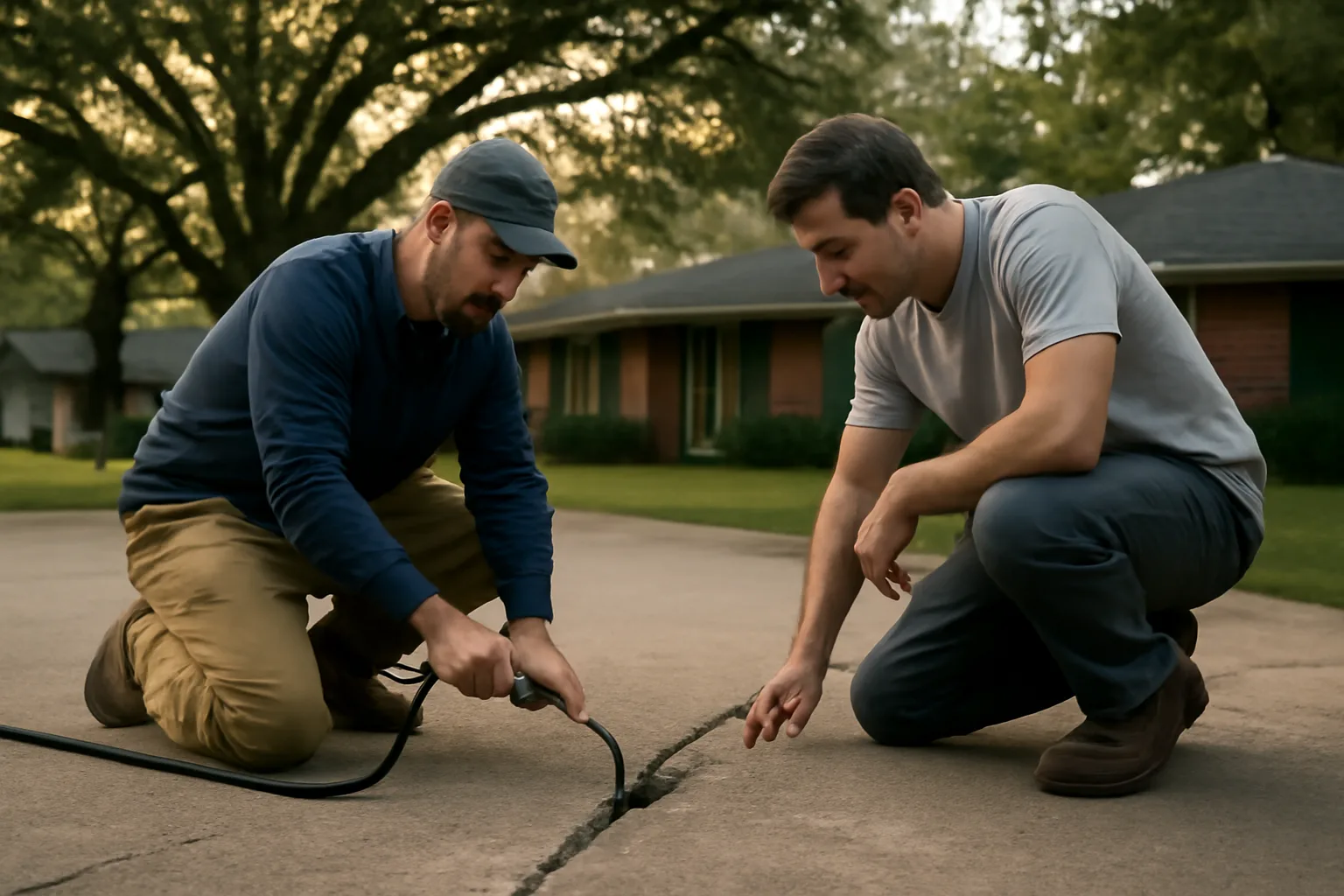
Slab lift is the work of raising a settled concrete slab back toward level by pumping material under it. Crews drill small ports, inject polyurethane foam or a cement slurry (mudjacking), watch the lift, then patch the holes.
The job looks simple from the street. It is still construction. You are changing bearing under a walk, a driveway, a garage floor, or a warehouse slab. You can crack the panel, lift a door out of plumb, or hit a utility. That is why boards treat it as contracting, not as a weekend gadget service.
Foam systems expand and set fast. Slurry systems are heavier and cheaper on material, slower to cure, and messier. Neither one is a license. OSHA still treats cutting and grinding on those slabs as silica work, with a permissible exposure limit of 50 μg/m3 as an 8-hour time-weighted average under 29 CFR 1926.1153 [1]. The same standard sets the action level at 25 μg/m3 [1].
If a customer asks what you do, say you lift and stabilize existing concrete. Do not call it foundation replacement unless you are actually replacing a foundation. Overclaiming the scope is how a concrete job becomes an unlicensed structural job in a complaint file.
Is there a national slab lift license or exam?
No. The United States does not issue a slab lift license and does not write a slab lift exam.
What exists is a patchwork. Some states run a contractor board exam. Some accept the NASCLA Accredited Examination for people who want one commercial general building test that participating jurisdictions will take in place of their own general exam [8]. Some states skip a trade exam and still make you register, bond, and insure. Cities can pile on a registration even when the state is quiet.
NASCLA is not a foam test. It is a commercial general building contractor exam used by participating boards [8]. If your plan is driveway lifting in one county, sitting NASCLA because a video ad called it national is a waste of study time. Use it if you will chase commercial work across states that actually accept it. Confirm acceptance on the board site, not on a prep vendor's landing page.
Manufacturer certificates travel with the chemical system. They do not travel as a license. A city inspector who asks for your contractor number does not want your weekend badge from a foam plant.
Which license classification covers slab lifting?
Boards almost never print a class named slab lift. The work usually sits under concrete, a concrete-related specialty, foundation repair, or general building. You have to ask the board which box they want checked.
California is the example people copy, often badly. The Contractors State License Board describes a C-8 concrete contractor as a person who "forms, pours, places, finishes and installs specified mass, pavement, flat and other concrete work" [5]. Slab lifting is repair of existing flatwork, so C-8 or a B general building license is where many California applicants land. That is not automatic. Get the classification in writing before you pay for books. The California path is spelled out in slab lift license in California and the start sequence in how to start slab lift in California.
Florida defines who counts as a contractor in chapter 489. A contractor is the person who, for compensation, undertakes or submits a bid to construct, repair, or alter structures, with the rest of the definition and the specialty list in section 489.105 [6]. Statewide certified contracting then runs through the Construction Industry Licensing Board process in section 489.113 [7]. Arizona makes it unlawful to act in the capacity of a contractor without a license [11]. None of those statutes say "slab lift." They say contractor.
My rule: email the board the exact scope (drill, inject, lift residential flatwork, no new structural foundation) and ask which classification, which exam bulletin, and whether a qualifier can carry it. Save the reply. If two clerks disagree, ask for a licensing supervisor.
How do you start slab lift if you still need the exam?
You start with the paper, not with a truck wrap. Form the entity, get an EIN from the IRS if you need one [9], pick the license class, prove experience if the board asks for it, sit the exam, then bind insurance and any required bond. Equipment comes after you know you can legally bid.
California will not let most applicants skip the knowledge showing. Business and Professions Code section 7065 tells the registrar to require an applicant to show "knowledge and experience in the classification applied for, and such general knowledge of the building, safety, health, and lien laws of the state and of the administrative principles of the contracting business" [4]. Section 7068 is the four-year experience rule for a standard applicant [15]. Other states use different year counts or no year count. Confirm the affidavit forms. Do not invent hours on those forms. Boards do audit them.
Washington is the other pattern. You register as a contractor with Labor and Industries. RCW 18.27.020 says it is a violation to advertise, offer, bid, or perform contractor work without being registered [12]. That is registration plus bond and insurance, not a trade exam. People still fail it by advertising before the registration shows as active.
A practical first-week list: entity, EIN, board application, experience affidavits, and the exam bulletin from the current testing vendor, not last year's PDF from a forum. Then price insurance. Then look at pumps. If you want a one-time mix and bid-per-sqft worksheet instead of building one from scratch, the $149 Mix + Bid-per-Sqft Kit is at /start. You do not need it to sit the exam.
State start guides worth opening next if that is your map: how to start slab lift in Arizona, how to start slab lift in Colorado, and how to start slab lift in Alabama.
What does the contractor exam actually test?
It tests whether you can run a contracting business inside that state's rules, plus enough trade knowledge that the board will not be embarrassed. It does not test whether you can feather a 1/8 inch lift on a garage floor.
Expect two buckets. Law and business: contracts, change orders, mechanics liens, payroll, workers compensation, estimating ethics, and the board's own practice act. Trade: soils in a shallow way, concrete materials, reinforcing, finishing, safety, and sometimes repair. Foam chemistry is light if it shows up at all.
California splits this into a Law and Business exam and a classification exam for most licenses, and it schedules those through its published exam process [14]. Florida certified contractors sit exams tied to chapter 489 definitions and scopes [6][7]. NASCLA's product is a commercial general building exam for people licensing in participating jurisdictions [8]. Read the candidate bulletin the vendor posted for your exact test code. If the bulletin lists a code edition, buy that edition. Studying the wrong year of a building code is a classic fail.
OSHA content shows up because boards like safety questions they can defend. 29 CFR 1926.701 is the general concrete-and-masonry construction rule, including the load limit language inspectors actually quote [2]. Silica numbers from 1926.1153 show up in newer outlines [1]. Isocyanate hazards sit on the OSHA isocyanates page if your work is polyurethane [10]. Learn the numbers. Do not memorize marketing claims from a foam brochure.
How do you apply and sit for the test?
You apply to the board first in most states. The board decides you are eligible. Then a testing vendor (PSI, Pearson VUE, or whoever the board named this year) lets you schedule. You do not walk into a test center and ask for the slab lift exam. There is no such ticket.
Read the current candidate bulletin. It names ID rules, calculator rules, reference books you may bring, and how many items are scored. I will not quote a question count or a passing percentage here because vendors change bulletins. The bulletin in your portal is the only number that matters.
Bring the ID the bulletin names. If it says government photo ID that matches your application, that is what you bring. People get turned away for a nickname on the license. Confirm exam fees with the board and the vendor the week you schedule. Fees move. Anyone publishing a "current" fee on a blog is guessing.
If you fail, the bulletin tells you the retake wait. Do not pay a tutor until you have the fail letter's content outline. Study the weak sections. Retaking the same practice app twelve times is how people fail the same way twice.
California applicants should use the board's own examination information and scheduling pages, not a reseller [14]. Arizona applicants should start from the license statute and the ROC application, not from a national "certification" cart [11]. For Arizona classification detail see slab lift license in Arizona.
What should you study, and what is a waste of money?
Study the board's candidate bulletin, the practice act, the lien statute, and the safety rules the outline names. If the outline names a code book, use that edition. That is the whole honest list.
Waste of money: a $400 weekend "slab lift exam cram" that is really a sales deck for a foam rig. Waste of money: a framed certificate from a chemical plant that you hang instead of a license. Waste of money: buying three states' books because an ad said NASCLA covers the country [8]. Buy NASCLA prep only if your target boards accept that exam.
Worth the money: the PSI or Pearson practice if the board wrote it. Worth the money: a used copy of the exact code edition on the bulletin. Worth the money: manufacturer training the week before you run live foam, because hot drums and wrong mix ratios ruin slabs. That class still does not replace the board exam.
I would skip most third-party "guaranteed pass" courses. Nobody can guarantee a board score. If you cannot sit still with a statute and a highlighter, pay a tutor for law and business only. Trade questions are closer to what you already do on a slab.
California's own classification text is free [5]. Florida's definitions are free in section 489.105 [6]. OSHA's silica and concrete rules are free [1][2]. Start there before you buy anything with a padlock on the sales page.
What paper do you need besides a passing score?
A passing score is one PDF. Contracting takes a stack.
Typical stack, in the order I would actually assemble it: entity documents, EIN acknowledgment [9], license application, experience affidavits, exam authorization, passing result, license issuance, bond if required, general liability, workers compensation (or a legal exemption if your state allows one and you truly have no employees), local business tax or city contractor registration, and then permits per job. Washington's version of this is the RCW 18.27 registration bar on advertising and bidding [12]. California still needs the license itself under the chapter 9 contractor definitions in Business and Professions Code section 7026 [3].
Insurance is not a score. Brokers will ask for your class and your receipts. If you inject isocyanates, tell them. OSHA treats isocyanate exposure as a real respiratory and sensitization hazard [10]. Hiding the chemical makes claims uglier later.
Do not advertise "licensed, bonded, insured" until each word is true on the same day. Screenshot the license lookup. Keep the bond rider. People lose complaint cases on leftover Facebook ads from the unlicensed month.
SBA's register-your-business walkthrough is a decent federal checklist for the entity and tax piece, not for the trade license [13]. Use it for EIN and state tax accounts. Use the board for everything with a classification letter on it.
What safety rules show up on exams and on jobs?
Silica and chemical hazard communication show up because they are written into federal rules, so item writers can cite them.
OSHA's construction silica standard says: "The employer shall ensure that no employee is exposed to an airborne concentration of respirable crystalline silica in excess of 50 μg/m3, calculated as an 8-hour TWA." [1] The action level is 25 μg/m3 [1]. Cutting ports with a dry grinder on a driveway is how a two-person crew blows past that without noticing. Wet methods and a shop vac with the right filter are boring. They are also what Table 1 in that standard is for. Read Table 1 if you cut or grind.
29 CFR 1926.701 is the concrete construction general rule [2]. It is written around cast-in-place work, but load and form language still appears on contractor outlines. If you lift a slab under a racked garage or a leaning wall, stop and get someone who can actually read structure. A foam pump is not a structural stamp.
Polyurethane systems bring isocyanates. OSHA's isocyanates topic page is the federal plain-language source for sensitization, asthma, and skin exposure [10]. Hazard communication under 29 CFR 1910.1200 still wants labels, safety data sheets, and training for employees who handle those drums. If you are a one-person shop, you still need the SDS on site. Inspectors ask.
I would budget more for respirators and a real SDS binder than for embroidered shirts. Shirts do not show up on the exam. Silica numbers do.
What happens after you pass?
Nothing happens automatically. You still wait for the board to issue, and you still buy the bond and insurance the issuance letter names. Confirm every timeline with that board. I will not invent a processing time.
Once the lookup shows active, you can bid inside that classification and that geography. You cannot bid a commercial building package on a specialty concrete card unless the board says you can. Scope creep after a pass is how new licensees get cited.
Set a renewal reminder the day the license prints. Renewal is its own paper path, with hours or fees the board sets that year. California renewal mechanics live on the board site, and the state-specific walkthrough is slab lift license in California if that is your card. Colorado applicants should use slab lift license in Colorado because that state does not copy California's exam model.
First jobs should be boring slabs. A level driveway with clear access. Not a pool deck hard against a house wall. Not a warehouse aisle under live forklifts. You are still learning how your foam or slurry behaves in that soil. Passing a multiple-choice test did not teach you that.
Keep the exam outline. Renewal classes sometimes map back to the same law-and-business topics. Tossing the outline is how people pay for a second full prep course three years later.
How do slab lift exam rules differ by state?
They differ a lot. That is the whole story, and anyone selling one national path is selling a myth.
California tests most classifications and wants experience under section 7068 plus the knowledge showing in section 7065 [4][15]. Florida uses chapter 489 certified and registered tracks, with contractor defined in 489.105 and practice qualifications in 489.113 [6][7]. Arizona requires a contractor license before you act in that capacity [11]. Washington bars unregistered bidding under RCW 18.27.020 and does not pretend registration is a trade exam [12]. Plenty of Texas cities register contractors while the state runs no general contractor exam like California's. Confirm the city. Confirm the county. Then confirm again if you cross a municipal line.
Use this as a field guide, not as a license grant:
| Place | Paper you usually hold | Separate trade exam? | Who to confirm |
|---|---|---|---|
| California | CSLB classification (often concrete or general building) | Yes, Law and Business plus class exam for most applicants | CSLB |
| Florida | CILB certified or registered contractor | Yes for certified statewide work | DBPR / CILB |
| Arizona | ROC license | Yes, per ROC class | Arizona ROC |
| Washington | L&I contractor registration | No trade exam in the California sense | L&I |
| NASCLA route | Participating-board commercial general exam | One multi-jurisdiction general exam, not a foam test | NASCLA plus each board [8] |
Alabama and Alaska and Arkansas each run their own boards and thresholds. Do not import California advice into those files. Start with how to start slab lift in Alabama or the matching state guide if that is where you will actually bid.
If you work two states, you likely hold two papers. Reciprocity is narrower than people want. Ask both boards about endorsement before you skip an exam.
What trips people up on the paper path?
They study foam and get tested on liens.
They apply in the wrong class, pass, then discover driveway lifting was never in that scope. They put a helper on payroll with no workers compensation. They advertise the day they schedule the exam. They use a qualifier who already qualifies three other companies and disappears. They treat a manufacturer certificate as a public-works credential.
Experience lies are the ugly one. California's four-year rule is in statute [15]. Other boards use affidavits that look softer and still get audited when a complaint lands. If you do not have the years, you wait, you work under someone who does, or you hire a qualifier the board allows. You do not invent a former employer.
The other fail is local paper. State license in hand, no city registration, no permit on a historic district driveway, angry inspector. The exam never asked about that street. The inspector still wins.
Last thing. Confirm every fee, every wait, every passing score, and every retake rule with the board and the testing vendor the week you act. Those numbers move. This site is an independent publisher, not a law firm and not a licensing service. The kit at /start is optional bid paper. It does not sit the exam for you and it does not make a board call you licensed.
Frequently asked questions
What is slab lift?
Slab lift is raising a settled concrete slab by pumping polyurethane foam or a cement slurry under it through drilled ports, then patching the holes. It is construction, not a gadget service. Boards treat it as concrete repair or general contracting. Confirm the classification before you bid.
How do you start slab lift?
Form the entity, get an EIN if you need one from IRS, apply for the contractor class that covers the work, prove experience if the board asks, sit that board's exam, then bind insurance and any bond. Register locally. Buy pumps after the lookup shows active. Confirm fees and waits with the board. Do not advertise first.
Is there a national slab lift certification exam?
No. There is no federal slab lift exam and no national license. NASCLA offers a commercial general building exam that some boards accept. That is still not a foam or mudjacking test. Manufacturer certificates do not replace a state contractor license. Ask the board that will print your card.
Do I need a contractor license to lift a driveway?
In many states, yes, once you bid or advertise the work for compensation. California defines contractors in Business and Professions Code section 7026. Florida defines them in section 489.105. Arizona bars acting as a contractor without a license. Some places use registration instead of an exam. Confirm the address where the driveway sits.
What score do I need to pass the slab lift exam?
There is no single score because there is no single exam. Each board and testing vendor publishes a passing standard in the current candidate bulletin. That bulletin is the only number that counts. I will not invent a percentage here. Open the bulletin for your test code the week you schedule.
Can I take the contractor exam before I have experience?
Sometimes you can sit a test before issuance, but many boards will not issue until experience is proven. California's standard path expects four years under Business and Professions Code section 7068. Other states differ. If you lack years, use a legal qualifier if the board allows one, or wait. Do not fake affidavits.
Is NASCLA the slab lift exam?
No. NASCLA's accredited exam is a commercial general building contractor test that participating jurisdictions may accept in place of their own general exam. It does not certify polyurethane injection or mudjacking. Use it only if your target boards actually list it. Confirm each board, not the prep vendor.
How long is the contractor exam?
It depends on the board and the test code. Law-and-business and trade exams are scheduled separately in some states and combined in others. Time limits live in the current vendor bulletin. Confirm there. Anyone quoting one runtime for every state is recycling an old PDF.
Do I need a polyurethane manufacturer certificate?
Not for the license, in ordinary cases. Manufacturer training is worth taking before you run live foam because mix ratios and temperatures ruin slabs. It does not replace the board exam, the bond, or city registration. Do not buy a framed plant certificate thinking it lets you bid public work.
Does mudjacking need a different license than foam lifting?
Usually no. Both are methods for lifting existing concrete. Boards care about the scope (repair of flatwork) more than the chemical. Your insurance broker may care about isocyanates if you switch to foam. Ask the board if the classification text is method-blind. Get that answer in writing.
What ID do I bring to the test center?
Bring exactly what the current candidate bulletin names, usually a government photo ID that matches the name on your application. Nickname mismatches get people turned away. Confirm calculator and reference-book rules in that same bulletin. Do not assume last year's list still holds.
Can a qualifier hold the license for my company?
Many boards allow a qualifying individual to supply the exam and experience while the entity holds the license. Rules on how many firms one qualifier may carry, and what happens if they leave, are board-specific. Read the practice act. A disappearing qualifier can freeze your bids overnight.
How often do I renew after I pass?
Renewal cycles are set by each board and can include fees or education. Confirm the cycle on your license record, not on a blog. Put a reminder on the issue date. Working on an expired card is unlicensed work even if you passed the exam years ago.
Are online slab lift certificates enough to bid public work?
No. Public owners ask for the contractor license number the awarding body recognizes, plus bonds and insurance. An online slab lift certificate is vendor training. It will not clear a public bid package. Use the awarding body's vendor registration list and the state license lookup.
Sources
- OSHA 29 CFR 1926.1153 Respirable crystalline silica: Construction silica PEL is 50 μg/m3 as an 8-hour TWA; action level is 25 μg/m3; quoted PEL sentence is in 1926.1153(d).
- OSHA 29 CFR 1926.701 Concrete and masonry construction, general requirements: Federal construction rule for concrete and masonry general requirements, including construction load limits on concrete structures.
- California Business and Professions Code section 7026: Defines who is a contractor under California's Contractors State License Law.
- California Business and Professions Code section 7065: Requires applicants to show knowledge and experience in the classification and general knowledge of building, safety, health, and lien laws and contracting business principles.
- CSLB Description of Classifications (C-8 Concrete): Official C-8 concrete contractor scope: forms, pours, places, finishes and installs mass, pavement, flat and other concrete work.
- Florida Statute 489.105 (2023): Defines contractor and related licensing terms used by Florida's Construction Industry Licensing Board.
- Florida Statute 489.113 (2023): Sets qualifications and restrictions for practicing contracting in Florida, including certified statewide practice.
- IRS Apply for an Employer Identification Number (EIN) online: Federal process for obtaining an EIN used on license and tax accounts.
- OSHA Isocyanates safety and health topics: Federal guidance that isocyanate exposure can cause sensitization, asthma, and skin disease, relevant to polyurethane slab-lift systems.
- Arizona Revised Statutes 32-1151: Makes it unlawful in Arizona to act in the capacity of a contractor without a contractor license.
- Revised Code of Washington 18.27.020: It is a violation to advertise, offer, bid, or perform contractor work in Washington without required contractor registration.
- U.S. Small Business Administration, Register your business: Federal checklist for entity registration and related tax accounts when launching a business.
- CSLB Examination Information: California board page for contractor examination information and the official exam process.
- California Business and Professions Code section 7068: Sets the standard four-year experience requirement for California contractor license applicants.