Last updated 2026-08-21
TL;DR
Slab lift means raising a sunken concrete slab by injecting grout or polyurethane foam under it, then patching the holes. You start by confirming your state contractor class, standing up an entity and insurance, and training on silica and the chemicals you pump. There is no federal slab lift license. Confirm fees with your board. OSHA's construction silica PEL is 50 µg/m3 as an 8-hour TWA.
What is slab lift?
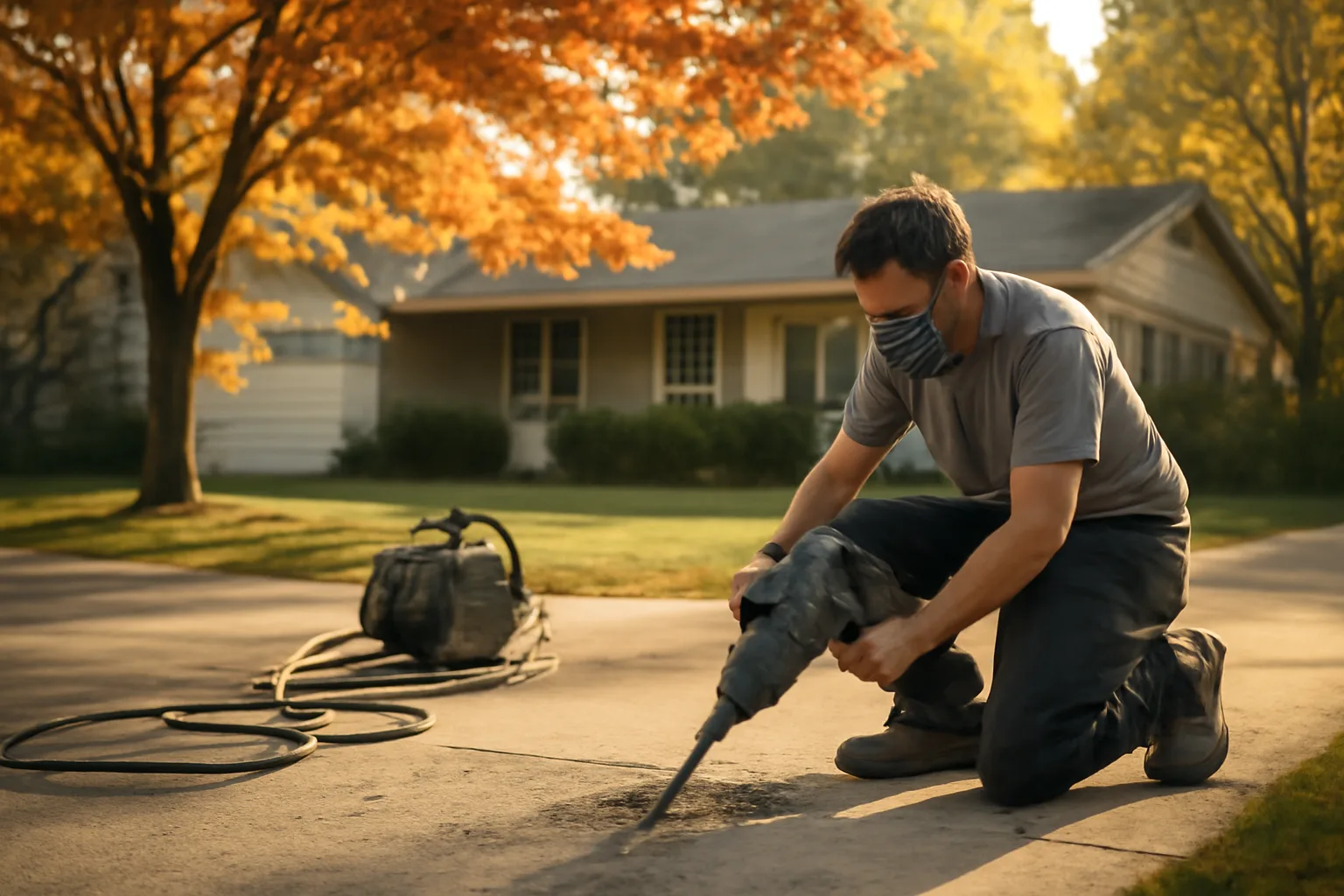
Slab lift is raising a sunken concrete slab by pumping fill under it until the panel moves back toward the height you want. You drill injection holes, pump grout or expanding polyurethane, watch the lift with a level, then patch the holes. You keep the existing slab. You do not tear it out.
That is the whole job. People also call it slabjacking, mudjacking, foam lifting, or concrete lifting. Highway crews have done a version of this for decades. FHWA's Slab Stabilization Guidelines for Concrete Pavements (report HIF-16-005) describe injecting material under concrete pavement to fill voids and restore support under the slab [1]. FHWA published that report in 2016 [1].
Residential and light commercial work is just smaller. Driveways, sidewalks, garage floors, warehouse aisles, patio slabs, pool decks. The slab dropped because the soil under it moved, washed out, or was never compacted right. The concrete is often still sound. Replacing it is loud, slow, and wasteful if the panel can come back to grade.
Two material families dominate private work. Cementitious slurry (classic mudjacking) uses a pumpable mix of cement, soil or sand, and water. Polyurethane foam uses two liquid components that react, expand, and harden under the slab. Both lift. They do not behave the same on weight, hole size, cure time, or moisture.
Slab lift is not a soil transplant. If water is still cutting a void, or clay is still swelling, the slab can drop again. You are selling a lift and a fill. Drainage and the source of the void are separate line items, and I would write them that way on the proposal.
How do you start slab lift?
You start slab lift by confirming the contractor license your state and city actually require, then building the paper around that license before you buy a pump. Get an entity and an EIN. Buy general liability and auto. Add workers comp the day you have a helper. Train on the injection system you will run. Then take paid work you can stand behind.
The national myth is that a weekend foam class makes you legal in all 50 states. It does not. Contracting law is state law, and sometimes city law. California treats this as contractor work under Contractors State License Board classifications such as C-8 Concrete [6]. Florida Statute 489.113 states, "No person who is not certified or registered shall engage in the business of contracting in this state" [8]. Other states leave more of it to municipalities. Confirm with the board that issues the card. Do not confirm with a forum.
You also start with a method choice. Foam rigs and mudjacking pumps are different capital bets. Do not finance both in month one. Pick the work you can sell nearby, then buy the smallest honest setup that can finish a driveway without begging a rental yard mid-job.
Training should come from the equipment and chemical supplier plus time watching a crew that already does this. OSHA still expects you to handle silica from drilling concrete and, if you run foam, isocyanates in the chemical system [2][4]. That is not optional orientation. That is the job.
Crew pay tracks other concrete trades. The BLS Occupational Outlook Handbook lists the median annual wage for cement masons and concrete finishers at $54,660 in May 2023 [9]. Check the live table before you write a plan, because BLS updates it.
Can't name your license class, your GL limits, and your SDS binder? Then you haven't started. You have shopped for a truck.
Is slab lift the same as foundation repair?
No. Slab lift raises a concrete panel that has dropped. Foundation repair usually means stabilizing a building's foundation system, which can include piers, brackets, drainage, and structural design. Some houses sit on a slab-on-grade, so the two jobs can meet on the same address. They are still different scopes.
Call about a sunken driveway, you are in slab lift. Call about cracked brick and sticking doors, stop. That can be expansive clay moving a foundation, not a floating sidewalk panel. Colorado Geological Survey describes how swelling soils damage foundations and flatwork when clay takes on water [13]. USGS Circular 1182 documents land subsidence as a separate, often regional process tied to groundwater and related causes [12].
I would not sell a foam lift as a foundation repair. I also would not send every patio to a structural engineer. Use an engineer when the slab is part of the building, when you see structural distress, or when a building official asks for it. For a detached sidewalk, that is usually overkill.
Some companies blur the language because "foundation" sells. That gets people into work they cannot license or insure. Read your policy. Many GL forms treat structural foundation work differently from flatwork lifting. Confirm with the carrier, in writing.
What license do you need to start slab lift?
The license you need is the contractor classification your state board (or city) assigns to concrete repair and flatwork, unless your state has a narrower specialty. There is no single federal slab lift license. Confirm the class and any dollar threshold with the board before you advertise.
California's C-8 Concrete classification covers poured concrete work, including slabs and related concrete construction, under the Contractors State License Board [6]. California Business and Professions Code section 7026 defines a contractor as a person who undertakes or offers to construct, alter, repair, or improve a structure or project for compensation [5]. Unlicensed contracting is a separate offense under section 7028 [7].
Florida splits certified (statewide) and registered (local) contractors under chapter 489. Contract without that credential and you are in 489.113 territory [8].
Other states look different. Some have no statewide residential contractor license and push it to the city. Some fold this into a general building license above a contract-dollar trigger. That is why a slab lift board in california page will not match slab lift board in arizona or slab lift board in georgia. Read the one for your state.
I would not start by stacking three specialty licenses "just in case." I would call the board, describe the work in plain language (drill, inject, lift, patch existing slabs), and write down the class they name. Get that answer in email if you can.
Handyman exemptions exist in some states under a dollar cap. Slab lift jobs blow through those caps fast, and many exemptions ban advertising as a contractor. Do not build a company on an exemption you have not read.
What insurance and jobsite paper do you need in year one?
In year one you need general liability, commercial auto (or hired and non-owned if you truly have no commercial unit), and workers comp once you have employees. Some states want the owner on the comp policy too. You also need a written hazard communication program and SDS for every chemical you pump, plus a silica plan if you drill or cut concrete. Confirm required limits with owners, GCs, and your state.
I will not quote a premium. Those numbers move with claims, state, and whether you handle foam chemicals. Anyone publishing a national average GL cost for slab lift is guessing.
OSHA's Hazard Communication Standard requires chemical manufacturers to classify hazards and employers to keep SDS and train workers on the chemicals in their workplace [3]. Foam systems bring isocyanate sheets. Cementitious grout brings cement alkali and silica. Treat both as real programs, not a binder you print the night before an audit.
Hire employees and workers comp becomes a state statute, not a vibe. Misclassifying helpers as 1099s to dodge it is how first-year operators meet investigators.
Pollution or contractor's pollution coverage comes up with chemical injection. Ask the broker. Do not assume a cheap GL form likes polyurethane under a slab next to a well. Bonding is a license issue in some states and a GC issue on commercial sites. Confirm the amount with the board. Never invent a current bond figure from a blog.
Should you start with mudjacking or polyurethane foam?
Start with the method your market already buys and that you can service, not the method with the flashiest demo video. Foam uses smaller holes, lighter material, and a faster set. Mudjacking uses cheaper bulk material, a heavier fill, and a pump most mechanics can understand. Both lift slabs.
Highway practice leaned on cementitious undersealing for a long time. FHWA's 2016 slab stabilization guidance is built around restoring support under pavement slabs, with grout injection as the core practice [1]. Private foam work grew later. Nobody has one clean national study that settles 10-year driveway callback rates for foam versus slurry. The closest public body of practice is pavement undersealing, and those slabs, loads, and specs are not your HOA driveway.
I would not buy a foam proportioner because a seminar said slurry is dead. Slurry still works on thick exterior slabs where extra weight helps. I would not start with a giant mud pump if every competitor in town sells foam through small holes and homeowners hate baseball-size patches.
Material cost per cubic foot is not the bid. Labor, travel, patches, callbacks, and chemical storage are the bid. Foam chemicals have shelf life and temperature limits. Slurry has mess and disposal. Pick your headache on purpose.
| Method | Typical holes | Fill | Time to walk | Main drawback |
|---|---|---|---|---|
| Polyurethane foam | Often under 1 in. | Expanding, light | Often minutes | Chemicals and material cost |
| Cementitious slurry | Often 1 to 2 in. | Heavy grout | Hours, mix dependent | Mess and larger patches |
What equipment do you actually need on day one?
Day one you need a way to drill, a way to pump, a way to measure lift, and a way to patch. For slurry that is a mixer, a grout pump, hose, and injection fittings. For foam that is a proportioner, heated hose if the system needs it, and the chemical drums the manufacturer specifies. Add a generator, water, PPE, a laser or digital level, and a truck that is legal.
Skip the wrap, the extra dump trailer, and the CNC-cut yard sign in month one. Those do not lift concrete.
Used pumps show up cheap because someone else already learned the maintenance. Budget for rebuild kits and a spare drill motor. Downtime on a two-person crew is how you miss the week's only good weather.
I would rent a rotary hammer set before I owned five of them. I would not rent the pump after week two if this is the business. Rental rates punish you and you never learn the machine.
Confirm electrical and pressure specs with the equipment maker. I will not invent a PSI rating or a drum price. Those change by brand. Buy the smallest rig that finishes a two-car driveway without a second trip for material.
What does OSHA care about on a slab lift job?
OSHA cares about the dust you make drilling concrete, the chemicals you pump, the PPE you skip, and whether anyone can prove you trained the crew. Silica and isocyanates are the two exposure stories that separate this trade from plain flatwork.
29 CFR 1926.1153 says, "The employer shall ensure that no employee is exposed to an airborne concentration of respirable crystalline silica in excess of 50 μg/m3, calculated as an 8-hour TWA" [2]. The action level is 25 µg/m3. Drilling injection grids in old concrete is a silica task. You need the specified exposure control methods or air monitoring, plus housekeeping that does not include dry sweeping clouds around the driveway.
Run polyurethane and you are in isocyanate country. NIOSH Alert 96-111 treats diisocyanates as occupational hazards that can irritate skin, mucous membranes, and the respiratory tract and can cause chemically induced asthma [4]. OSHA Table Z-1 sets a ceiling for methylene bisphenyl isocyanate (MDI) of 0.20 mg/m3 [11]. That is a ceiling, not an all-day average you can make up later.
PPE rules sit in 29 CFR 1926.95. The employer provides and requires the equipment when hazards are present [14]. Gloves, eye protection, and the respirator your program actually fit-tests are not optional fashion.
I would write the silica plan and the hazcom training before the first paid hole. Inspectors do not care that you are new. OSHA sets the respirable crystalline silica PEL for construction at 50 µg/m3 as an 8-hour TWA in 29 CFR 1926.1153 [2].
How do you bid slab lift work without guessing?
You bid slab lift by measuring the area, estimating void and lift height, converting that to material, then adding labor hours, travel, patches, and a callback reserve. You do not bid a Facebook per-square-foot number you saw from another state.
Lift height is not uniform. A slab that dropped 1.5 inches on one corner and 0.25 inches in the middle is a different material ticket than a uniform 0.5 inch. Probe or sound for voids. Look at drainage. If water is still running under the slab, your bid needs a drainage note or you need to walk.
I build a simple sheet: square feet, average lift, estimated void factor, material unit, labor hours, mobilization, patch count, tax. Then I walk the site again because the first estimate is always kind.
Want a ready worksheet? SlabLiftPath publishes a $149 one-time Mix + Bid-per-Sqft Kit at /start. You can also make the same sheet in an afternoon. The kit is optional. The discipline is not.
Never guarantee a municipal fee or a board processing time in a bid. Confirm those with the building department. Never promise an approval date. Commercial work wants certificates of insurance, maybe a bond, maybe certified payroll. Those are not later. They change the number.
What soils and slab failures are you lifting against?
You are lifting against whatever failed under the slab. Common residential causes are poorly compacted fill, water washing fines out, leaking laterals, and expansive clay that swells and shrinks. The lift does not rewrite the soil report.
USGS Circular 1182 documents how land subsidence from groundwater and related processes damages infrastructure across the United States [12]. That is the regional version. The local version is a downspout dumping beside a garage slab for eight years.
Colorado Geological Survey explains that swelling soils expand when wet and shrink when dry, which moves foundations and flatwork [13]. Pump a patio in that setting and ignore grading, and you will be back.
I would refuse jobs where a broken sewer is still open under the slab, unless plumbing is in the contract first. I would also refuse to "just foam it" when the slab is broken into rubble. Lift needs a panel that can act as a panel.
A soil survey is free context, not a site investigation. For a house with structural cracks, get an engineer. For a city sidewalk flag, look at the base and the tree roots and move on.
What records should you keep from the first job?
Keep before and after photos with a level in the frame, a simple elevation sketch, material lot numbers, the SDS revision dates, the signed proposal, change orders, and the check. IRS Publication 583 is the starter map for business records and why the Service expects you to keep them [10].
Photos win the callback argument. Measurements win it faster. I mark lift at the same points I shot before injection. If you cannot show 1.25 inches at the corner you promised, you are negotiating from memory.
Chemical lot numbers matter if a foam batch behaves badly. Cement tickets matter less on a driveway, more on a spec job.
Get an EIN if you hire or you form an entity. The IRS explains the online EIN application for employers and eligible entities [15]. Do not use your social on invoices once you have a company.
Keep the silica training roster. Keep fit-test records if you use respirators. These are boring files. They are also the files that end an OSHA visit early.
Which state board do you call before you advertise?
Call the contractor licensing board (or the city building department if your state has no statewide license) before you print a door hanger. Describe the work. Ask which classification, which exam, which bond, and which insurance they want to see. Then read the statute they cite.
Start with your state, not a national association blog. In Florida, you are in chapter 489 and the Construction Industry Licensing Board process [8]. In California, you are in the CSLB class system and Business and Professions Code chapter 9 [5][6]. In Colorado, Alabama, or Idaho, the answer changes. Use a state page such as slab lift board in florida, slab lift board in colorado, slab lift board in alabama, or slab lift board in idaho as a map to the agency, then confirm every fee and form on the board's current page.
SlabLiftPath is an independent publisher, not a law firm and not a service company. We do not issue licenses and we do not process applications. For worksheets, see /start. For the legal answer, see the board.
If a salesperson says the class is optional because you "inject, you don't construct," get that in writing from the board. I have never seen that story survive a complaint.
Frequently asked questions
What is slab lift?
Slab lift is raising a sunken concrete slab by injecting grout or polyurethane foam underneath until the panel comes back toward grade, then patching the holes. You keep the existing concrete. Highway crews call a related practice slab stabilization. It is a repair of support under a slab, not a new pour and not a full foundation rebuild.
How do you start slab lift?
Confirm the contractor class with your state board or city, form an entity, get an EIN if you need one, buy liability and auto insurance, add workers comp when you have help, and train on silica plus your injection chemicals. Then buy or lease one pump system. A weekend class does not replace a license. Confirm every fee with the board.
How much does a slab lift contractor license cost?
There is no honest national fee. California, Florida, and city-only states charge different application, exam, and bond amounts, and those numbers change. I will not invent a current fee. Open the board's license fee page for your class and read this year's amount. If a blog lists a number without a year and a form name, ignore it.
Can I do slab lift as a handyman?
Only if your state's handyman exemption covers the contract amount and the type of work, and many do not once you advertise as a contractor or exceed a dollar cap. Slab lift jobs often exceed those caps. Confirm the exemption text with the board. I would not build a company on an exemption.
Is polyurethane foam lifting better than mudjacking?
Not always. Foam usually means smaller holes, lighter fill, and a fast set. Slurry is cheaper in bulk, heavier, and familiar on pavement work. FHWA slab stabilization guidance is built around restoring support under concrete pavements, historically with grout. Residential callback data is thinner than sales decks imply. Pick what you can service.
Do I need a specialty classification or a general contractor license?
It depends on the state. California often points concrete flatwork toward classes such as C-8. Florida uses certified or registered contractor categories under chapter 489. Some states only care above a dollar threshold or leave it to the city. Describe the work to the board and write down the class they name.
What training is required for polyurethane injection?
OSHA does not issue a foam card. You still need hazard communication training, chemical-specific SDS training, and a respirator program if you use respirators. Suppliers run equipment classes. Those classes do not replace a contractor license. NIOSH treats diisocyanates as asthma hazards, so treat sensitization as a real risk.
Does slab lift fix the soil problem or just the slab?
It fills a void and lifts the panel. It does not stop a leaking pipe, a downspout, or expansive clay from moving again. Fix water first when water caused the drop. Swelling soils, described by sources such as the Colorado Geological Survey, keep moving with moisture. Say that out loud in the proposal.
How big a hole do you drill for slab lift?
Foam jobs often use holes under an inch. Slurry jobs often use holes in the 1 to 2 inch range. Those are field norms, not a national code. Hole pattern depends on slab thickness, void, and the port system. Patch quality is what the owner sees. Do not invent a single required diameter.
Can I start slab lift without employees?
Yes. Plenty of first-year operators run owner-only. You still need the license your state requires, GL and auto, and the same OSHA programs once you add people. Some states still want workers comp on the owner. Confirm. Solo work is slower on big slabs. Do not fake a crew on the website.
What happens if I lift a slab and it cracks?
Existing cracks often open or shift during a lift. New cracks happen when a panel is already weak or you lift too fast on one port. Say that in the contract. Photos and pre-lift crack maps save you. If the slab is rubble, replacement is the honest bid. I would not promise a crack-free lift.
Do I need an engineer stamp?
Not for most detached flatwork. Yes when the slab is the building, when you see structural distress, or when the building official asks. Expansive-soil foundation movement is a different problem than a sunken sidewalk. If you are unsure, pause and get an engineer. Guessing on a house slab is how you buy a claim.
Is slab lift seasonal?
In cold climates, chemical temperature and frozen ground limit foam and slurry work. Rain and standing water under a slab also stop a clean lift. Plan cash for the off months. Southern markets run longer. I would not staff like July is permanent.
Where do I confirm my state's contractor rules?
The contractor licensing board or, if your state has no statewide license, the city or county that issues contractor registrations. Read the statute and the current fee page. State-by-state maps help you find the agency. Confirm processing times and fees there. Nobody else can bind the board.
Sources
- FHWA HIF-16-005 Slab Stabilization Guidelines for Concrete Pavements: FHWA guidance describes injecting material under concrete pavement slabs to fill voids and restore support; report published 2016.
- OSHA 29 CFR 1926.1153 Respirable crystalline silica: Construction employers must keep respirable crystalline silica at or below 50 µg/m3 as an 8-hour TWA; action level is 25 µg/m3.
- OSHA 29 CFR 1910.1200 Hazard Communication: Employers must maintain SDS and train workers on hazardous chemicals in the workplace.
- NIOSH Publication 96-111 Preventing Asthma and Death from Diisocyanate Exposure: NIOSH identifies diisocyanates as occupational hazards that can irritate the respiratory tract and cause chemically induced asthma.
- California Business and Professions Code section 7026: California defines a contractor as a person who undertakes or offers to construct, alter, repair, or improve a structure or project for compensation.
- CSLB C-8 Concrete classification: California C-8 Concrete covers poured concrete work including slabs and related concrete construction.
- California Business and Professions Code section 7028: Acting in the capacity of a contractor in California without the required license is a punishable offense.
- Florida Statute 489.113 (2023): Florida law states that no person who is not certified or registered shall engage in the business of contracting in the state.
- BLS Occupational Outlook Handbook, Cement Masons and Concrete Finishers: Median annual wage for cement masons and concrete finishers was $54,660 in May 2023.
- IRS Publication 583 Starting a Business and Keeping Records: IRS guidance on records new businesses should keep for income, expenses, and substantiation.
- OSHA 29 CFR 1910.1000 Table Z-1: OSHA Table Z-1 lists a ceiling of 0.20 mg/m3 for methylene bisphenyl isocyanate (MDI).
- USGS Circular 1182 Land Subsidence in the United States: USGS documents land subsidence, including groundwater-related processes, as a cause of infrastructure damage in the United States.
- Colorado Geological Survey, Swelling Soils: Swelling soils expand when wet and shrink when dry, which can move foundations and flatwork.
- OSHA 29 CFR 1926.95 Criteria for personal protective equipment: Construction employers must provide and require PPE when hazards are present.
- IRS Apply for an Employer Identification Number (EIN) Online: The IRS provides an online EIN application for employers and other eligible entities.