Last updated 2026-08-21
TL;DR
Slab lift raises a sunken concrete slab by pumping grout or expanding polyurethane under it. You start with an entity, a free IRS EIN, the insurance a job or state demands, and a call to your contractor board about class. No federal slab lift license exists. Drill dust is silica under OSHA 1926.1153. Foam uses isocyanates. Confirm every fee with the board.
What is slab lift?
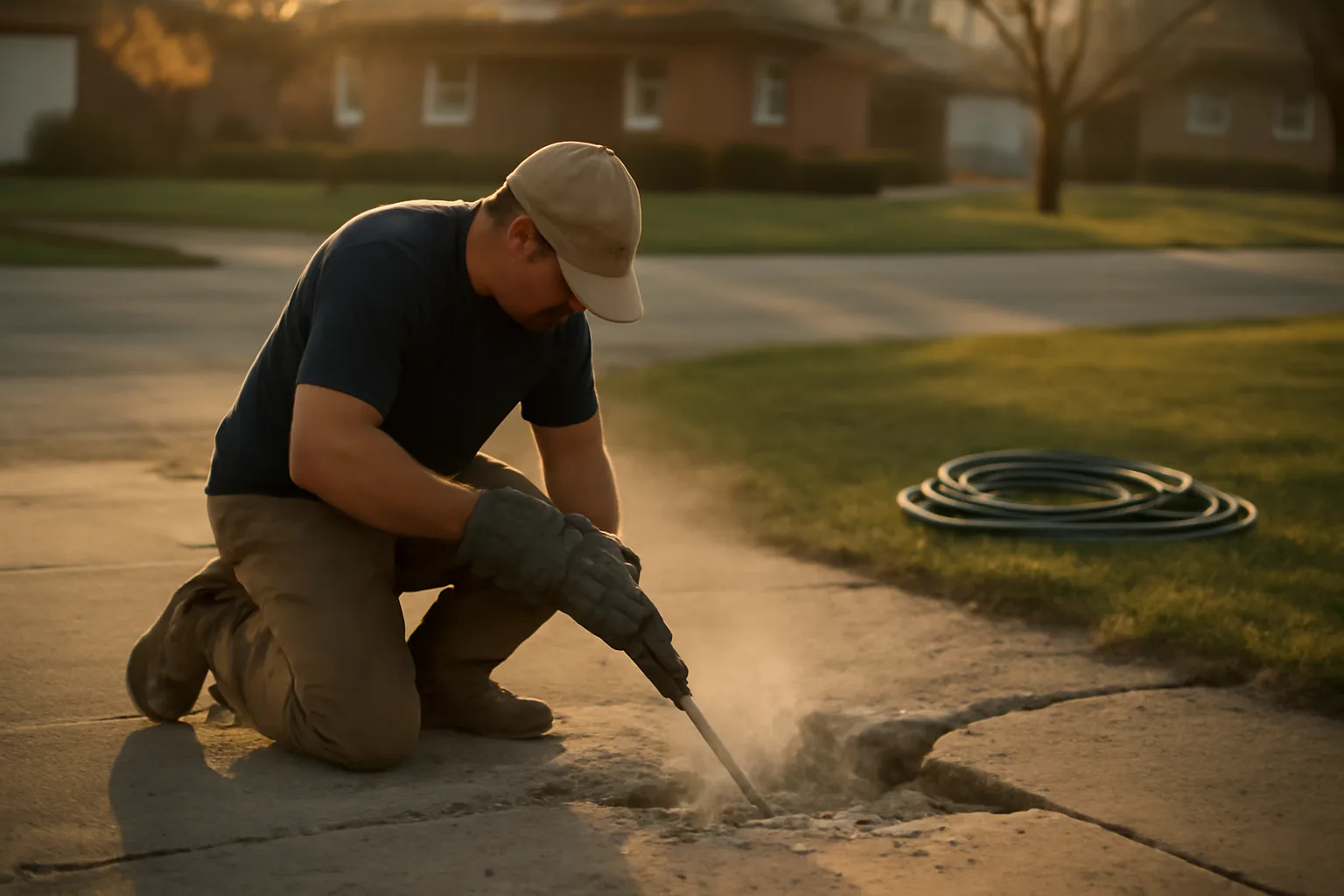
Slab lift raises a settled concrete slab by pumping material under it until the slab comes back toward the grade you want. You are filling voids and pushing up from below. You are not tearing the slab out. You are not pouring a new one.
Two methods cover most jobs. Mudjacking (some people say slabjacking) pumps a cementitious slurry through holes you drill in the slab. Polyurethane slab lift pumps a two-part foam that expands and then hardens. Highway crews have run undersealing and slabjacking on concrete pavement for decades. A residential driveway is the same idea, smaller.
I would not call this foundation repair on a contract until the licensing board says that class fits. Driving piers under a footing is a different scope. Mixing those words on a bid is how people wander into a class they do not hold.
The physical sequence sounds simple and is easy to botch. You map the low spots, check for utilities, drill a pattern, inject, watch the slab with a level or laser, stop before you crack a high corner, patch the holes, and clean the site. Commercial work adds traffic control and a spec book.
Census NAICS 238110 (Poured Concrete Foundation and Structure Contractors) is the closest federal industry box for poured concrete trades. Slab lift shops often file there or under a broader specialty-trade code. Confirm what your insurer and tax software actually want. [13]
Came here from a career-switch piece? Read slab lift vs nearby career after this page. This guide stays on the paper path.
How do you start slab lift?
You start on paper, not on a truck. Form an entity your state filing office recognizes, get a free EIN from the IRS if you need one, open a business account, buy the insurance the state or the job actually requires, then ask the contractor board (or the city) whether slab lift sits under concrete, general contracting, or a local specialty rule. There is no federal slab lift card. [5]
Then you train on the rig you will run. Foam proportioners and slurry pumps are not the same machine. I would not buy a new custom foam truck in month one unless work is already under contract. A used pump a supplier will still support, a clean trailer, a drill, a silica-rated vac, and PPE get more people to a first paid slab than a wrap ever will.
Do it in this order. Entity. EIN. Bank account and a bookkeeping habit. Workers compensation and liability if you have employees or a contract that demands the certificate. License or registration check with the board. SDS file plus a written silica and chemical plan. Supplier account. A written bid and a change-order habit.
Confirm every fee and processing time with the board that issues the card. SlabLiftPath is an independent publisher, not a board and not a contractor. Nobody here can promise you an approval date.
Want a harder-state reality check next? Use The hardest states for slab lift work (and why they hurt).
Do you need a contractor license for slab lift?
Often yes, once you bid someone else's property. The class and the agency change by state and sometimes by city. There is no federal slab lift license. Your job is to read the class description and confirm it with the board, not with a forum.
California is blunt. Business and Professions Code section 7028 says: "It is a misdemeanor for a person to engage in the business or act in the capacity of a contractor within this state without having a license therefor, unless the person is particularly exempted from the provisions of this chapter." [8] CSLB's C-8 Concrete classification is the box many concrete specialty shops start from. Confirm the current class text with CSLB before you print it on a truck. [12]
Florida chapter 489 is the contractor statute. Section 489.113(1) requires a person who wants to contract statewide to establish competency and qualifications to be certified under that part. [7] Section 489.105 is where the definitions live, including who counts as a contractor. Read both. [6]
Arizona makes unlicensed contracting its own problem. Arizona Revised Statutes 32-1151 bars acting in the capacity of a contractor without the license the Registrar of Contractors requires. [9]
Some states leave general contracting to cities. That does not set you free. A permit counter can still stop you. Lifting only your own slab is usually not contracting. Bidding a neighbor's driveway is.
Paying a license mill that will not show you the statute is a waste of money. Read the class, then file. For neighboring writeups in this series see slab lift guide 12 and slab lift guide 24.
What safety rules hit slab lift on day one?
Two hazards show up on almost every slab lift job: respirable crystalline silica from drilling concrete, and, if you run foam, isocyanates in the chemical system. Treat both as real, not as toolbox-talk filler.
OSHA's construction silica rule is 29 CFR 1926.1153. The standard says: "The employer shall ensure that no employee is exposed to an airborne concentration of respirable crystalline silica in excess of 50 μg/m3, calculated as an 8-hour TWA." [1] The action level is 25 μg/m3. Table 1 in that same standard lists specified exposure control methods for many drilling tasks. Follow Table 1 with the shroud, water, or vac the table names, and you can skip a full exposure assessment for that task. Freelance the method and you own the assessment. OSHA's construction silica fact sheet (OSHA 3681) is the readable version of the same rule. [11]
Foam systems commonly use methylene diphenyl diisocyanate (MDI) or related isocyanates. NIOSH's isocyanates topic page states that isocyanates are powerful irritants to the mucous membranes of the eyes and gastrointestinal and respiratory tracts, and that workers can become sensitized. [4] EPA publishes an MDI fact sheet under TSCA risk management. [10] Once someone is sensitized, later exposures can go badly at levels that did not bother them last year.
Hazard communication still applies. 29 CFR 1910.1200 (and the construction pointer at 1926.59) requires labels, safety data sheets, and training on the chemicals you bring to a driveway. [2] PPE rules sit in 29 CFR 1926.95. [3]
I would buy a HEPA vac that is actually rated for silica and the respirator cartridges the SDS names before I bought a vinyl wrap. The wrap does not keep anyone's lungs legal.
What paper do you file before the first paid job?
File the entity with your state corporations office, then get an EIN if you need one. The IRS online EIN application is free. If a site asks you to pay for an EIN, you are on the wrong site. [5] Open a bank account in the business name so job money does not hit a personal card and stay there.
Then the local layer. Many cities want a business tax certificate. That is not a contractor license. If the state or city treats slab lift as contracting, file that application and wait for the board. Confirm the current checklist on the board's license-class or application page. Do not trust a blog's memory of last year's exam outline.
Hire anyone and most states require workers compensation. General liability is what a GC or a property manager wants to see before you drill. OSHA injury-and-illness recordkeeping under 29 CFR 1904 applies once you meet the size and industry tests in 1904.1. Partial exemptions exist for small employers in certain industries. Read the section. Do not guess. [14]
SBA's page on choosing a business structure is a decent federal overview of sole prop versus LLC versus corporation. It will not pick your contractor class. [15]
Write the contract. Scope. What happens if the slab is too broken to lift. Who marks utilities. Who owns callbacks. In lien states, the preliminary notice rules are their own statute. Confirm those dates with the state lien law. I will not invent them here.
How much money do you need to start slab lift?
Nobody has a clean national start-cost study for this niche. Treat any single "you need $X to start" post as marketing. The closest federal wage series is BLS Occupational Outlook Handbook data for cement masons and concrete finishers, a cousin occupation, not a slab lift census. Read the current OOH table if you want a wage benchmark. Do not treat it as your revenue. [16]
What I would spend on first: the state entity fee (confirm it), an insurance deposit, a drill, a silica-rated vac, PPE, a rotary laser or good levels, and a used pump the chemical or slurry supplier will still talk to. What I would wait on: a new custom rig, radio ads, a second crew, and anything with your name in three-foot letters.
Polyurethane programs sometimes come with minimums. Ask, in writing, what happens if you only do two driveways a month. A cheap drum price that assumes a volume you do not have is not cheap.
Want bid paper instead of a per-square-foot number invented on a napkin? SlabLiftPath sells a $149 one-time Mix + Bid-per-Sqft Kit. That kit is not a license and it is not insurance. The rest of this page works if you never buy it.
Should a new shop start with mudjacking or polyurethane?
Start with the method you can get parts, training, and a supplier for within a day's drive. An orphaned foam machine is a paperweight. An orphaned slurry pump is a heavy paperweight.
Slurry (mudjacking) materials are familiar to a lot of city inspectors. The mix is cementitious. You add weight to the soil. Holes tend to be larger. Cleanup is messier. Foam is lighter on weak fill, usually means smaller holes, and can return traffic faster on many jobs. The chemistry is less forgiving and the SDS is not optional.
Both methods are still contracting once you bid someone else's slab. The license class does not shrink because your hose is smaller.
I would not buy both plants in year one so I could "offer everything." Pick one. Get good. Add the second method when the calendar and the shop space justify it. For more side-by-sides in this series, see slab lift guide 30 and slab lift guide 36.
| Factor | Slurry (mudjacking) | Polyurethane foam |
|---|---|---|
| What you pump | Cementitious mix | Two-part isocyanate foam |
| Main extra hazard | Silica in dust and mix | Isocyanates, plus silica from drilling |
| Added load on soil | Higher | Lower |
| Inspector familiarity | Often higher | Mixed, depends on the city |
| License question | Still a board question | Still a board question |
| Year-one advice | Easier if you already know concrete mix | Only if the supplier will train you |
What insurance do you actually need for slab lift?
You need what the state requires for your headcount, plus what the site will not let you enter without. That is usually workers compensation once you have employees, auto on the truck, and commercial general liability if you want to work for anyone who reads contracts.
Read the GL form for injection, pollution, and "your work" language. Some policies get odd about chemical injection under a slab. I have no premium to quote you that would still be true next month, and a fake number would be worse than none. Ask the person who can show you the endorsement.
Expensive pump that leaves the building? Ask about an equipment floater. Inland marine is the boring name for that conversation. Skip identity-theft riders and other junk add-ons until the pump and the people are covered.
Certificates of insurance are how GCs stall you. Build time to send them. Do not start drilling on a handshake because the cert "is coming."
What does a first year in slab lift actually look like?
Lumpy. Paper in month one. A few driveways if your marketing is local and honest. Commercial work pays better and pays slower. You will spend more hours on access, buried lines, and "is this slab one piece or a puzzle" than on the pump itself.
Keep photos, injection volumes, and before-and-after elevations. That file is how you handle a callback without a shouting match. A laser reading you did not write down did not happen.
I would not hire a second person until the book is full two weeks out for several months running. Payroll tax mistakes cost more than they save. Hire anyone and you inherit FLSA pay rules and, in most states, workers compensation from day one of that hire. Confirm classification with DOL guidance if you were about to call everyone a 1099 helper. Misclassification is a real enforcement topic, not a vibe. [16]
Callbacks will happen. Budget a small reserve. A shop that spends every deposit on the next chemical order is one bad slab from stopping.
Which states make slab lift licensing harder?
States with a statewide contractor board and a named concrete or specialty class make you pick a box and often prove experience or pass an exam. California (CSLB), Florida (chapter 489), and Arizona (ROC under Title 32) are the clean examples in the statutes cited above. Confirm current exam bulletins with those boards. Do not treat this paragraph as the bulletin. [6][8][9]
States that push contracting down to cities are not "easy." They are uneven. One county issues a privilege license and shrugs. The next wants a bond and a test. You find out at the permit desk if you did not call first.
No one can honestly promise you a timeline. Boards change queues. If a site guarantees a date, they are selling something else.
The companion piece is The hardest states for slab lift work (and why they hurt). Use it for the comparison, then still call the board.
What equipment do you need on the first slab lift job?
You need a way to drill concrete, control the dust, inject the material you chose, and measure lift. That means a drill, a silica-rated vac or wet method that matches OSHA Table 1 for the task, a pump or proportioner, hoses, a level or rotary laser, patch material, and cones if cars still use the driveway. A generator if the site is dead. [1]
You also need the SDS packet in the truck, the respirator the SDS names, and gloves that match the chemical. Foam shops need the temperature and ratio discipline the supplier trained. Slurry shops need a mix that will pump and then set, not a random bagged blend.
Waste of money: buying both a full slurry plant and a foam rig in month one. Waste of money: a second truck before the first one is paid for. Spend on dust control and measurement. Those two things keep you legal and keep you from over-lifting a corner.
How do you bid slab lift without guessing?
You bid after you see the slab, the soil story, and the access. Per square foot, per inch of lift, per estimated void, or a day rate plus material can all work. Soil that will not hold material will eat a pretty per-foot number. I walk away from a slab that is already a pile of loose pieces unless the owner signs a repair-plus-lift scope.
There is no honest national price list. Replacement cost is your ceiling. If lift will cost more than rip-out and pour, say so on the first visit. That conversation saves you a bad review and a board complaint.
Write exclusions. Utilities. Hidden voids under a loaded rack. A slab hung up on a footing. Weather that kills foam reaction or slurry set. If it is not in the bid, you will do it for free.
More comparison pages in this series: slab lift guide 42 and slab lift guide 48.
What records should you keep for the board and for OSHA?
Keep the license or registration, city certificates, insurance, SDS file, silica plan, training roster, contracts, change orders, injection logs, and elevation photos. Have staff? Keep I-9s and payroll. Keep the IRS EIN letter. That pile is boring and it is exactly what an investigator wants to see.
OSHA's 1904 rules tell you when a 300 log is required. Small shops sometimes qualify for a partial exemption, but you still report severe injuries on the timelines OSHA names. Read 1904.1 rather than copying another shop's binder. [14]
Want a next step on paper kits after you have the statutes straight? The site start page is /start. Use it or ignore it. The board still wins either way.
A clean claim you can reuse: OSHA sets the respirable crystalline silica limit for construction at 50 μg/m3 as an 8-hour TWA in 29 CFR 1926.1153. [1] Another: the IRS does not charge a fee for an EIN filed on its own application. [5]
Frequently asked questions
What is slab lift?
Slab lift is raising a sunken concrete slab by pumping slurry or expanding polyurethane under it so the slab moves back toward grade. You drill, inject, watch a level, and patch. It is not a full replacement pour and it is not the same scope as piering a footing. Confirm the license class before you sell it as foundation work.
How do you start slab lift?
Start with an entity, a free IRS EIN if you need one, a business bank account, required insurance, and a call to the contractor board or city about class. Then train on one injection method and buy dust control before you buy advertising. There is no federal slab lift license. Confirm every fee and timeline with the board that issues the card.
Is slab lift the same as mudjacking?
Mudjacking is one slab lift method. It pumps a cementitious slurry under the slab. Polyurethane slab lift is the other common method. Both raise concrete. They use different machines, different hole sizes in practice, and different chemical hazards. The contractor-license question is usually the same once you bid someone else's property.
Is there a federal slab lift license?
No. Licensing sits with states and sometimes cities. California BPC 7028, Florida chapter 489, and Arizona ARS 32-1151 are examples of state contractor statutes. OSHA still applies on the job for silica, PPE, and hazard communication even when no state slab lift card exists. Confirm class language with the board, not with a national myth.
Does drilling concrete for slab lift trigger OSHA silica rules?
Yes if you have employees on a construction worksite. 29 CFR 1926.1153 sets a 50 μg/m3 8-hour TWA limit and a 25 μg/m3 action level. Table 1 lists control methods for many drilling tasks. Follow the table or run your own assessment. A shop vac from a hardware aisle is not a silica program.
Are polyurethane foam chemicals a real exposure issue?
Yes. Many slab lift foams use MDI or other isocyanates. NIOSH warns that isocyanates irritate eyes and airways and can sensitize workers. EPA publishes MDI fact sheets under TSCA. Keep the SDS in the truck and wear what it names. Sensitization is not something you shrug off after a weekend.
Can I start slab lift as a sole proprietor?
Often yes, as a tax structure. SBA outlines sole prop, LLC, and corporation tradeoffs. A sole prop does not skip contractor licensing, local business tax, or OSHA duties if you hire. An EIN is still wise once you have employees or want a bank account that is not your personal name. Confirm entity rules with your state filing office.
Do I need workers compensation to do slab lift?
If you have employees, most states require it. If you are truly alone, some states still want an exemption filing. GCs will often demand a certificate anyway. I would not step onto a commercial slab without the certificate the contract names. Confirm the current rule with your state workers compensation agency.
How long does a contractor license take for slab lift?
It depends on the board, the exam cycle, and whether your experience packet is complete. No honest publisher can promise a date. Confirm current processing language on the board's application page. Anyone selling a guaranteed turnaround is not the board.
Can you lift a slab that is already cracked into pieces?
Sometimes you can lift pieces. Often you just make a rocking puzzle. I would not bid a full lift on a shattered slab unless the owner accepts a written repair-plus-lift scope. Replacement can be the cheaper honest answer. Say that on the first visit.
What NAICS code do slab lift businesses use?
Many file under 238110, Poured Concrete Foundation and Structure Contractors, or a broader specialty-trade code. Census publishes the 2022 NAICS text for 238110. Ask your insurer and your tax preparer what they want on the policy and the return. The code does not replace a contractor license.
Should I buy a foam rig or a mudjacking pump first?
Buy the system you can get trained on and repaired near you. Foam is lighter on weak soil and usually means smaller holes. Slurry is familiar and heavier. Buying both in month one is a waste for most new shops. Pick one method, price it honestly, and add the second only when the calendar is full.
Do I need a CDL to haul slab lift equipment?
Only if the truck meets your state's commercial motor vehicle threshold, which often tracks federal GVWR rules around 26,001 pounds, or if you haul material that triggers a hazmat endorsement. Read the door-jamb GVWR sticker and confirm with your DMV. A trailer plus a heavy pump can cross a line a pickup alone does not.
Where do I confirm my state's contractor class for slab lift?
Call or read the official class description at the state contractor board, or at the city if your state has no statewide general contractor license. In California start with CSLB class text. In Florida read chapter 489 and the CILB application checklist. In Arizona read ROC classifications and ARS 32-1151. Do not treat a national blog as the class.
Sources
- OSHA 29 CFR 1926.1153 Respirable crystalline silica: Construction employers must keep respirable crystalline silica at or below 50 μg/m3 as an 8-hour TWA; action level is 25 μg/m3; Table 1 lists specified controls for many drilling tasks.
- OSHA 29 CFR 1910.1200 Hazard Communication: Employers must have labels, safety data sheets, and training for hazardous chemicals used in the workplace.
- OSHA 29 CFR 1926.95 Criteria for personal protective equipment: Construction employers must provide and require PPE wherever hazards of processes or environment make it necessary.
- NIOSH Isocyanates topic page: Isocyanates irritate eyes and respiratory and gastrointestinal tracts and can sensitize workers.
- IRS Apply for an Employer Identification Number (EIN) online: Businesses can apply for an EIN online through the IRS at no charge.
- Florida Statutes s. 489.105 (2023) Definitions: Florida chapter 489 defines contractor and related licensing terms used by the Construction Industry Licensing Board.
- Florida Statutes s. 489.113 (2023) Qualifications for practice; restrictions: A person who wants to engage in contracting on a statewide basis must establish competency and qualifications to be certified under chapter 489.
- California Business and Professions Code § 7028: Acting as a contractor in California without a license is a misdemeanor unless an exemption applies.
- Arizona Revised Statutes § 32-1151: Arizona prohibits acting in the capacity of a contractor without the license required by the Registrar of Contractors.
- OSHA 3681 OSHA's Crystalline Silica Rule: Construction: OSHA's construction silica fact sheet restates the 50 μg/m3 PEL and explains Table 1 specified exposure control methods.
- CSLB C-8 Concrete classification: California CSLB describes the C-8 Concrete contractor classification used by many concrete specialty shops.
- U.S. Census Bureau NAICS 2022 detail 238110: NAICS 238110 is Poured Concrete Foundation and Structure Contractors, the closest common industry code for poured concrete trades.
- OSHA 29 CFR 1904.1 Partial exemption for employers with 10 or fewer employees: OSHA recordkeeping duties under part 1904 depend on employer size and industry; small employers may have a partial exemption but still have reporting duties.
- U.S. Small Business Administration Choose a business structure: SBA outlines sole proprietorship, partnership, LLC, and corporation options for new firms.
- BLS Occupational Outlook Handbook, Cement masons and concrete finishers: BLS publishes current wage and outlook data for cement masons and concrete finishers, the closest official occupation group to concrete field work.