Last updated 2026-08-21
TL;DR
Slab lift is the trade of raising settled concrete slabs by pumping grout or expanding polyurethane under the panel. You start by confirming whether your state treats it as licensed contracting, getting an EIN if you will hire, buying insurance that matches your method, and learning one method well. There is no national license. Confirm every fee and classification with your contractor board before you bid.
What is slab lift?
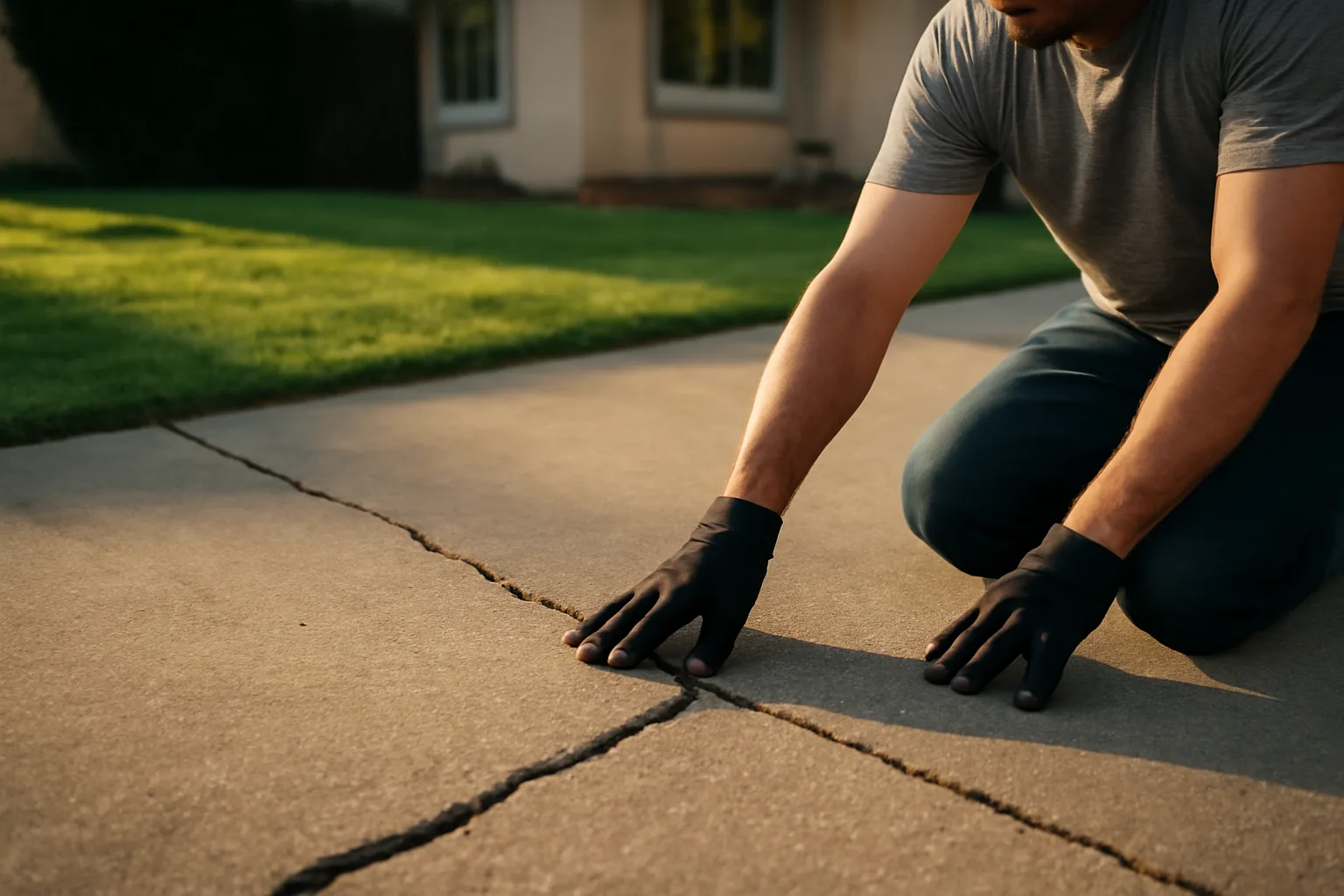
Slab lift is the work of raising a sunken concrete slab back toward level by pumping material under it. You drill a pattern of holes, inject grout or expanding polyurethane, watch the panel come up, then patch the holes. Homeowners buy it for driveways, sidewalks, garage floors, pool decks, and patio slabs that dropped after soil washed out or compressed.
You are not pouring a new slab. You are not smearing compound on the surface and calling it done. The product is the original panel, put back close to grade, with small patches where the ports were.
The soil story is almost always the same. Water moves fines. A downspout dumps next to the slab. Poorly compacted fill settles. The concrete stays in one piece longer than the dirt does, then it tilts. A lift fills the void and uses pump pressure, or foam expansion, to move the panel. You stop when the high side and the low side make sense again. Overlift cracks things. Underlift leaves a trip edge.
People use a pile of names for this. Slab jacking. Mudjacking. Concrete leveling. Polyjacking. Foam lift. Void fill. If a customer says slab lift, they usually mean make this driveway walkable without tearing it out.
This is construction for pay. California law treats a contractor as a person who takes money to construct, alter, repair, or improve a structure or other improvement. The statute says a contractor is "any person who undertakes to or offers to undertake to, or purports to have the capacity to undertake to, or submits a bid to, or does himself or herself or by or through others, construct, alter, repair, add to, subtract from, improve, move, wreck or demolish any building, highway, road, parking facility, railroad, excavation or other structure, project, development or improvement, or to do any part thereof." [4] A driveway is an improvement. Treat the work that way before you print a yard sign.
Census filing is a different animal from a license. The NAICS code many concrete structure shops land in is 238110, Poured Concrete Foundation and Structure Contractors. [13] That code helps on insurance applications and tax software. It does not let you skip a board.
What federal rules already apply on a slab lift job?
Federal construction rules already apply the moment you put employees on a slab lift job. The big three are silica from drilling, hazard communication for the chemicals, and respiratory protection when a respirator is required. There is no OSHA standard titled slab lift, and there does not need to be.
Drilling concrete makes respirable crystalline silica. OSHA's construction rule sets a hard number. "The employer shall ensure that no employee is exposed to an airborne concentration of respirable crystalline silica in excess of 50 μg/m3, calculated as an 8-hour TWA." [2] The action level is 25 μg/m3. Medical surveillance kicks in when an employee will be exposed at or above the action level for 30 or more days a year. Table 1 of that same standard lists control methods for handheld drills. Read the table. Do not invent your own dust story.
Foam systems are not water. Two-part polyurethane uses isocyanates, often MDI. NIOSH has said isocyanates are "powerful irritants to the mucous membranes of the eyes and gastrointestinal and respiratory tracts," and they can cause asthma. [11] That is a chemical exposure problem, not a marketing footnote. You need the safety data sheets. OSHA's hazard communication standard requires you to have them and to train people on the hazards. [14]
If someone needs a respirator, 29 CFR 1910.134 is the program you follow: medical evaluation, fit testing, and a written program. [3] Skipping the program because the cartridge is only for smell is how shops get citations.
One more concrete rule people skip. OSHA says no construction loads go on a concrete structure unless the employer determines, based on information from a person qualified in structural design, that the structure can take those loads. [1] A cracked garage slab with a loaded pump truck parked on it is not a theoretical problem.
Sole proprietors without employees sit in a gray zone on some OSHA duties. State plans differ. Confirm. Your lungs still take the dust.
How do you start slab lift?
You start slab lift by locking the legal path in one state, then buying insurance and one method you can actually run. There is no federal slab lift card. There is no national board that blesses your first driveway.
Read the contractor statute in the state where you will take money. Florida defines contractor classes in chapter 489 and expects the work to sit in a certified or registered class when the statute says so. [7] Washington says you may not act as a contractor without registration. RCW 18.27.020 is blunt about that. [12] California wants a license once the job is no longer tiny. Confirm the class name with the board. Do not trust a Facebook group.
Stand up the boring paper next. Form an entity if you want the liability split. File IRS Form SS-4 if you need an employer identification number. [10] You will need that number for payroll, many bank accounts, and a lot of insurance applications.
Then insurance. General liability, the rig, the truck, and workers' compensation if you have employees. Read what slab lift insurance you need and what it costs before you price a single square foot. A cheap policy that excludes the chemical you pump is not cheap.
Pick mudjacking or foam and learn it. Not both. Not this year.
Ask the city about a business tax, a fictitious name, and whether a sidewalk lift needs a permit. Some cities want a permit. Some do not. Write down who you asked.
Here is what I would actually do. I would work another crew's hose for a season if I could stand it. Then I would bid small exterior slabs with easy access. I would not start on a house foundation. I would not buy a franchise pitch before the board has a file on me.
BLS put the median wage for cement masons and concrete finishers at $54,660 in May 2023. [9] That is adjacent labor, not your net. Nobody has a clean public survival rate for first-year slab lift shops. Anyone who quotes one is selling something.
Is slab lift licensed work in most states?
In most states, paid slab lift is licensed or registered contracting. The label changes state to state. The fact that you use a small hole instead of a ready-mix truck does not turn the job into a weekend hobby.
California's minor work exemption is small. BPC 7048 has long said the chapter does not apply when the aggregate contract price for labor, materials, and all other items is less than five hundred dollars. [5] Confirm the live dollar figure on the statute page before you lean on it, because the legislature can amend that number. A real driveway lift is not a tiny job either way. Contracting without a license is its own offense under BPC 7028. [6]
Florida puts unlicensed contracting in the penalty section of chapter 489. [8] Do not test that.
Washington makes registration the gate. [12]
Texas does not run a single statewide general contractor license the way California does. Cities still have registration, permits, and advertising rules. Confirm with the city and county. I will not invent a Texas slab-lift card.
| Place | What the paper actually is | Who confirms it |
|---|---|---|
| California | Contractor license once the job is over the small statutory exemption | CSLB |
| Florida | Certified or registered contractor under ch. 489 | DBPR |
| Washington | Contractor registration before you act as a contractor | L&I |
| Texas | No statewide general contractor license for this work | City and county |
Boards change classifications. The table is a starting map, not your file. Call the board. Get the class in writing.
If you already hold a concrete class, ask whether lift work sits inside it. California's C-8 Concrete contractor forms, pours, places, finishes and installs specified mass, pavement, flat and other concrete work. [15] Lift and repair language is a board question, not a guess.
What paper do you file before the first slab lift job?
Before the first paid hole, you want four things: a board file (license or registration), a tax ID, a written contract habit, and a permit answer from the building department. Skip the logo until those four exist.
IRS Form SS-4 is how you apply for an EIN. [10] You need it when you have employees. Many carriers and banks want it anyway.
State paper is the long pole. Processing times change. Fees change. I will not quote a current fee or a wait, because both go stale. Confirm them with the board the week you apply. No one honest promises an approval date.
Local paper is messy. Business tax receipt. Fictitious name. Right-of-way permit if the sidewalk is the city's. HOA approval if the driveway sits behind a gate that cares.
Contracts matter even when a state does not dictate every clause. Write the area, the method, the target (level to the adjacent slab, not perfect), what cracks will still be there, and how change orders work. If you cannot explain the leftover crack in writing, you are not ready.
Workers' compensation and unemployment accounts open when you hire. That is not optional in most states. Confirm with the state fund or the insurance department.
Keep the SDS packet in the truck. Hazard communication is still on you. [14]
What insurance do you need before you pump anything?
You need general liability that actually covers concrete raising, auto on the truck, inland marine or scheduled equipment on the pump, and workers' compensation when you have employees. Confirm every exclusion. Foam jobs raise chemical and pollution questions that a generic artisan policy may duck.
I would not pump isocyanate on a form I have not read. NIOSH documented the asthma and irritation risk. [11] Some carriers treat a spill as a pollution event and then exclude it. Ask in writing.
Limits are a broker conversation, not a blog number. Job sites and general contractors will dictate additional insureds and waiver language. Residential driveways are quieter. Commercial lots are not.
For the deeper policy stack, use what slab lift insurance you need and what it costs. Then read slab lift guide 11 and slab lift guide 17 if you want the same questions from another angle.
A year of premium hurts. An uncovered over-lift on a stamped patio hurts more.
Certificates are not policies. Owners ask for a COI. That paper only proves a snapshot. If you cancel for nonpay the week after the job, you still have a claim problem. Pay the thing.
If you add a helper for one Saturday, you may have just created an employee. Confirm with the carrier and the state. A 1099 label does not impress an auditor.
Should you start with mudjacking or foam?
Start with one method. Mudjacking pumps a cementitious slurry under the slab. Foam injects a two-part polyurethane that expands and lifts. Both are slab lift. They are not the same shop.
Mudjacking usually means larger holes, heavier material, cheaper raw ingredients, and more weight on weak soil. Used pumps show up on the secondhand market. You still need a mixer, hoses, and a way to control lift.
Foam usually means smaller holes, faster set, less added weight, and a chemical program you have to respect. Proportioners, heated hose, and A/B storage cost real money. Material cost per job is higher. The sales pitch writes itself. So do the SDS duties. [14]
I would pick based on capital and the work you can reach. If your market is old city sidewalks with cheap access, slurry can still win. If every customer already decided they want tiny holes on a stamped patio, foam is what they will buy.
A waste of money is owning both systems in month three. Another waste is a manufacturer certification that your contractor board will not record.
How much does a starter slab lift setup cost?
There is no official starter price for a slab lift rig, and I will not invent one. Manufacturer quotes move with options, used versus new, and whether the trailer is in the number. You confirm current quotes with the maker or a used dealer.
What you can plan without a fake total: a way to drill, a way to pump, a way to patch, a truck that can legally carry or tow it, silica controls, PPE, and a place to store chemicals that matches the SDS. Foam adds temperature control. Slurry adds sand and cement logistics.
Labor is the line new owners undercount. Two people on a driveway is normal. One person saving payroll on a panel that needs a gauge watcher and a pump operator is how you over-lift.
If you want bid math on paper, SlabLiftPath sells a $149 one-time Mix + Bid-per-Sqft Kit. It is a worksheet kit, not a license and not a pump. This guide still works if you never buy it.
Do not finance a new dump trailer because a sales rep talked about image. A clean used flatbed and a level does more for the first twenty jobs.
How do you price a slab lift job without guessing?
You price a slab by measuring four things (the area, the drop, the access, and the material you will actually burn), then adding labor, mobilization, patching, and the insurance load. There is no honest national average. Anyone publishing one is advertising.
Foam shops often talk square feet, sometimes with a lift band. They also watch pounds of chemical. Slurry shops talk square feet and hole count. If you cannot estimate material on a 400 square foot driveway with a 1.5 inch drop, do not bid it.
Write exclusions. Landscaping you will wreck. Irrigation you cannot see. A slab that is already in four pieces. Interior tile that will crack when the panel moves. If the owner wants the slab to look new, sell a replacement, not a lift.
I would walk away from a bid that only works if nothing surprises you. Something will.
Keep a job cost sheet. First-year operators remember the pump and forget the extra hour of traffic control. That hour is real.
For more on the risk side of a bid, slab lift guide 29 is the next read.
What skills do you need before you bid a slab?
You need three things before you bid: read a slab, run a pump without breaking it, and know when to walk. That is the skill list. Marketing comes last.
Reading a slab means finding the void, the hinge point, and the pieces that will not travel together. A single panel with one settled corner is a teaching job. A garage that dropped because the footing moved is a different trade. New operators who take foundation work because the dollar number is bigger regret it.
Pump skill is feel plus gauges plus a spotter. Overlift is permanent. So is a cracked stamp.
Customer skill is telling the truth about remaining cracks. The slab can be level and still look like a slab that settled.
I would spend money on a dust shroud, a good rotary hammer, and time next to someone who has lifted a hundred driveways. I would not spend it on a weekend certificate a board does not issue.
OSHA still expects the silica method to match the task. [2] Skill includes running the vacuum, more than the hose.
Where do first-year slab lift operators waste money?
First-year operators waste money on image, dual systems, and work they should have declined. The pattern is boring and expensive.
A wrapped truck before a license. A franchise fee before you know if you can lift a patio without cracking it. Two pumps. A brand-new one-ton. Interior house slabs in month two. Foundation piers because a video said the ticket is bigger.
Skipping insurance to keep cash is not a savings plan. Read slab lift guide 35 and slab lift guide 41 if you want that spelled out in more detail.
Cheap bits that wander. No vacuum. Then a silica problem you get to own. [2]
Bidding at a number you copied from a national website. Your access, your dump fees, and your wage load are not theirs.
What I would spend on: board fees, a policy that matches the method, one working system, and enough consumables to finish the first ten jobs without a parts panic.
Can you add slab lift to an existing concrete license?
Often you can add slab lift under an existing concrete or general class, but only the board can say yes. Do not assume a handy-person registration covers foam injection. Do not assume a painting license does either.
Ask the board two questions. Does my current classification include raising existing concrete slabs? If not, what classification or dual license do I file? Get the answer in writing.
Florida's definitions in section 489.105 are where class arguments start in that state. [7] California conversations often start with C-8. [15] Registration states still want you on the registry before you advertise. [12]
Incidental work doctrines exist in some states and get people in trouble when the driveway is the whole job. If slab lift is what you sell, carry the class that matches.
SlabLiftPath is an independent publisher, not a law firm and not a service company. If you want the kit after you have the board answer, it lives at /start. Confirm every fee, quota, and processing time with the relevant board. Nobody here can promise an approval.
Frequently asked questions
What is slab lift?
Slab lift is raising a settled concrete slab by injecting grout or expanding polyurethane under the panel, then patching the drill holes. You are restoring grade on the existing slab, not pouring a replacement. Driveways, sidewalks, garage floors, and patios are the usual jobs. It is construction for pay in most states, so contractor rules apply.
How do you start slab lift?
Confirm the license or registration class with your state board, file tax IDs you actually need, buy insurance that matches the method, then learn one lift system. There is no federal slab lift license. Do not bid structural foundations first. Confirm fees and processing with the board. Nobody honest will promise an approval date.
Do I need a contractor license to lift a driveway?
Usually yes once you take money to improve the property. California licenses the work above a small statutory exemption in BPC 7048. Florida treats unlicensed contracting as a chapter 489 problem. Washington requires contractor registration. Texas has no statewide general contractor card, but cities still regulate the work. Confirm with the board that governs your job site.
Is mudjacking the same as slab lift?
Mudjacking is one slab lift method. You pump a cementitious slurry under the slab through larger holes. Foam lifting is the other common method, using two-part polyurethane and smaller ports. Customers say slab lift for both. Your shop should pick one method for year one and learn it instead of owning two incomplete rigs.
Is there a federal slab lift license?
No. The United States does not issue a national slab lift license. OSHA still applies to employee exposures such as silica and chemicals. Tax IDs still come from the IRS. The permission to take construction money comes from your state contractor board or registration agency, plus any city permit. Confirm the class name with that board.
Does OSHA apply if I work alone?
OSHA's construction standards are written around employers and employees. A true sole proprietor with no employees sits in a gray zone that also depends on whether your state runs an OSHA state plan. Confirm. Silica dust and isocyanates still damage lungs. Run dust control and keep the SDS packet even if no inspector is coming this week.
Can I lift a house foundation as my first job?
I would not. A driveway panel with one settled corner is a teaching job. A house that dropped because a footing moved is structural work with a different failure cost. New operators chase the bigger ticket and then own a cracked stem wall. Walk those jobs until you can read voids, hinges, and broken panels on simple exterior slabs.
What NAICS code do slab lift companies use?
Many concrete structure shops use 238110, Poured Concrete Foundation and Structure Contractors, on the Census NAICS listing. That code helps on insurance applications and tax software. It is not a license and it does not tell a contractor board what you may sell. Ask your broker and your board which description they want on the application.
Do I need a permit to lift a sidewalk?
Sometimes. If the sidewalk is in the public right of way, the city often wants a permit or a licensed contractor on the ticket. A private driveway on the owner's lot may be quieter, or it may still need a building permit. Call the building department for that address. Write down the name of the person who answered.
How do isocyanates change the insurance conversation?
Two-part polyurethane uses isocyanates such as MDI. NIOSH warns they irritate eyes and airways and can cause asthma. Some general liability forms treat a chemical spill as pollution and then exclude it. Ask the broker, in writing, whether the policy covers the foam you pump. Do not learn the exclusion after a patio claim.
What is the California $500 rule?
BPC 7048 has long exempted a project when the aggregate contract price for labor, materials, and all other items is less than five hundred dollars. Confirm the current figure on the live statute, because the legislature can change it. A normal driveway lift is not a tiny job. Unlicensed contracting is still a separate problem under BPC 7028.
Should I buy a franchise to start?
I would not, not before the board has a file on you and you can lift a simple patio without cracking it. Franchise fees buy a name and a playbook. They do not replace a state license, a silica plan, or a policy that covers the chemical. Learn one method, get the paper right, then decide if a brand is worth the check.
Sources
- OSHA 29 CFR 1926.701 Safety requirements: No construction loads on a concrete structure unless a qualified person determines it can support the loads
- OSHA 29 CFR 1926.1153 Respirable crystalline silica: Construction PEL for respirable crystalline silica is 50 μg/m3 as an 8-hour TWA, with a 25 μg/m3 action level
- OSHA 29 CFR 1910.134 Respiratory protection: Respirator use requires a written program, medical evaluation, and fit testing
- California Business and Professions Code section 7026: California defines a contractor as a person who undertakes to construct, alter, repair, or improve a structure or other improvement
- California Business and Professions Code section 7048: California contractor licensing chapter has a minor-work exemption tied to a small aggregate contract price in BPC 7048
- California Business and Professions Code section 7028: Contracting without a required California license is a statutory offense
- Florida Statutes section 489.105 (2023): Florida chapter 489 defines contractor classifications for certified and registered contractors
- Florida Statutes section 489.127 (2023): Florida sets statutory prohibitions and penalties for unlicensed contracting
- BLS Occupational Outlook Handbook, Cement Masons and Concrete Finishers: Median annual wage for cement masons and concrete finishers was $54,660 in May 2023
- IRS About Form SS-4: Employers apply for an EIN using Form SS-4
- NIOSH Publication 2006-149, Preventing Asthma and Death from MDI Exposure: Isocyanates irritate eyes and airways and can cause occupational asthma
- Washington RCW 18.27.020: Washington requires contractor registration before a person may act as a contractor
- U.S. Census Bureau NAICS 238110 (2022): NAICS 238110 is Poured Concrete Foundation and Structure Contractors
- OSHA 29 CFR 1910.1200 Hazard communication: Employers must have safety data sheets and train workers on chemical hazards
- CSLB C-8 Concrete contractor classification: California C-8 covers forming, pouring, placing, finishing, and installing specified concrete and flatwork